MAPS OF HISTORY · The Mongol Empire · ALL CHAPTERS · CHAPTER 9
CHAPTER 9 · 1259–1266 · 1265
The Family War
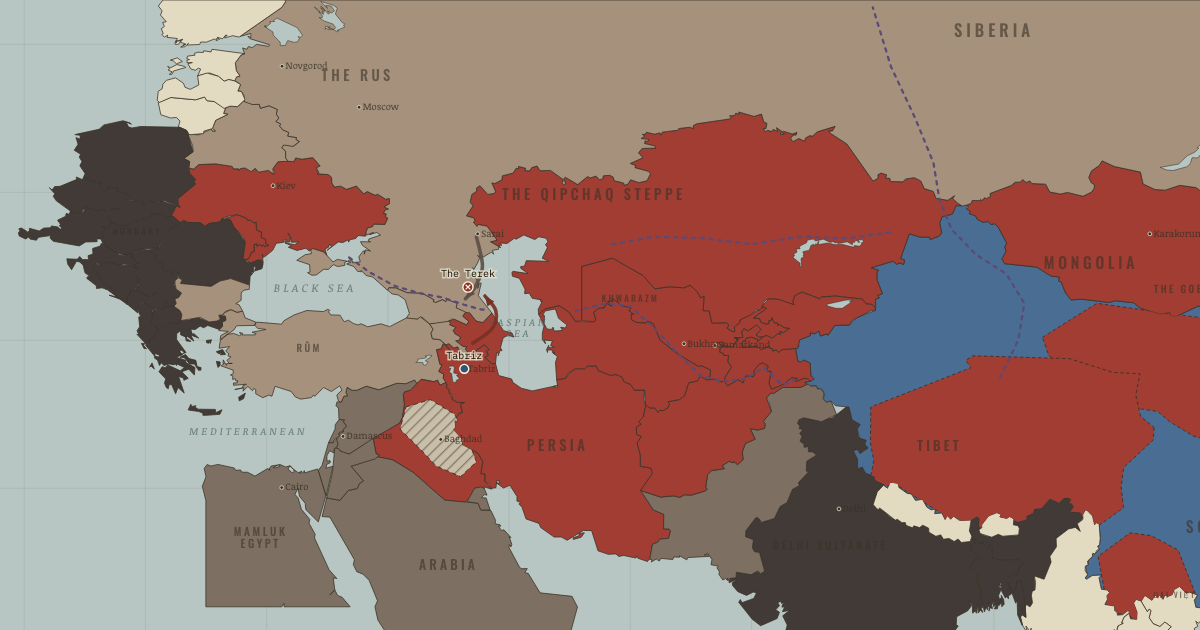
The map above is the world of 1264 — Four empires in one.
BRIEF EXPLANATION — THE ESSENTIAL ARGUMENT
Möngke’s death produced two rival elections that no rule could reconcile. Khubilai claimed the great khanship from his Chinese base while Ariq Böke claimed it from Mongolia, and Khubilai won the resulting civil war in 1264. The struggle exposed a deeper flaw, because the expanding family domains had no accepted procedure for settling who should rule the whole empire.
At the same time Berke of the Golden Horde went to war with Hülegü’s Ilkhanate over territory, plunder and religion. That war made an alliance with the Mamluks possible and turned dynastic boundaries into military frontiers. The empire stayed connected by family, commerce and prestige, yet it no longer acted as a single state.
GUIDED EXPLANATION
Möngke died in 1259 with no settled successor, and his supporters split. Khubilai was elected at Shangdu while Ariq Böke was raised by another assembly in Mongolia, and neither gathering included the whole ruling family. The civil war that followed was decided by armies and supply, because Khubilai’s access to north Chinese grain let him starve out Ariq Böke, who surrendered in 1264. Khubilai took the title of Great Khan, but the victory did not restore his effective command over every branch of the family.
The deeper split ran along the Caucasus. Berke, ruler of the Golden Horde and a convert to Islam, opposed his cousin Hülegü over Azerbaijan, over campaign spoils, and over the destruction of Baghdad, and he allied with Hülegü’s Mamluk enemies. The fighting near the Terek in 1262–63 was the first open war between major Chinggisid states, and after it the dashed borders on the map matter more than the shared red colour. Yuan China, the Golden Horde, the Chagatai lands and the Ilkhanate developed separate revenues, armies and religious partnerships, and although they still exchanged envoys and claimed one dynasty, expansion had regionalized the very institutions built to hold the empire together.
The internal borders now explain more than the outer edge, because armies faced cousins across those lines and force was drawn away from Egypt, Europe and other outside targets. Diplomacy shifted accordingly, so that the Golden Horde could treat the Mamluks as useful partners against a fellow Chinggisid state. Religion strengthened that alliance without replacing the underlying disputes over pasture, routes and spoils. The empire’s shared identity survived in culture and law even after any unified strategy had ended.
DEEP EXPLANATION — EVIDENCE & INTERPRETATION
A succession system under continental strain
Steppe political practice combined family inheritance with election by a kurultai, and that flexibility could produce an accepted leader when the contenders met and negotiated. Distance and permanent regional armies changed the calculation entirely. Princes campaigning thousands of kilometres away could not attend safely, and whoever controlled the homeland or the richest tax base could convene an assembly certain to favour him, with no neutral institution able to reject both rival elections. The trouble was not that nomads lacked law; it was that a negotiated system designed for a mobile aristocracy scaled poorly across fixed regional commands. Every succession pause exposed the same tradeoff, because shared family ownership preserved legitimacy while giving several branches a plausible claim to decide the centre. The map records the result. Historical explanation must also keep institutions, environmental limits and decisions visible, because none of those forces worked alone.
Empires split through payroll first
The khanates did not appear suddenly in 1264, because each branch had already spent decades drawing its soldiers, taxes and advisers from its own conquest zone. Khubilai depended on Chinese revenue and officials, Hülegü on Persian administration, and Berke on Volga trade and Qipchaq networks, and those local dependencies shaped policy long before any border became formal. Berke’s conversion to Islam mattered because it strengthened his ties with Muslim merchants and made a Mamluk alliance intelligible, though disputes over pasture and spoils were just as central, so religion, economics and dynastic rivalry reinforced one another. The general pattern is regionalization: provincial commands turn into states once their survival depends more on local resources than on approval from a distant centre. That distinction prevents a visible event from becoming a single-cause story. Outcomes emerged through interacting political, material and human constraints over time.
New here? Chapters 1–2 of every atlas are free to sample, and the WW2 atlas is free in full. One membership opens all thirteen — the Cartographer’s Circle.
THE SITES
WHY IT HAPPENED
An inheritance law for herds, not empires. Steppe custom pulled two ways at once: ultimogeniture (the youngest keeps the hearth) versus tanistry (the assembled family acclaims the ablest). For herds and pastures the ambiguity was survivable; for a continent it guaranteed that every khan’s death triggered a legitimacy auction with cavalry. Note the toll on this very atlas: 1227 pauses the west, 1241 saves Hungary, 1259 saves Syria, 1260 splits the state. The empire’s deadliest recurring enemy was its own funeral rites.
Regionalization by success. Each family branch had governed its front for a generation — and been captured by it. Khubilai’s power base was Chinese grain, generals and taxes; Berke’s was the Volga trade and a Muslim merchant class; Hülegü’s, Persia’s bureaucrats. By 1260 the branches were solving different problems in different languages with different gods. The war only ratified what administration had already divided; empires, this chapter argues, are partitioned first by payroll and only later by treaty.
Islam enters the family. Berke’s conversion turned a spoils dispute into something new: a Chinggisid obliged to avenge Baghdad against a Chinggisid who had burned it. Religion did not cause the Horde–Ilkhan war (pastures and plunder shares did that), but it made the Mamluk alliance thinkable and durable — and it announced the empire’s future: within sixty years three of the four khanates pray toward Mecca, and the conquerors of Islam have become its swords.
THE TURN
The Terek, January 1263. The battle itself was indecisive strategy and decisive symbolism: the first full war between Chinggisid states, fought weeks after Ain Jalut proved outsiders could win too. From this winter the khanates permanently point armies at each other — which is why the Mamluks survive, why Europe is never seriously threatened again, and why the dashed lines on your map matter more than any front drawn against a foreign enemy. The empire was undefeated; it was also over.
WHAT IT CHANGED
The Mamluks are underwritten by Mongols. Every Ilkhan invasion of Syria for sixty years is cut short or deterred by the Horde at its back — the two-front trap the family war built. Baybars corresponds with Berke as brother-in-faith; Cairo’s slave markets restock from the Horde’s steppes. Ain Jalut (Ch. 8) won a battle; the Terek institutionalized the reprieve.
Four laboratories of assimilation. Cut loose from Karakorum, each khanate marries its region: the Yuan perform Chinese emperorship (Ch. 10), the Ilkhans become Persian patron-kings, the Horde turns Turkic-Muslim astride the fur and slave trades, Chagatai’s ulus stays closest to the steppe — and their divergence, more than any battle, is how “the Mongols” exit history: not defeated, but absorbed by what they ruled.
Kaidu’s forty-year veto. Ögedei’s grandson Kaidu turns Central Asia into a standing revolt against Khubilai (the Altai dashed line is his war zone into the 1300s), which quietly shapes the far side of the map: resources Khubilai might have aimed at Japan or Vietnam bleed north against cousins instead. When you weigh Chapter 11’s failures, remember a third of the Yuan army faces inward.
FIELD QUESTION — Was the empire’s division inevitable — or the contingent result of Möngke dying in front of a minor Song fortress?
Some division was likely because regional branches already controlled distinct armies, revenues and advisers, while no binding succession rule existed. Möngke’s sudden death determined the timing and the particular rivals. Had he lived longer, central reforms might have delayed or reshaped the break. The careful distinction is between structural pressure toward regional rule and the contingent form of the 1260–64 civil wars. The first was strong; the second was not predetermined.
AN INTERESTING FACT
Kaidu’s long revolt produced the era’s most improbable celebrity: his daughter Khutulun, described independently by Marco Polo and by Rashid al-Din — sources at opposite ends of the empire — as an undefeated wrestler who rode into battle beside her father and would marry only a man who could throw her. Polo says her stake was a hundred horses a bout and that she banked ten thousand; the number is surely Polo being Polo, but the woman is not invented. Four centuries later, filtered through a French teller of oriental tales, her story helped seed the riddling princess of Puccini’s Turandot — the family war’s strangest afterlife: an opera.
THE DISPATCH
One short letter when a new atlas opens — and the printable study guide for The Mongol Empire is yours now, free.
NO TRACKING · YOUR ADDRESS IS USED FOR THE DISPATCH AND NOTHING ELSE · UNSUBSCRIBE ANYTIME