MAPS OF HISTORY · WW2 · ALL CHAPTERS · CHAPTER 7
CHAPTER 7 · 1937–MAY 1942 · MAY 1942
Rising Sun: From China to Pearl Harbor
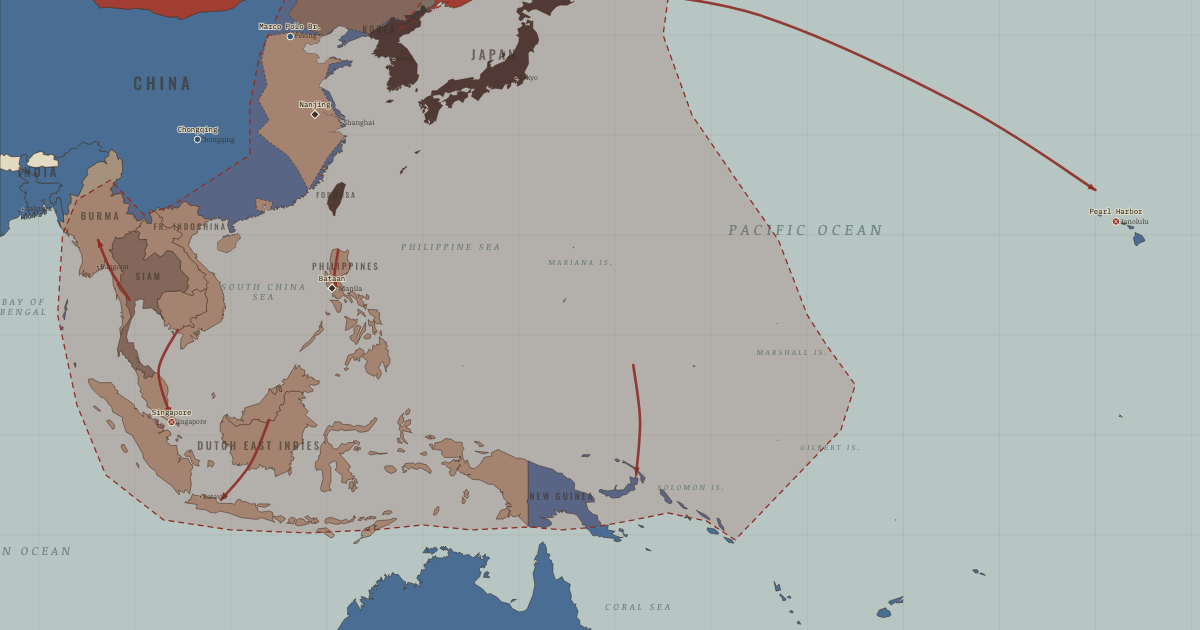
The map above is the world of MAY 1942 — The hundred days.
BRIEF EXPLANATION — THE ESSENTIAL ARGUMENT
The war in the Pacific grew out of a war Japan could not end in China, and understanding that trap explains the attack on Pearl Harbor. Japan had invaded China in 1937 and captured its major cities, ports, and railways, yet it could not force the Chinese government to surrender, and the occupation was marked by mass atrocities. The Nanjing Massacre, in which Japanese forces murdered and raped civilians and prisoners on a vast scale, belongs on this map as human suffering to be remembered, never as a move in a contest. China’s refusal to give in tied down a large part of the Japanese army for years.
When Japan occupied southern French Indochina in 1941 to tighten the pressure on China, the United States responded with an oil embargo that threatened to strangle the Japanese war machine within months. Japan’s leaders faced a stark choice, and they chose to seize the oil and resources of Southeast Asia while trying to disable the one force that could stop them, the United States Pacific Fleet. The strike on Pearl Harbor on 7 December 1941 brought America into the war, yet it missed the American aircraft carriers, which were at sea, and left the fuel tanks and repair yards largely intact.
GUIDED EXPLANATION
The conflict in Asia began well before the war in Europe. Japan had seized Manchuria in 1931 and launched full-scale war against China in 1937, capturing the coastal cities and the railways, but the Chinese state withdrew inland to Chongqing and fought on. Occupation brought systematic violence against the population, and the Nanjing Massacre included mass murder and sexual violence against civilians and prisoners, which this atlas treats as memorial history rather than as strategy. China’s continued resistance mattered strategically as well as morally, because it tied down a large share of the Japanese army that might otherwise have been used elsewhere.
In 1941 Japan occupied southern French Indochina to squeeze China further and to prepare a move south, and the United States answered by freezing Japanese assets and cutting off oil. Because Japan imported roughly 80 percent of its oil, most of it from the United States, its reserves now set a deadline for action. Its leaders rejected withdrawal and resolved to seize the Dutch East Indies for their oil while first crippling American power in the Pacific. Six carriers struck Pearl Harbor on 7 December, sinking or damaging battleships but missing the carriers at sea and leaving fuel and repair facilities usable. Japan then swept through Malaya, Singapore, the Philippines, and the Dutch East Indies, a perimeter that displayed enormous reach while resting on sea routes it could not securely defend.
Japan’s decision was shaped as much by its institutions as by oil. The army refused to abandon the war in China, while the navy warned that an oil cutoff would soon make any southern campaign impossible, so a fortified perimeter and a knockout blow at Pearl Harbor were meant to buy time for a negotiated settlement. That theory required the United States to accept its losses rather than mobilize its far larger economy. The attack produced the opposite effect, uniting American opinion and joining the Asian and European wars once Germany declared war on the United States. Japan won an immense empire in a hundred days, yet every new garrison lengthened the sea lanes that its thin merchant fleet and escorts could not reliably protect, so the empire was overextended from the moment it was won.
DEEP EXPLANATION — EVIDENCE & INTERPRETATION
Escalation from the China war
Japan’s leaders had built themselves a trap, and its shape is worth naming. The war in China consumed men, money, and fuel without producing surrender, yet ending it by withdrawal threatened the army’s prestige and seemed to waste the sacrifices already made. Expanding south promised the oil and raw materials Japan lacked, but it also meant war with the United States, Britain, and the Netherlands at once. This is the sunk-cost pattern, in which past investment makes an even more dangerous commitment feel necessary, although the new commitment does nothing to solve the original problem. Institutions deepened the trap, because the army and navy pursued rival priorities, civilian cabinets were weak, and no single actor could easily reverse imperial policy. The American embargo set the timing but did not make Pearl Harbor inevitable, since Japanese leaders chose war from several unattractive options because they ranked the preservation of empire above the avoidance of a far stronger enemy.
Tactical success, strategic failure
Pearl Harbor achieved complete surprise and briefly knocked out the American battle line, yet its political effect worked directly against its strategic purpose. Japan hoped that shock and a defensive perimeter would persuade the United States to negotiate, but the attack instead unified American opinion and turned any compromise into dishonour. Several operational omissions compounded the error, because the carriers were absent, the submarines survived, and the fuel tanks and repair yards remained usable, so damaged ships could be raised and rebuilt at Hawaii rather than sent home. Japan bought time for its southern conquests, but not the lasting ability to stop American mobilization, and United States industrial capacity vastly exceeded its own. A plan built on discouraging the enemy therefore attacked the one state best equipped to absorb losses and expand production. The episode illustrates the wide gap between winning a battle and achieving a sustainable political aim.
The WW2 atlas is free in full — no sign-up.
THE SITES
ON THIS DAY
WHY IT HAPPENED
An empire built on imported oil. Japan imported 80% of its oil, mostly from the USA. The July 1941 embargo (answering the Indochina occupation) started a countdown clock: fight soon with full tanks, or never fight at all. Economics set the timetable of Pearl Harbor almost to the month.
The China quagmire. Four years of victories had produced no victory — Chiang Kai-shek traded space for time (sound familiar from Russia?), and Japan’s army demanded ever-wider war to justify sunk costs. Escalation as a substitute for strategy.
Khalkhin Gol turns Japan south. In summer 1939 (see the marker on the Mongolian border) Zhukov crushed a Japanese army testing Siberia. Tokyo signed a neutrality pact with Moscow and pointed its ambitions at the resource-rich, European-owned south instead — a border battle you’ve never heard of that shaped the entire Pacific war, and freed the Siberian divisions that saved Moscow.
The knockout-blow theory. Admiral Yamamoto — who had studied at Harvard and opposed the war — argued that if Japan must fight, its only chance was to destroy the US fleet on day one and win a big enough buffer that America would negotiate rather than pay the price of taking it back. He never believed it would work: “I shall run wild for six months … after that I have no expectation of success.”
THE TURN
Pearl Harbor, 7 December 1941. Tactically brilliant: eight battleships hit for the loss of 29 aircraft. Strategically self-defeating: the American carriers were at sea, the oil tanks and shipyards were barely touched — and a divided, isolationist America became a united, vengeful one overnight.
WHAT IT CHANGED
The sleeping giant. US industry, one-tenth mobilized, out-produces the entire Axis within a year — by 1944 America launches more ship tonnage every month than Japan builds all year. Yamamoto’s six months prove almost exactly right.
Hitler’s strangest decision. Four days after Pearl Harbor, Germany declares war on the United States — obliging nobody, uniting everybody. Roosevelt’s “Germany first” strategy now faces no political obstacle.
Empires lose their aura. Singapore’s surrender — 80,000 troops to a smaller Japanese force — shatters the myth of European invincibility in Asia forever. Whatever happens next, the colonial world of 1939 is not coming back; the roads to Indian, Indonesian and Vietnamese independence all pass through 1942.
FIELD QUESTION — Pearl Harbor was one of the most successful surprise attacks in history. Make the case that it was also one of the worst strategic decisions ever made.
The attack met its immediate military aim but undermined its political aim. It missed carriers and key base infrastructure, while unifying a previously divided United States. Japan needed America to negotiate before superior US industry took effect. Pearl Harbor instead made negotiation politically impossible and full mobilization likely.
AN INTERESTING FACT
Tokyo meant the Pearl Harbor strike to follow — by about half an hour — a formal note breaking off negotiations. But the message came in fourteen parts, the embassy was ordered to let no secretary see it, and the diplomats, typing it themselves and badly, delivered it nearly an hour after the bombs fell. American codebreakers reading the “Magic” intercepts had finished decoding it before the Japanese embassy did — and even delivered on time, the note declared no war; it merely ended the talks.
THE DISPATCH
One short letter when a new atlas opens — and the printable study guide for WW2 is yours now, free.
NO TRACKING · YOUR ADDRESS IS USED FOR THE DISPATCH AND NOTHING ELSE · UNSUBSCRIBE ANYTIME