ON THIS DAY ·
Attack on Pearl Harbor
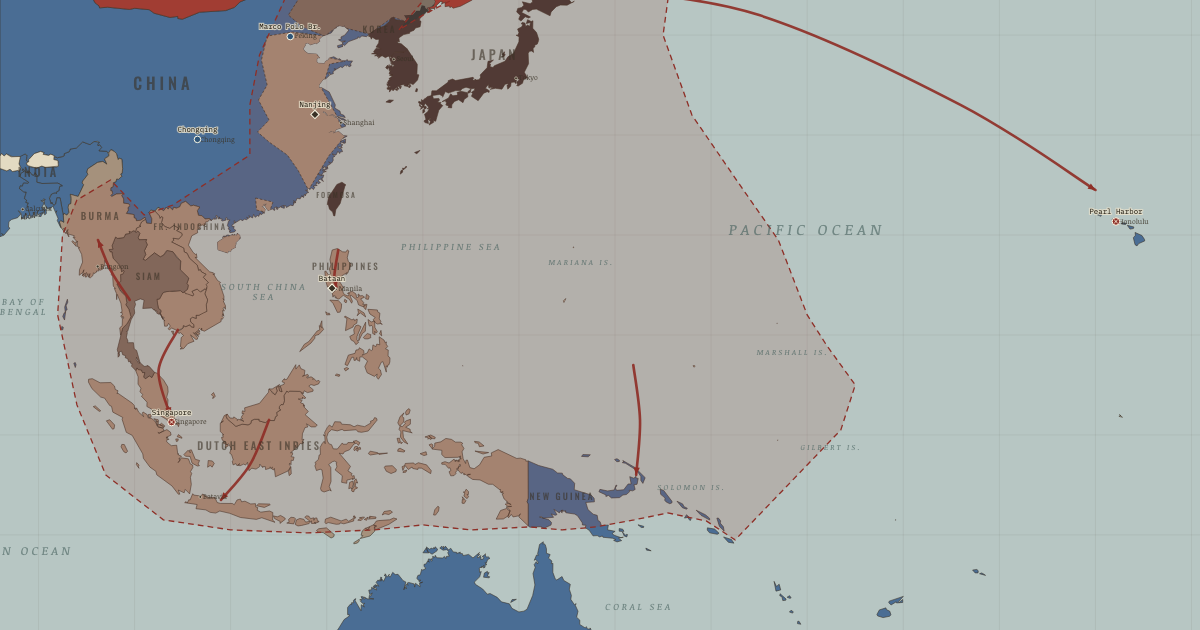
“A date which will live in infamy” — six carriers strike Pearl Harbor. Tactically brilliant, strategically catastrophic.
WW2 is free — every chapter. No sign-up.
The moment in context
The conflict in Asia began well before the war in Europe. Japan had seized Manchuria in 1931 and launched full-scale war against China in 1937, capturing the coastal cities and the railways, but the Chinese state withdrew inland to Chongqing and fought on. Occupation brought systematic violence against the population, and the Nanjing Massacre included mass murder and sexual violence against civilians and prisoners, which this atlas treats as memorial history rather than as strategy. China’s continued resistance mattered strategically as well as morally, because it tied down a large share of the Japanese army that might otherwise have been used elsewhere.
From Japanese expansion and Pearl Harbor, chapter 7 of The War Room — WW2, 1936–1945 (MAY 1942).
Teach this in 5 minutes
- Why it happened — An empire built on imported oil. Japan imported 80% of its oil, mostly from the USA. The July 1941 embargo (answering the Indochina occupation) started a countdown clock: fight soon…
- The turn — Pearl Harbor, 7 December 1941. Tactically brilliant: eight battleships hit for the loss of 29 aircraft. Strategically self-defeating: the American carriers were at sea, the oil…
- What it changed — The sleeping giant. US industry, one-tenth mobilized, out-produces the entire Axis within a year — by 1944 America launches more ship tonnage every month than Japan…
Then ask the room: Pearl Harbor was one of the most successful surprise attacks in history. Make the case that it was also one of the worst strategic decisions ever made. The argued answer is on the chapter page →
The atlas that shows it
THE FREE PRINTABLE STUDY GUIDE
Join the Dispatch — a short welcome series, then a letter when a new atlas opens — and the printable study guide for WW2 is yours now, free.
NO TRACKING · YOUR ADDRESS IS USED FOR THE DISPATCH AND NOTHING ELSE · UNSUBSCRIBE ANYTIME