ONE LAND · 12 ATLASES
History of France in maps
France as it appears in 12 interactive history atlases, from 264 BC to 2015: Gaul, France — the crusade’s recruiting ground, France. Each era below lists who ruled the land and when control changed, linked to the dated map that shows it.
WW2 is free — every chapter. No sign-up.
What was France before it was France? Below, every era of this land in the Maps of History atlases — who ruled it, what it was called, and when control changed — each line linked to the dated map that shows it. Modern borders stand in as an honest approximation; every atlas says so on the map itself.
Gaul (mod. France) · Ancient Rome
Gaul: sixty feuding tribes, conquered in eight years by Caesar at a cost ancient sources put at a million dead and a million enslaved (Ch. 5). Then four centuries of deep Romanization — Lyon a second Rome, Latin becoming French — before the Gallic Empire (260–274) proved even secession here meant seceding into a copy of Rome. Overrun after 406; the Franks who inherited it gave it their name and kept its Roman church.
| 264 BC | Tribal peoples & confederations — the opening position |
| 50 BC | Roman territory |
| Breakaway Roman empires (260–274) | |
| Roman territory | |
| Former Roman lands (lost) |
ANCIENT ROME: EVERY CHAPTER AND MAP →
Francia (mod. France) · Norse and Aztecs
| Other peoples and states — the opening position |
NORSE AND AZTECS: EVERY CHAPTER AND MAP →
France — the crusade’s recruiting ground · Crusades
The crusade’s recruiting ground and its heartland. So many crusaders spoke French that “Franks” — al-Faranj — became the Muslim word for all Latin Christians. Every major expedition drew on France, and its king Louis IX led two of them; but the crown also turned crusading inward, using the Albigensian Crusade against the Cathars to absorb the independent, cultured south of the country.
| Latin Christendom — the opening position |
CRUSADES: EVERY CHAPTER AND MAP →
France · Industrial Revolution
An industrial power by a different road. With less coal and a large peasant population, France grew steadily through skilled, high-quality production: Lyon silk, Alsatian cottons, the engineering of Le Creusot, and later cars and electricity. Its banks financed railways across Europe and its loans built Russian industry. Historians once called it a laggard, and many now see a path suited to its resources. It lost Alsace and much of Lorraine to Germany in 1871.
| Industrialising — the opening position | |
| Industrialising | |
| Industrial economy | |
| Industrialising | |
| Industrial economy |
INDUSTRIAL REVOLUTION: EVERY CHAPTER AND MAP →
France · Age of Revolutions
The age’s epicenter. Bankrupted by helping America, France produced the Revolution (1789), the Republic (1792), the Terror, Napoleon, and armies that rewrote every border on this map — then had kings restored twice and expelled twice (1830, 1848). Its Declaration of Rights and its Code remain the age’s two most-copied documents; follow chapters 3–4, 6–9, 11–12.
| The conservative monarchies — the opening position | |
| Republics & revolutionary states | |
| Restored monarchies (after 1815) | |
| Republics & revolutionary states |
AGE OF REVOLUTIONS: EVERY CHAPTER AND MAP →
France · Meiji Japan and post-Soviet Russia
| Western powers and allies — the opening position |
MEIJI JAPAN AND POST-SOVIET RUSSIA: EVERY CHAPTER AND MAP →
France · WWI
France fought the war on its own soil, with its richest provinces — coal, iron, industry — behind German lines from 1914. It mobilized 8 million men and lost 1.4 million; Verdun (Ch. 7) became its national epic, the 1917 mutinies its hidden crisis (Ch. 10), Foch its answer in 1918. Victory came with a security terror at its heart: next time there would be twenty million fewer Frenchmen than Germans.
| The Entente & Allies — the opening position | |
| The Entente & Allies |
France · Road to WW2
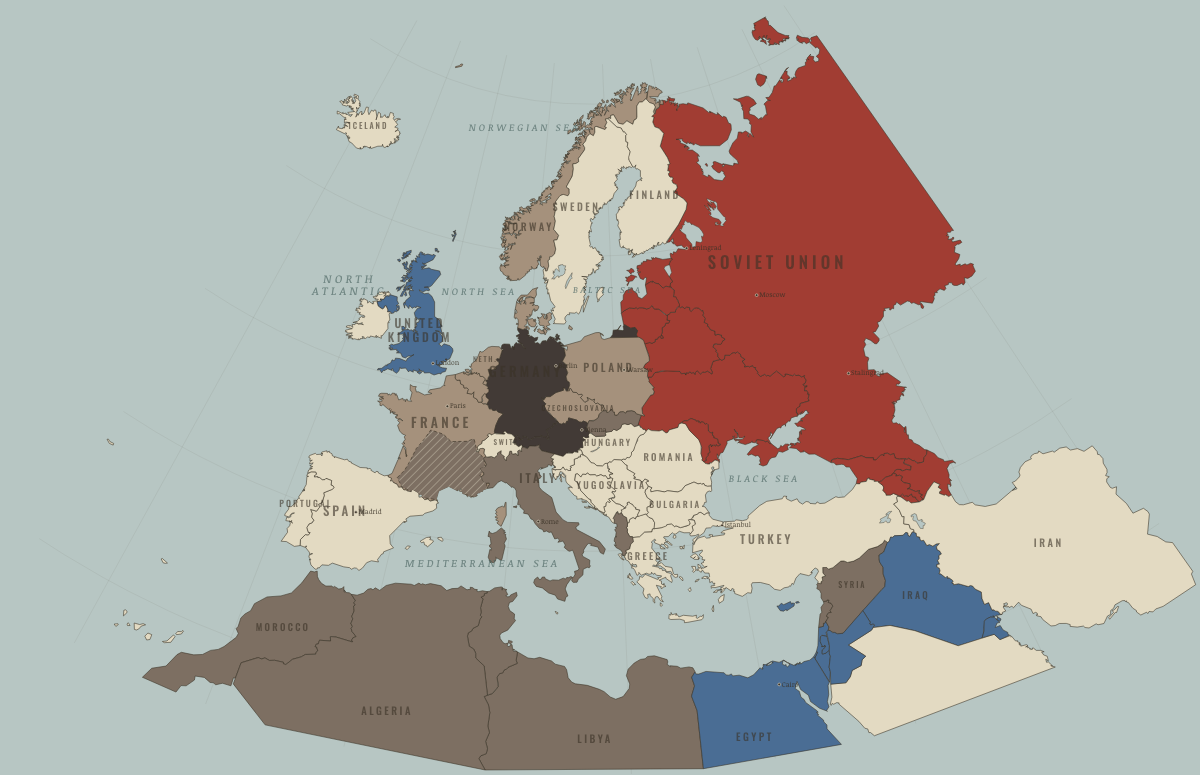
The most invaded great power, whose security system — Versailles, the Maginot Line, eastern alliances — was dismantled clause by clause while its politics tore itself apart. It declined to fight the Rhineland bluff alone in 1936 and fought superbly and too late in 1940, falling in six weeks to doctrine, not decadence. Divided into an occupied north and Vichy south, its agency continued — on both sides.
| Democracies & powers fighting them — the opening position | |
| Occupied — held by force |
ROAD TO WW2: EVERY CHAPTER AND MAP →
France · WW2
Great power in 1939; defeated in six weeks in 1940 (Ch. 3). Split into occupied north and collaborationist Vichy south, while de Gaulle’s Free French and the Resistance kept another France alive. Liberated 1944, restored as an occupying power in Germany — carrying scars that still shape its politics.
| Western Allies — the opening position | |
| Axis-occupied | |
| Western Allies |
France · Cold War
Fought the era’s two worst colonial exits — Indochina (Dien Bien Phu, Ch. 7) and Algeria, which killed its Fourth Republic — then chose armed independence within the West: its own bomb (1960), out of NATO’s integrated command (1966), lectures for both blocs. De Gaulle’s wager — that Europe should be a power, not a theater — is still being tested.
| NATO & core Western allies — the opening position |
COLD WAR: EVERY CHAPTER AND MAP →
France · Feminism and the Tunisian Revolution
France gave the second wave its philosopher, Simone de Beauvoir, and its most daring civil disobedience, from the Manifesto of the 343 (1971) to open, illegal abortions by the MLAC. French women had voted only since 1944–45. The Veil law legalised abortion in January 1975, the year after a new ministry for the condition of women was created, and France ratified CEDAW in 1983.
| Right won in law — the opening position | |
| No reform yet / outside this story | |
| Right won in law |
FEMINISM AND THE TUNISIAN REVOLUTION: EVERY CHAPTER AND MAP →
France · Refugee crises
France ran its own occupation zone in Germany and the Saar, repatriated millions of its prisoners and forced labourers in 1945, and took tens of thousands of DPs as workers. In 1979 its intellectuals of left and right united behind “A Boat for Vietnam”, and over two decades it resettled about 96,000 Indochinese, many with French education or family ties from the colonial era.
| Western bloc or democracy — the opening position |
REFUGEE CRISES: EVERY CHAPTER AND MAP →
Related
THE FREE PRINTABLE STUDY GUIDE
Join the Dispatch — a short welcome series, then a letter when a new atlas opens — and a printable atlas study guide of your choice is yours now, free.
NO TRACKING · YOUR ADDRESS IS USED FOR THE DISPATCH AND NOTHING ELSE · UNSUBSCRIBE ANYTIME