ONE LAND · 12 ATLASES
History of People's Republic of China in maps
People's Republic of China as it appears in 12 interactive history atlases, from 1206 to 2000: China, Qing China, People's Republic of China. Each era below lists who ruled the land and when control changed, linked to the dated map that shows it.
WW2 is free — every chapter. Try chapters 1–2 of any 2 other atlases (3 with a free account). Opening a new atlas uses one of them. Membership opens all 21 — Join.
Free printable Chinese Revolution study guide, sent by email ↓
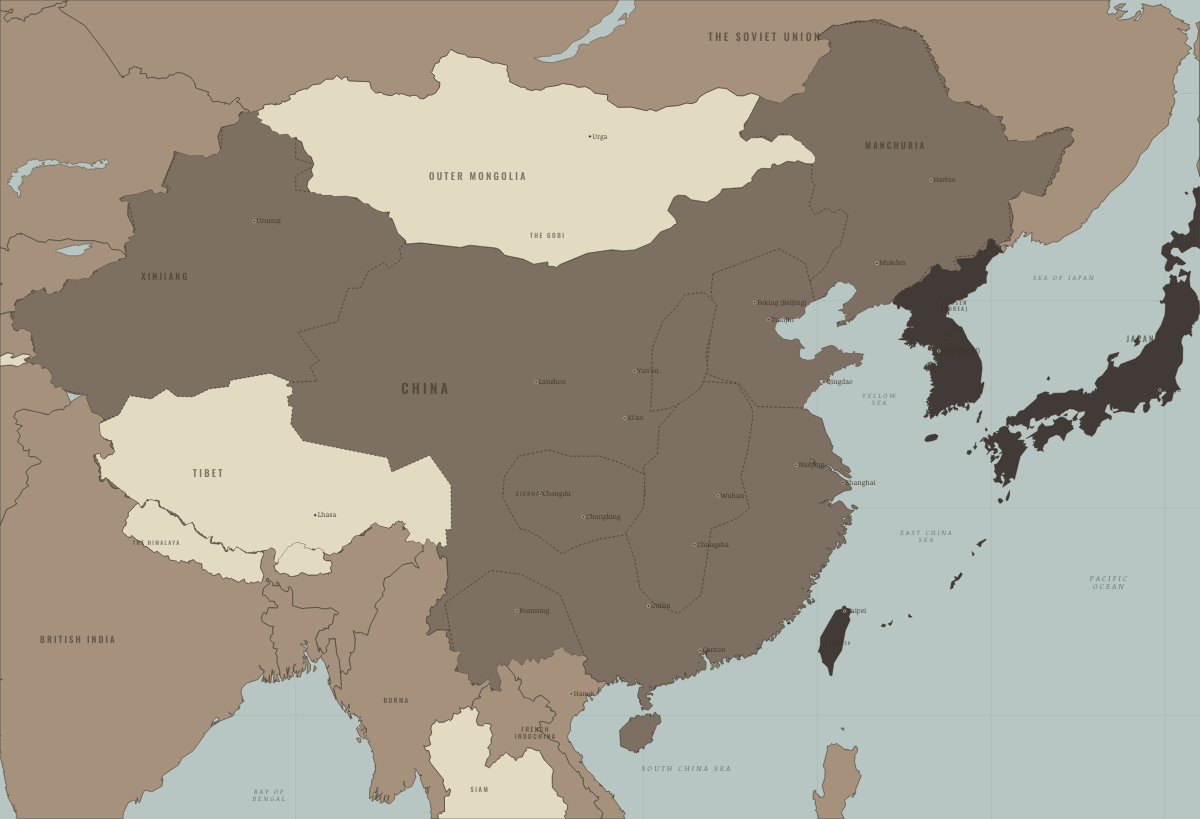
What was People's Republic of China before it was People's Republic of China? Below, every era of this land in the Maps of History atlases — who ruled it, what it was called, and when control changed — each line linked to the dated map that shows it. Modern borders stand in as an honest approximation; every atlas says so on the map itself.
China (Jin, then Song, then Yuan) · Mongol Empire
Two conquests in one country: the Jurchen Jin north, taken 1211–34 by absorbed siegecraft and defecting Khitans, and the Song south — the empire’s longest war (to 1279), won with navies, Persian trebuchets and Chinese administration. Khubilai’s Yuan reunified China after three centuries and moved its capital to Beijing, where it remains. Chinese history counts the conquerors as a legitimate dynasty; weigh what that absorption means.
| Song China — the long rival — the opening position | |
| The Mongol Empire |
MONGOL EMPIRE: EVERY CHAPTER AND MAP →
Qing China · Industrial Revolution
In 1750 the largest economy on earth, with a Yangzi delta as rich and commercial as England. Defeated in the Opium Wars, forced to open treaty ports and pay indemnities, and devastated by the Taiping war of 1850–64, China industrialised slowly, in a few treaty-port cities such as Shanghai and in arsenals built by reforming officials. Its share of world manufacturing fell from about a third in 1750 to about six per cent by 1900.
| Opened by force or treaty — the opening position | |
| Opened by force or treaty |
INDUSTRIAL REVOLUTION: EVERY CHAPTER AND MAP →
China (Qing, then the People’s Republic) · Meiji Japan and post-Soviet Russia
Qing China is the warning at the start of this atlas: beaten by Britain in 1842, forced to open treaty ports, stripped of the lands beyond the Amur by Russia in 1858–60 and defeated by Japan in 1894–95. On the Eurasia map the People’s Republic offers the great alternative to the Soviet path, since from 1978 Deng Xiaoping freed farms and markets while keeping the party in power. Every comparison of Gorbachev’s choices begins with China’s.
| Independent neighbours — the opening position |
MEIJI JAPAN AND POST-SOVIET RUSSIA: EVERY CHAPTER AND MAP →
China · Russian Revolution
China’s Qing empire lost the lands north of the Amur and east of the Ussuri, roughly a million square kilometres, to Russia by the treaties of Aigun (1858) and Peking (1860). China, itself in revolution and warlord fragmentation after 1911, bordered the chaos and received a flood of White émigrés (Harbin became a Russian city-in-exile). The young Chinese Communist movement watched the Bolshevik victory closely; the Comintern would soon be at work in it.
| Neutral or independent — the opening position |
RUSSIAN REVOLUTION: EVERY CHAPTER AND MAP →
China (Tibet & Sinkiang) · Indian independence
China on this map is Tibet and Sinkiang — the high dead ground of the Great Game, where British India probed (Younghusband’s 1904 lance-charge to Lhasa) and republican China’s claims ran ahead of its reach. Tibet governed itself from 1913 behind the Himalayan wall the Raj was content to keep ambiguous (the McMahon Line of 1914, signed but never ratified by China, waits in these mountains). The ambiguity outlived the Raj: free India inherited the line, and 1962 collected the bill.
| Beyond the Raj · Portuguese & French India — the opening position |
INDIAN INDEPENDENCE: EVERY CHAPTER AND MAP →
People's Republic of China · WWI
China declared war in 1917, sending no soldiers but 140,000 laborers to the Western Front (Ch. 9) — its bid to recover German-held Shandong at the peace table. Versailles gave Shandong to Japan; the May Fourth movement of 1919 — nationalist, iconoclastic, radicalizing — is the direct answer. The Chinese Communist Party was founded two years later by men May Fourth made.
| The Entente & Allies — the opening position | |
| The Entente & Allies |
China (the Republic, 1912–49) · Chinese Revolution
The protagonist and the prize. In 1911 the Qing empire dissolves and its succession stays open for thirty-eight years: Yuan’s stillborn republic, a decade as a market of armies, a Nationalist state real enough to be worth capturing and hollow enough to be captured, an invasion that breaks it, and a peasant-based party-state that inherits everything. Every color this map has worn — blue, grey-tan, charcoal, red — is a claim on the same inheritance: the right to answer for China. The red that ends the atlas is not the end of the question; Taiwan, and the century since, are its continuation.
| The Republic of China — the government of the day — the opening position | |
| Warlord cliques — the fractured republic | |
| The Republic of China — the government of the day | |
| Communist-controlled territory |
CHINESE REVOLUTION: EVERY CHAPTER AND MAP →
People's Republic of China · Stalin’s Soviet Union
China was the great prize of Soviet strategy in Asia. In the 1920s Moscow advised both the Nationalists and the Communists, and Chiang Kai-shek’s massacre of communists in 1927 sharpened the war scare. Stalin supplied Chiang against Japan from 1937 and occupied Manchuria in August 1945. When Mao Zedong proclaimed the People’s Republic in October 1949, the map turned grey-tan, and the Sino-Soviet treaty of February 1950 made China an ally.
| Satellites & communist allies — the opening position | |
| Satellites & communist allies |
STALIN’S SOVIET UNION: EVERY CHAPTER AND MAP →
People's Republic of China · Road to WW2
The war’s longest sufferer and quietest load-bearing wall. It absorbed Manchuria and Jehol for the sake of time, unified against Japan after Xi’an (1936), lost its coast, capital and best army — and did not surrender, pinning a million-man Japanese army from Chungking while the world decided whether to care. It ended 1941 an Allied great power; its endurance had made the “China Incident” unwinnable.
| Neutral & unaligned — the opening position | |
| At war on its own soil |
ROAD TO WW2: EVERY CHAPTER AND MAP →
People's Republic of China · WW2
The forgotten ally: at war from 1937, four years before Pearl Harbor, absorbing over half of Japan’s army at a cost of perhaps 20 million dead. The war’s end resolved nothing internally — civil war resumed, and the People’s Republic of 1949 was forged in the anti-Japanese struggle.
| Western Allies — the opening position |
People's Republic of China · Cold War
The era’s greatest variable: US-aligned in 1945, red in 1949 (the map’s largest single change), Moscow’s ally, then Moscow’s enemy — shooting at Soviet border posts by 1969 and toasting Nixon by 1972 (Ch. 9). Mao’s internal catastrophes — the Great Leap famine, the Cultural Revolution — killed tens of millions off this map’s cameras. It ended the era communist, market-reforming, and rising: the Cold War participant with the longest afterlife.
| US-aligned states — the opening position | |
| Soviet-aligned states | |
| Communist, outside Moscow’s bloc |
COLD WAR: EVERY CHAPTER AND MAP →
People's Republic of China · Refugee crises
China was one of the largest receivers of Indochinese refugees, a fact easily lost behind the boats. More than 250,000 people from Vietnam, most of them Hoa, crossed into China by the end of 1979, and Beijing settled them on state farms in Guangxi, Guangdong and elsewhere with UNHCR support. China also fought a short war against Vietnam in 1979, partly over their treatment.
| Soviet-occupied or communist — the opening position |
REFUGEE CRISES: EVERY CHAPTER AND MAP →
Related
THE FREE PRINTABLE STUDY GUIDE
Join the Dispatch — a short welcome series, then a letter when a new atlas opens — and a printable atlas study guide of your choice is yours now, free.
NO TRACKING · YOUR ADDRESS IS USED FOR THE DISPATCH AND NOTHING ELSE · UNSUBSCRIBE ANYTIME