ONE LAND · 11 ATLASES
History of the United Kingdom in maps
The United Kingdom as it appears in 11 interactive history atlases, from 264 BC to 2015: Britannia, England, Great Britain and Ulster, United Kingdom, Britain. Each era below lists who ruled the land and when control changed, linked to the dated map that shows it.
WW2 is free — every chapter. Try chapters 1–2 of any 2 other atlases (3 with a free account). Opening a new atlas uses one of them. Membership opens all 21 — Join.
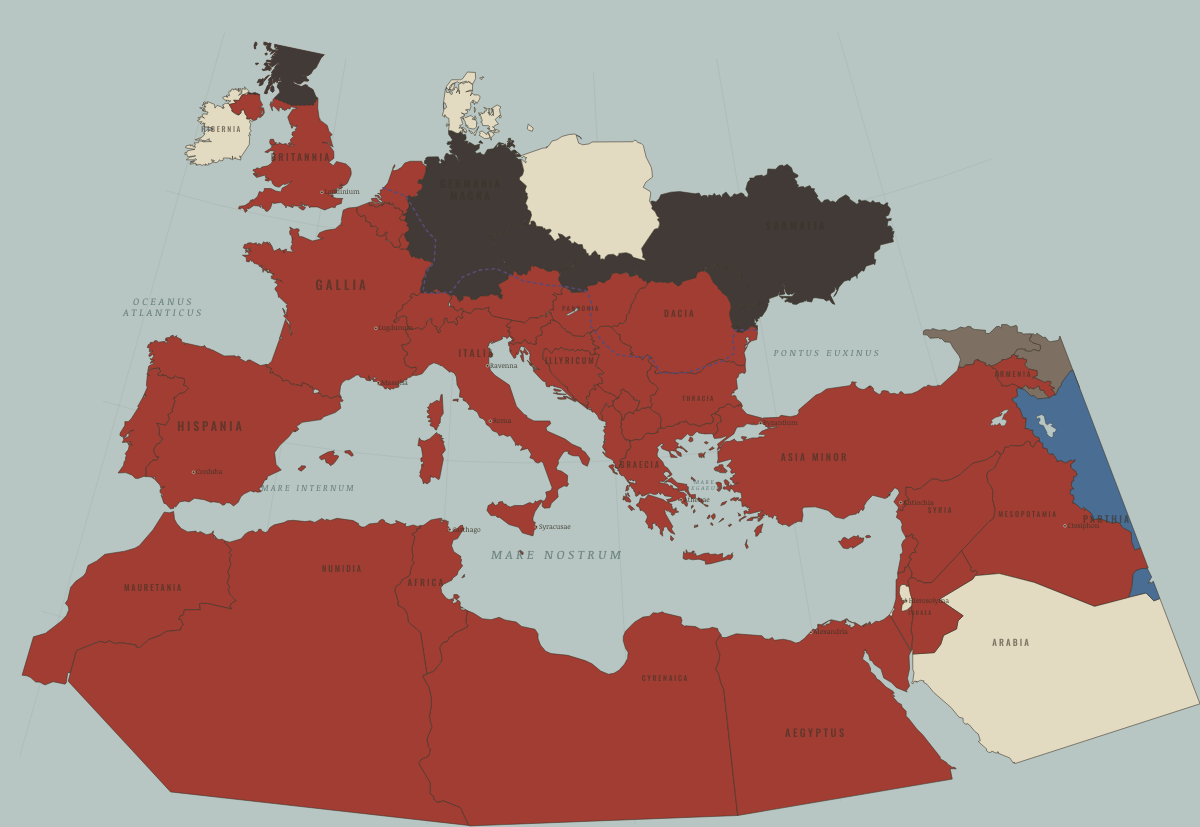
What was the United Kingdom before it was United Kingdom? Below, every era of this land in the Maps of History atlases — who ruled it, what it was called, and when control changed — each line linked to the dated map that shows it. Modern borders stand in as an honest approximation; every atlas says so on the map itself.
Britannia (mod. Britain) · Ancient Rome
Britannia: invaded for an emperor’s prestige in AD 43, bounded by Hadrian’s Wall in 122, and abandoned by administrative letter in 410 — the only province subtracted intact. What followed is the atlas’ starkest experiment: within two generations towns, coinage and literacy collapsed to pre-Roman levels. When the state beneath a civilization vanishes, archaeology shows what it had been holding up (Chs. 10, 12).
| 264 BC | Tribal peoples & confederations — the opening position |
| Roman territory | |
| Breakaway Roman empires (260–274) | |
| Roman territory | |
| Former Roman lands (lost) |
ANCIENT ROME: EVERY CHAPTER AND MAP →
England (mod. Britain) · Crusades
England’s crusade is essentially one man’s: Richard the Lionheart, who beat Saladin at Arsuf and Jaffa, seized Cyprus, and spent his kingdom’s treasure and his own liberty on the Third Crusade — yet judged, correctly, that Jerusalem could not be held and settled for a treaty of access. He grasped that the real key was Egypt, an insight that drove every crusade after him.
| Latin Christendom — the opening position |
CRUSADES: EVERY CHAPTER AND MAP →
Great Britain and Ulster · Industrial Revolution
The first industrial nation, and for a century the workshop of the world. Coal, cotton, iron and steam turned a commercial island into an economy in which, by 1851, most people lived in towns. Its lead rested on cheap coal, high wages, an Atlantic empire and a culture of tinkering, and its costs fell on child workers, handloom weavers and the enslaved growers of its cotton. By 1914 Germany and the United States made more, and Britain had become the world’s banker.
| Agrarian economy — the opening position | |
| Industrialising | |
| Industrial economy | |
| Industrialising | |
| Industrial economy |
INDUSTRIAL REVOLUTION: EVERY CHAPTER AND MAP →
United Kingdom · Age of Revolutions
The counter-revolutionary superpower — and the age’s quiet revolutionary. Britain fought France for 22 years with subsidies, blockade and Wellington, banked the world after 1815, and dodged every continental barricade by conceding reform in time (1832) and abolishing slavery (1833) — while its factories created the working class whose questions dominate 1848. Lost one empire in America; built a larger one meanwhile.
| Britain & its empire — the opening position |
AGE OF REVOLUTIONS: EVERY CHAPTER AND MAP →
United Kingdom · Meiji Japan and post-Soviet Russia
| Western powers and allies — the opening position |
MEIJI JAPAN AND POST-SOVIET RUSSIA: EVERY CHAPTER AND MAP →
United Kingdom · WWI
Britain entered for Belgium (and the balance of power) with a six-division army, and ended with a 4-million-man citizen force, conscription, and the war’s decisive weapons: the blockade, the convoy, and the 1918 BEF — arguably history’s best army by armistice day (Ch. 12). The cost — 880,000 dead, the Somme’s first day, a debt to America — ended its century as unchallenged hegemon.
| The Entente & Allies — the opening position | |
| The Entente & Allies |
United Kingdom · Road to WW2
The status-quo power with a global empire, a Depression treasury and a bone-deep memory of 1916. It tried every tool short of force — naval deals, sanctions-lite, Munich — then guaranteed Poland and meant it. Alone with its empire from June 1940 to June 1941, it won the war’s first defensive victory over southern England and waited for the allies its enemies would provide.
| Democracies & powers fighting them — the opening position |
ROAD TO WW2: EVERY CHAPTER AND MAP →
United Kingdom · WW2
The only power to fight Germany from first day to last. Saved by the Channel, the RAF and radar in 1940; kept the Atlantic open; became the launchpad for D-Day — and spent the empire doing it. Emerged victorious, bankrupt, and about to decolonize.
| Western Allies — the opening position |
United Kingdom · Cold War
Started the era a victor and a creditor of nothing: bankrupt, rationed, and handing its burdens — Greece, India, Palestine — to Washington within three years. Suez (Ch. 5) ended its pretensions to independent world power; it settled into the role of America’s closest ally, nuclear and permanent-seated, managing decline with more grace abroad than at home.
| NATO & core Western allies — the opening position |
COLD WAR: EVERY CHAPTER AND MAP →
United Kingdom · Feminism and the Tunisian Revolution
Britain’s second wave began on the factory floor, with the Dagenham machinists of 1968, and moved through the Ruskin conference of 1970 to the Equal Pay Act (in force 1975) and the Sex Discrimination Act of 1975. Its Abortion Act of 1967 drew women from France, Spain and Ireland. Britain signed CEDAW in 1981 and ratified it in April 1986, which is why it is grey-tan on the 1985 map.
| Right won in law — the opening position | |
| Partial or unequal; treaty signed only; transition | |
| No reform yet / outside this story | |
| Partial or unequal; treaty signed only; transition |
FEMINISM AND THE TUNISIAN REVOLUTION: EVERY CHAPTER AND MAP →
Britain · Refugee crises
Britain was an occupying power, a mandatory power in Palestine and a country of resettlement at once. It ran the zone where Friedland and Bergen-Belsen lay, handed over Cossacks at Lienz, intercepted Jewish refugees bound for Palestine, and recruited about 86,000 DPs as “European Volunteer Workers” for its mines, farms and textile mills. In 1956 it took more than 20,000 Hungarians, and in the 1980s Hong Kong’s British government screened and returned Vietnamese.
| Western bloc or democracy — the opening position |
REFUGEE CRISES: EVERY CHAPTER AND MAP →
Related
THE FREE PRINTABLE STUDY GUIDE
Join the Dispatch — a short welcome series, then a letter when a new atlas opens — and a printable atlas study guide of your choice is yours now, free.
NO TRACKING · YOUR ADDRESS IS USED FOR THE DISPATCH AND NOTHING ELSE · UNSUBSCRIBE ANYTIME