Cold War · OCT 1949
Was China ever America’s to lose in 1949?
The seminar question: ““Who lost China?” convulsed American politics for a decade. Was it ever America’s to lose?”
On 29 August 1949 the Soviet Union tested an atomic bomb years earlier than most Western estimates, ending the American nuclear monopoly. Five weeks later Mao Zedong proclaimed the People’s Republic of China. Washington answered with the ‘Who lost China?’ debate and NSC-68, which called for roughly tripled defence spending.
Chapter 3 is part of membership. WW2 is free — every chapter. Try chapters 1–2 of any 2 other atlases (3 with a free account). Opening a new atlas uses one of them. Membership opens all 21 — Join.
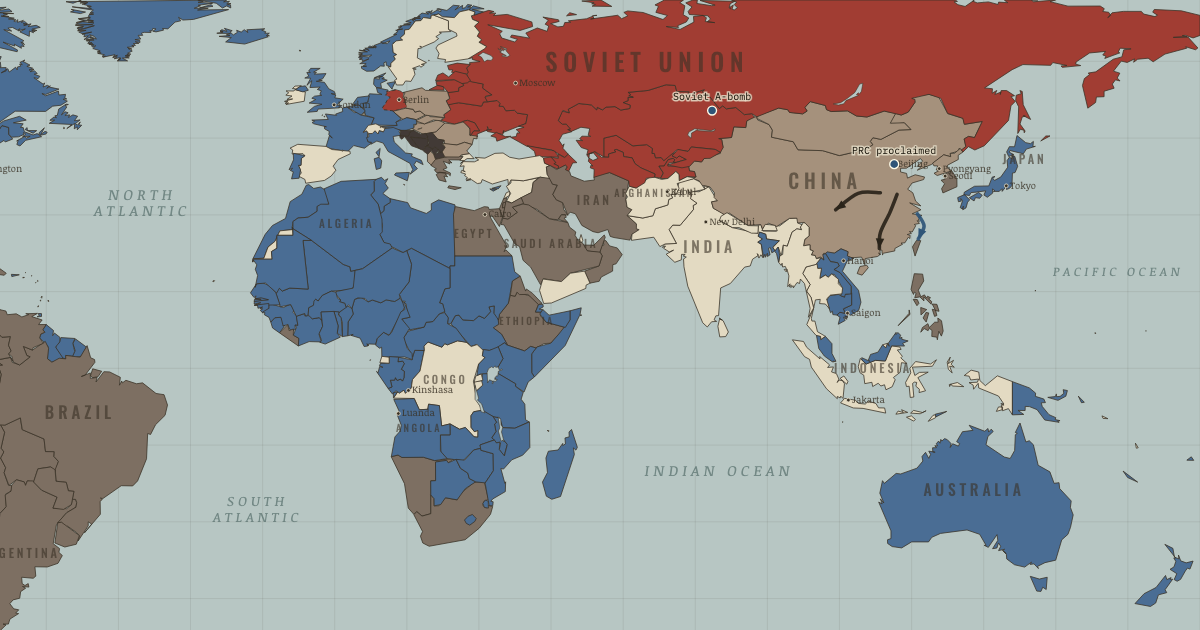
The Soviet test revealed how a determined industrial state actually acquires the bomb. Espionage helped, because the physicist Klaus Fuchs had passed genuine Los Alamos designs to Moscow and so shortened the path to a plutonium weapon, but the USSR still had to build the entire nuclear complex itself, mining uranium and raising reactors under enormous strain. The result mattered because deterrence now replaced simple atomic superiority. From this point onward the decisive question in any crisis slowly changed from who would win a war into whether anyone could survive one, and that shift reshaped the mental world of the whole era.
The short answer
- Why Chiang lost — and it wasn’t Moscow’s doing. The Nationalists entered the civil war (1946) with three times the troops, American equipment and every major city. And lost in three years. Mechanisms: hyperinflation (prices rose millions-fold, dissolving the urban middle class and army pay), catastrophic corruption that diverted US aid, strategic overreach into Manchuria where whole armies were cut off and captured, and a peasant base won by communist land reform in a country 85% rural. Stalin, hedging to the end, had actually urged Mao to stop at the Yangtze. Chiang wasn’t out-spent. He was out-governed.
- Espionage plus industry, not either alone. Fuchs, Hall and the Rosenberg network saved the Soviet program perhaps one to two years and confirmed the plutonium-implosion path. But the bomb still required an industrial miracle: a ruined country built an entire nuclear sector under Beria’s ministry of terror, with gulag labor mining the uranium. The lesson Washington drew (spies everywhere) fueled McCarthyism. The truer lesson. That a determined industrial state cannot be denied the bomb, only delayed. Went largely unlearned, in 1949 and since.
- NSC-68: worst-case logic in a frightened spring. Nitze’s review assumed Soviet intent to dominate Eurasia, treated any loss anywhere as a global loss of credibility, and dismissed negotiation until strength was rebuilt. Critics inside government (Kennan, Bohlen) called the threat inflated and the price ruinous. The document mattered because it converted containment from a diplomat’s concept into a defense budget. From $13 billion toward $50 billion within two years. And because its credibility logic would later march America into Vietnam.
THE TURNING POINT
Semipalatinsk, 29 August 1949. The test itself changes no border. That is the point. From this morning, every future crisis on this map is played between two nuclear powers, and the question “who would win a war?” is slowly replaced by “can anyone survive one?” Deterrence, arms racing, the entire mental architecture of the era. Mutual assured destruction, first strike, credibility. Descends from this plume over the steppe.
What it changed
The arms race goes exponential. Truman answers the Soviet bomb by ordering the hydrogen bomb (January 1950) over the objections of Oppenheimer’s advisory committee. The US tests one in 1952, the USSR in 1953. Warhead counts climb from hundreds toward tens of thousands. The race acquires its own bureaucratic momentum. Each side’s worst-case planners citing the other’s.
An alliance Moscow will come to regret. Mao travels to Moscow and extracts the Sino-Soviet Treaty (February 1950) after two months of humiliating negotiation. Aid, advisers, and a nuclear tutor. The alliance looks like a communist monolith from Washington. In fact its resentments (Stalin’s condescension, unequal terms) are the seed of the split that will remake the map in the 1960s.
The frontier of containment moves to Asia. With China “lost,” the US redraws its Pacific line: occupation-era Japan becomes the anchor ally, and a January 1950 speech by Secretary Acheson leaves Korea ambiguously outside the stated defense perimeter. Stalin and Kim Il-sung both read it. The Cold War’s first hot war is now five months away.
The full answer, argued
The question assumes an outside power could decide a civil war among 500 million people. The very fallacy the era kept repeating. The internal evidence is decisive: no plausible aid package cures hyperinflation, land hunger and a delegitimized government. Marshall himself, sent to mediate in 1946, concluded exactly that. But notice what the question did even though its premise was false: it made “losing” any country politically fatal, narrowing every later president’s options. Kennedy and Johnson both privately cited China when refusing to leave Vietnam. A wrong question, asked loudly enough, can govern policy for twenty years. That is the transferable warning.
An interesting fact
Moscow never announced First Lightning — Washington learned of it from the weather. On 3 September 1949 a WB-29 of the Air Force’s infant long-range detection program, flying a routine filter-paper run from Japan to Alaska, picked up radioactive debris that laboratory analysis traced to a plutonium implosion bomb. Truman broke the news to the world on 23 September; TASS answered with a shrug about large-scale “blasting work,” and the test went unconfirmed at home for years — the Soviet public learned of its own bomb from the adversary’s press.
This is the study layer of Soviet atomic bomb and Mao’s victory, chapter 3 of The Cold War, 1945–1991; the full index of the atlas is here.
Related questions
THE FREE PRINTABLE STUDY GUIDE
Join the Dispatch — a short welcome series, then a letter when a new atlas opens — and the printable study guide for The Cold War is yours now, free.
NO TRACKING · YOUR ADDRESS IS USED FOR THE DISPATCH AND NOTHING ELSE · UNSUBSCRIBE ANYTIME