Cold War · AUG 1953
Should UN forces have stopped at the 38th parallel?
The seminar question: “Would stopping at the 38th parallel in October 1950 have been the better war?”
North Korea invaded across the 38th parallel on 25 June 1950. After the Inchon landing reversed the war, UN forces pushed north and China intervened with some 300,000 troops. The front settled near where it began; the armistice of 27 July 1953 was a ceasefire, not a peace. Estimates of the dead range from 2.5 to 4.5 million.
Chapter 4 is part of membership. WW2 is free — every chapter. Try chapters 1–2 of any 2 other atlases (3 with a free account). Opening a new atlas uses one of them. Membership opens all 21 — Join.
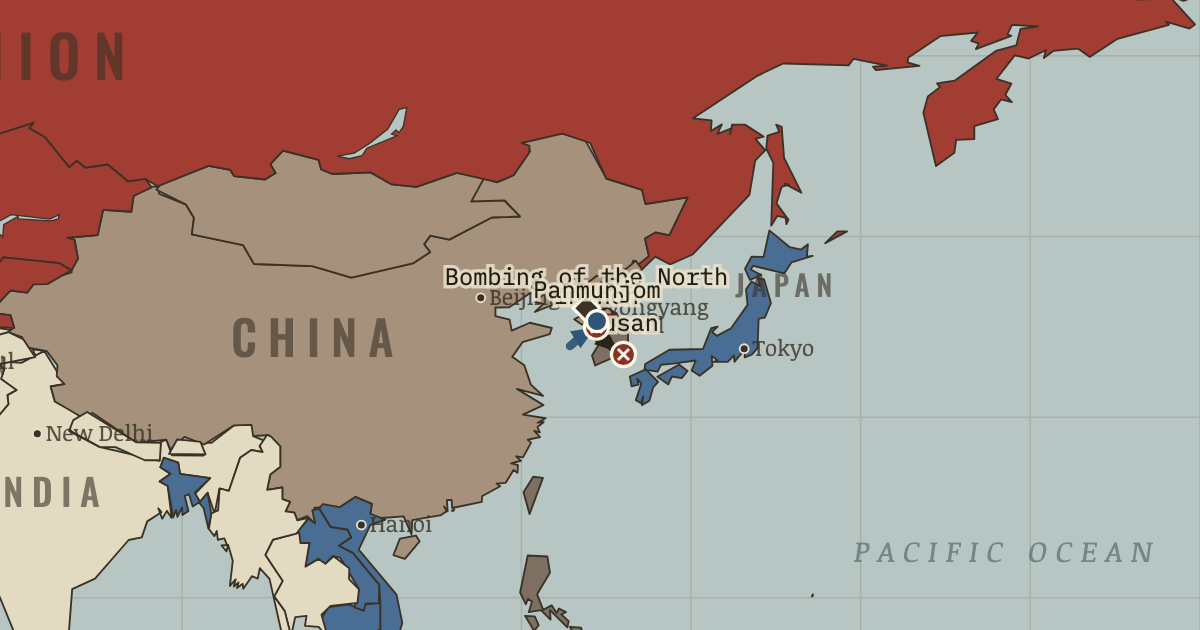
The war moved in sharp reversals, each of which carried a lesson. North Korean forces drove the defenders into a small perimeter around the southern port of Pusan before an amphibious landing at Inchon cut their supply lines and opened the road north. The UN command then made the fateful choice to cross the 38th parallel and pursue outright reunification, and that decision mattered because Beijing saw hostile forces approaching the Yalu River on China’s border and chose to enter the war rather than accept an American-aligned state there.
The short answer
- Three men’s miscalculations, compounding. Kim promised a three-week war of liberation and believed the South would rise to greet him. Stalin, weighing the new Soviet bomb and China’s victory, judged the risk cheap. And made sure Soviet involvement stayed deniable (pilots flew in Chinese markings). Acheson’s perimeter speech in January had honestly described existing policy, and thereby helped convince both that America would stand aside. Wars often begin exactly here: not from strength or plan, but from stacked misreadings of an adversary’s red lines.
- Why China came in. Mao’s Politburo argued for weeks. The country was ruined, the army had no navy or modern air force. But an American army on the Yalu meant a hostile power on China’s industrial doorstep, possibly with Chiang restored behind it. And Mao judged that a revolution that flinched abroad would not survive at home. He was also promised (and only partly received) Soviet air cover. Deepening the resentments of 1950 that resurface in the split. Beijing signaled its red line through Indian diplomats for weeks. Washington read the signals as bluff.
- A war the UN could join by accident. The Soviet delegation was boycotting the Security Council over China’s seat, so the resolutions authorizing force passed unvetoed. The first and last time the UN fought a war under its own flag against a great-power client. Moscow never repeated the mistake. The veto returned, and with it the pattern that UN action works only where the superpowers agree. Which is to say, rarely, and never at the center.
THE TURNING POINT
Inchon, 15 September 1950 — brilliance, then hubris. The landing is the century’s last great amphibious masterstroke: the North Korean army disintegrates in two weeks. But its very brilliance is what turns a defensive war into a war of conquest. MacArthur’s prestige silences doubters as UN forces roll past the parallel toward China despite Beijing’s explicit warnings. Within ten weeks the same commander presides over the longest retreat in American history. One battle, both lessons: audacity wins wars. Unexamined audacity un-wins them.
What it changed
The Cold War militarizes — globally and permanently. NSC-68’s tripled budgets sail through Congress. US defense spending jumps from ~5% to ~14% of GDP by 1953 and never returns to prewar levels. NATO acquires an integrated command, US divisions return to Germany, and West German rearmament. Unthinkable in 1949. Is on the table within months. Korea, not Berlin, builds the armed camp the map shows for the next forty years.
Japan’s boom, Korea’s bill. US procurement for the war. Trucks, textiles, steel. Pumps roughly $3 billion into occupied Japan. Toyota later dated its survival to Korean War orders. The 1951 San Francisco treaty ends the occupation and locks Japan into the Western column as its Asian arsenal. One divided nation’s catastrophe capitalizes another’s miracle: the Cold War’s economics in a single strait.
The DMZ: the era’s longest sentence. The armistice line on your map. Find it, four kilometers wide, still garrisoned. Is the Cold War’s most durable artifact: a 1953 ceasefire governing a 21st-century border, with a totalitarian hereditary state fossilized behind it. Scrub to 1991 and note what does not change. Some Cold War facts outlived the Cold War.
The full answer, argued
The case for crossing: the aggressor’s army was destroyed, unification seemed days away, and stopping would have restored the exact status quo that had just produced a war. The case against: explicit Chinese warnings, an intelligence picture MacArthur’s command chose to dismiss, and the arithmetic that a peninsula bordering China matters infinitely more to Beijing than to Washington. The outcome-based verdict is brutal: crossing bought two more years of war, two million more deaths, and the same border. The harder, fairer question is procedural. Who was empowered to hear the warnings? Truman deferred to a victorious general until April 1951, then fired him at the cost of a political firestorm. Design decision-making that can absorb bad news before the Yalu, not after. You will meet this problem again at the Bay of Pigs and in Vietnam.
An interesting fact
The armistice ceremony matched the war’s bitterness. On 27 July 1953 Nam Il and William Harrison signed eighteen copies in about ten minutes and left without a word, a handshake or a glance. South Korea’s name is on none of them — Syngman Rhee refused to sign, and five weeks earlier had released some 27,000 anti-communist prisoners overnight in a deliberate attempt to blow up the talks. The ceasefire that still governs the peninsula thus carries no signature from the state that lives along its line.
This is the study layer of Korean War, chapter 4 of The Cold War, 1945–1991; the full index of the atlas is here.
Related questions
THE FREE PRINTABLE STUDY GUIDE
Join the Dispatch — a short welcome series, then a letter when a new atlas opens — and the printable study guide for The Cold War is yours now, free.
NO TRACKING · YOUR ADDRESS IS USED FOR THE DISPATCH AND NOTHING ELSE · UNSUBSCRIBE ANYTIME