ON THIS DAY ·
Declaration by United Nations signed
Twenty-six Allied nations sign the Declaration by United Nations in Washington — the first official use of the name that will outlive the war.
WW2 is free — every chapter. No sign-up.
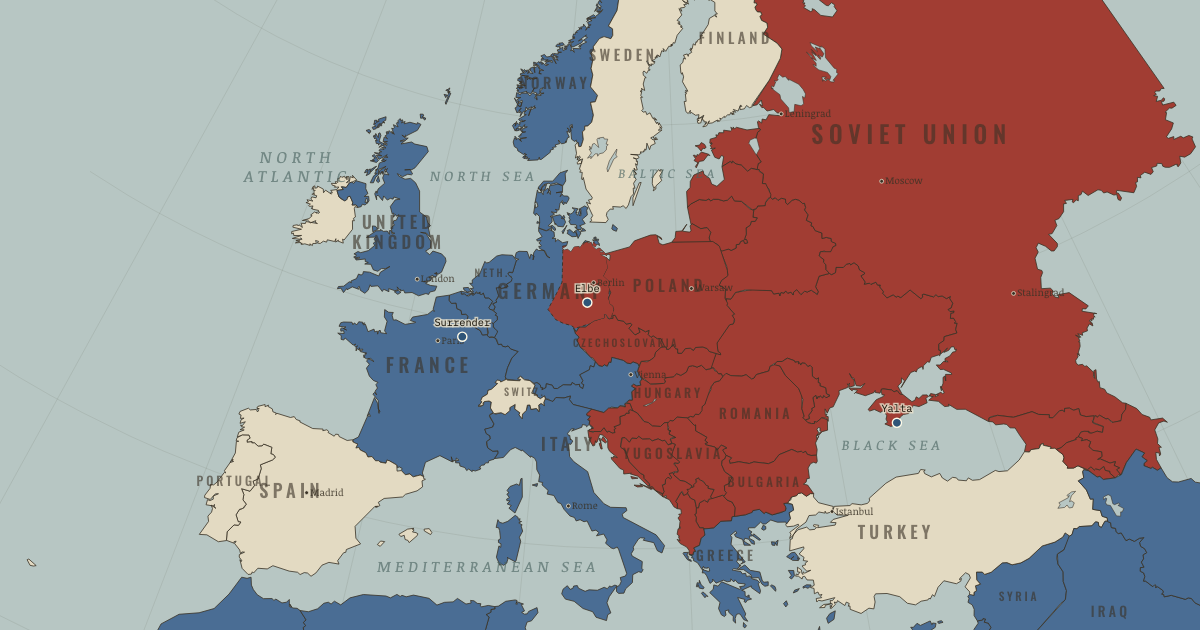
The moment in context
The final map is best read as a distribution of power rather than as a settled peace. Soviet armies occupied much of Eastern Europe while Western armies held the west, and although the agreements reached at Yalta and Potsdam mattered, it was military position that determined how those promises would actually be enforced. Germany was divided into occupation zones and later into two separate states, and Korea was split at the 38th parallel. The former allies now understood security in incompatible ways, because the Soviet Union sought controlled buffer states after suffering repeated invasion, while Western governments read that same control as naked expansion.
From Aftermath of WW2, chapter 15 of The War Room — WW2, 1936–1945 (OCT 1945).
Teach this in 5 minutes
- Why it happened — Why the peace looked like this: armies are arguments. No conference redrew Europe — Yalta and Potsdam largely ratified where soldiers stood. Occupation zones became states; the 38th parallel became…
- The turn — The handshake that became a border. Torgau, 25 April 1945: soldiers of two victorious armies grin for the cameras on a broken bridge. Within three years, the line where they met is…
- What it changed — The long peace — under a mushroom cloud. No great-power war since 1945: deterrence, exhaustion, institutions, or luck? Historians argue; all four probably. But the wars didn’t stop — they…
Then ask the room: Was the Second World War “one war”? Argue both sides using what you’ve seen on this map. The argued answer is on the chapter page →
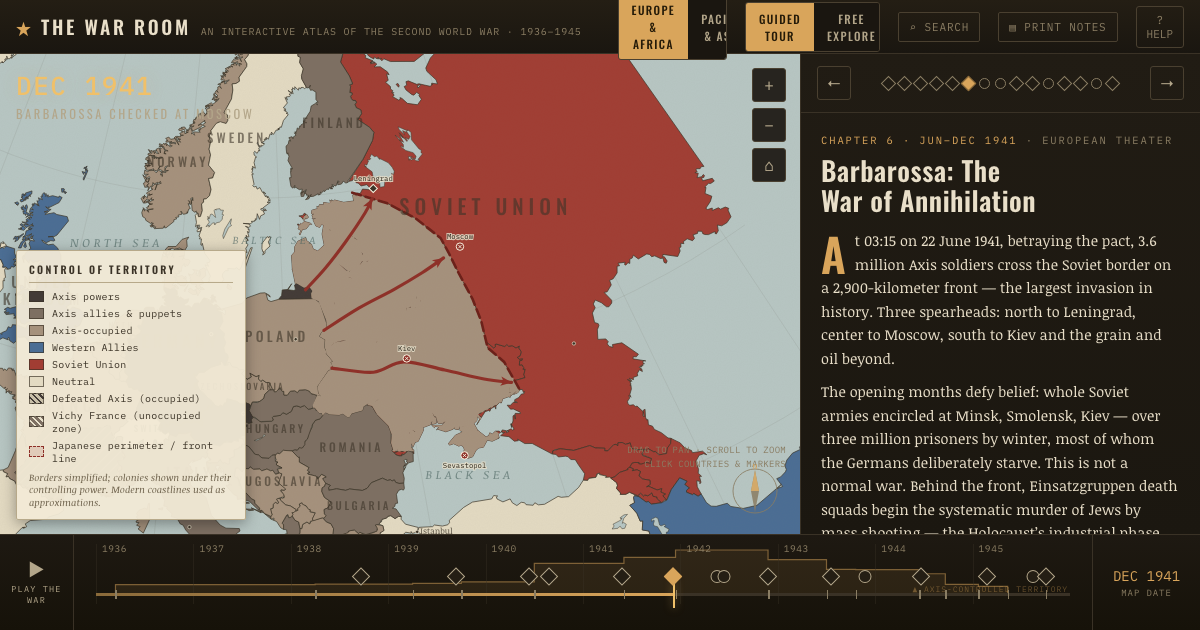
The atlas that shows it
THE FREE PRINTABLE STUDY GUIDE
Join the Dispatch — a short welcome series, then a letter when a new atlas opens — and the printable study guide for WW2 is yours now, free.
NO TRACKING · YOUR ADDRESS IS USED FOR THE DISPATCH AND NOTHING ELSE · UNSUBSCRIBE ANYTIME