ON THIS DAY ·
Surrender of Beiping
31 Jan 1949 — Encircled and hopeless after Tianjin’s 29-hour fall, General Fu Zuoyi negotiates: the garrison marches out, the PLA marches in, and the old capital — its palaces, its universities — passes without a shell. In October it will be the capital again.
WW2 is free — every chapter. Try chapters 1–2 of any 2 other atlases (3 with a free account). Opening a new atlas uses one of them. Membership opens all 21 — Join.
Free printable Chinese Revolution study guide, sent by email ↓
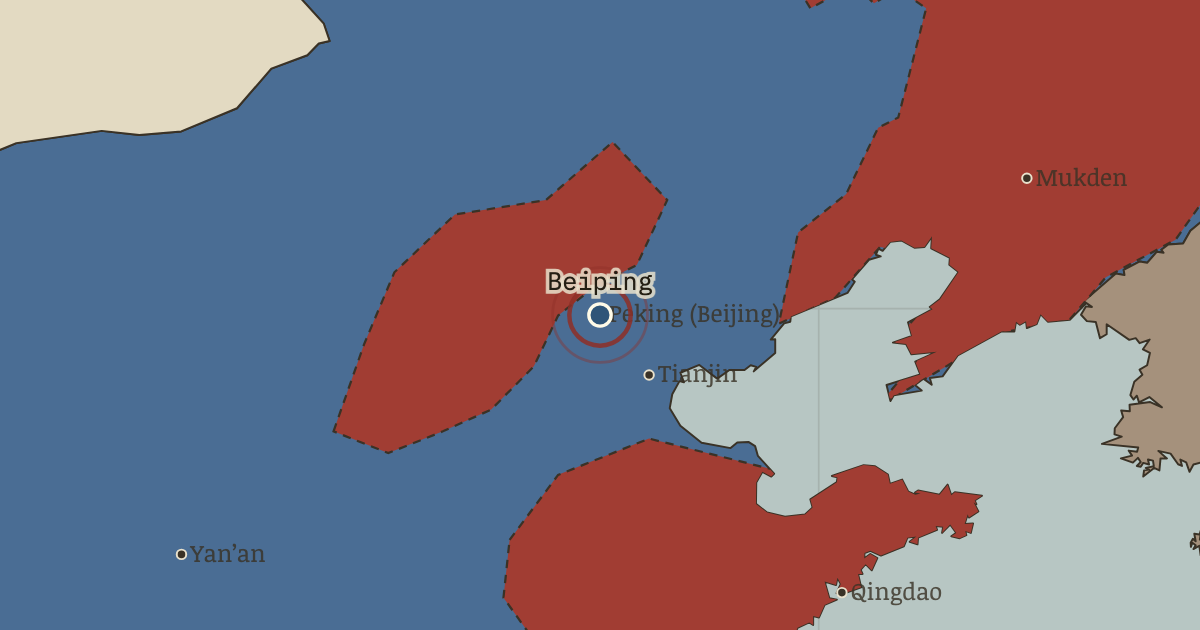
The moment in context
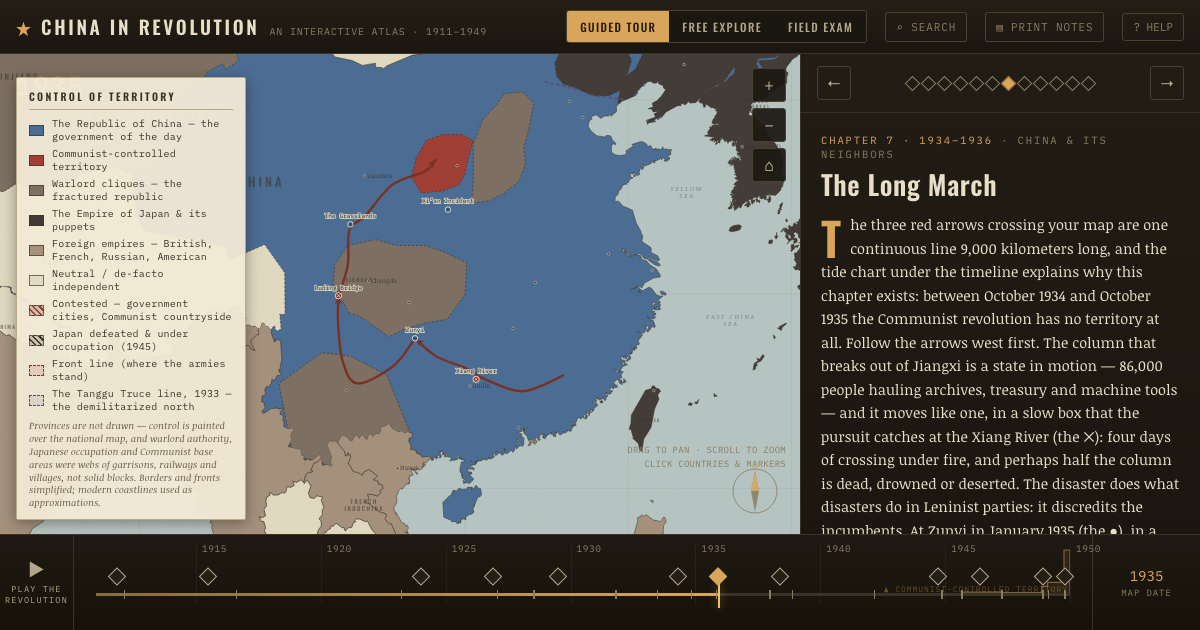
Operational art is the craft of linking separate battles to a single larger aim, and here that aim was to isolate and destroy whole enemy armies. Fourteen months settled everything, and the map finally moved the way maps move when a war is being decided rather than merely fought. The direction came from a farm courtyard in the Taihang foothills (the ● at Xibaipo), where Mao and Zhu De ran a million-man war by telegraph, the last rural headquarters of a party five months from governing an empire. Manchuria came first. The red arrow of Liaoshen aimed not at the front but at the bottleneck, and Jinzhou (the ✕), the single rail gate between the northeast and China proper, fell in thirty-one hours in October 1948. Half a million Nationalist troops, the government’s best, were sealed inside a region that had already starved under siege; the ◆ at Changchun marks the war’s cruelest victory, a garrison starved out over five months with civilian dead of the order of 150,000, held on this map as memory rather than triumph. Within weeks the sealed armies surrendered or defected in place, and Manchuria, hatched with contest since 1945, turned solid red. The Communists now fielded the larger, better-equipped army, twenty-one years after Nanchang.
From Liaoshen, Huaihai and Pingjin campaigns, chapter 11 of China in Revolution, 1911–1949 (1948).
The place: Surrender of Beiping — map and full story →
Teach this in 5 minutes
- Why it happened — Operational art, learned the hard way. The campaigns were not human waves. They were textbook encirclement warfare — isolate a region by seizing its transport gate (Jinzhou), fix the…
- The turn — Jinzhou, October 1948. Thirty-one hours at a railway bottleneck sealed half a million men and decided which army would enter the endgame with the material advantage —…
- What it changed — The Yangtze becomes a formality. With the strategic reserve destroyed, the river line of April 1949 is defended by fragments and negotiation theater. The crossing (Chapter 12’s…
Then ask the room: Were the three campaigns won by Communist excellence or lost by Nationalist collapse — and can those be separated? The argued answer is on the chapter page →
The atlas that shows it
THE FREE PRINTABLE STUDY GUIDE
Join the Dispatch — a short welcome series, then a letter when a new atlas opens — and the printable study guide for China in Revolution is yours now, free.
NO TRACKING · YOUR ADDRESS IS USED FOR THE DISPATCH AND NOTHING ELSE · UNSUBSCRIBE ANYTIME