MAPS OF HISTORY · China in Revolution · ALL CHAPTERS · CHAPTER 11
CHAPTER 11 · 1948–1949 · 1948
The Three Campaigns
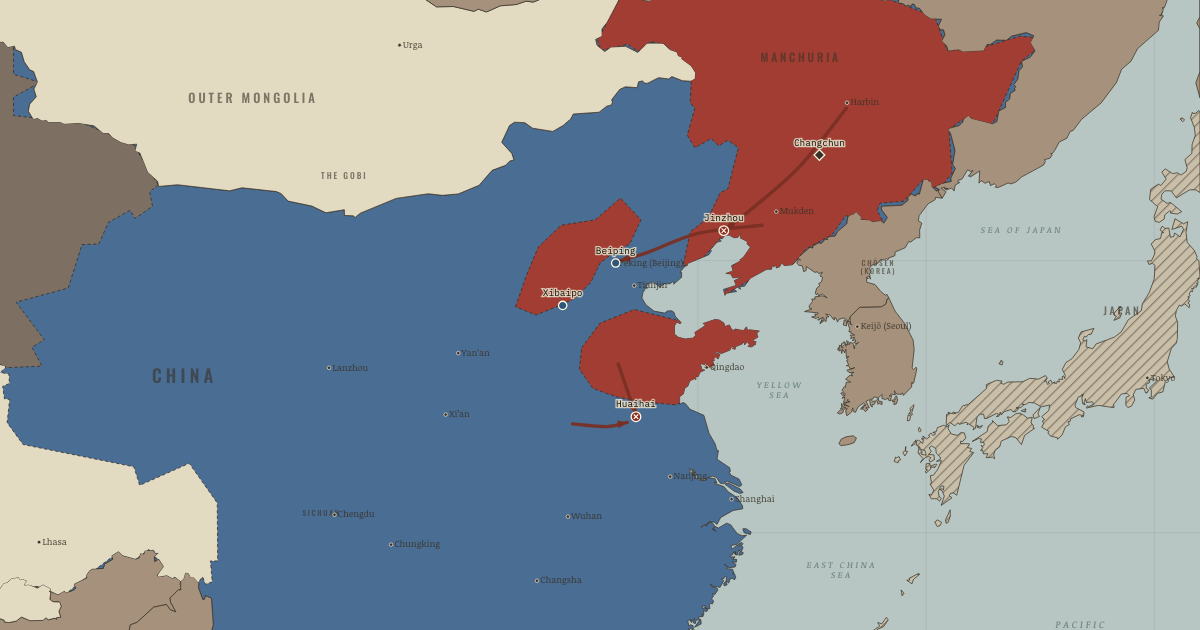
The map above is the world of 1948 — Liaoshen and Huaihai — the north goes red.
BRIEF EXPLANATION — THE ESSENTIAL ARGUMENT
The Liaoshen campaign aimed at Jinzhou, the single rail gate out of Manchuria, because taking it would trap the Nationalist armies in the northeast, and it did. Changchun’s siege in the same campaign caused mass civilian death and remains a memorial in this atlas rather than a triumph. Once Manchuria turned Communist, the balance of equipment and manpower shifted decisively for the first time in the war.
At Huaihai, Communist armies destroyed the Nationalist groups pocket by pocket while millions of civilian laborers moved their food and ammunition. The Pingjin campaign then brought the fall of Tianjin and the negotiated surrender of Beiping. Together the three campaigns removed roughly 1.5 million government troops and left the Yangtze as a line with no strategic reserve behind it, which made the final collapse only a matter of time.
GUIDED EXPLANATION
Operational art is the craft of linking separate battles to a single larger aim, and here that aim was to isolate and destroy whole enemy armies. Fourteen months settled everything, and the map finally moved the way maps move when a war is being decided rather than merely fought. The direction came from a farm courtyard in the Taihang foothills (the ● at Xibaipo), where Mao and Zhu De ran a million-man war by telegraph, the last rural headquarters of a party five months from governing an empire. Manchuria came first. The red arrow of Liaoshen aimed not at the front but at the bottleneck, and Jinzhou (the ✕), the single rail gate between the northeast and China proper, fell in thirty-one hours in October 1948. Half a million Nationalist troops, the government’s best, were sealed inside a region that had already starved under siege; the ◆ at Changchun marks the war’s cruelest victory, a garrison starved out over five months with civilian dead of the order of 150,000, held on this map as memory rather than triumph. Within weeks the sealed armies surrendered or defected in place, and Manchuria, hatched with contest since 1945, turned solid red. The Communists now fielded the larger, better-equipped army, twenty-one years after Nanchang.
Then came the plains. Around Xuzhou (the ✕ at Huaihai) the war’s largest battle consumed the winter, 600,000 Communist troops against 550,000 Nationalists. Behind the red columns moved more than five million peasant laborers with barrows and carrying poles, the land reform of 1946–47 marching as logistics, and Deng Xiaoping coordinated the front committee. Whole government divisions defected mid-battle with their maps and radios, and the encircled army groups were destroyed one pocket at a time. South of the Huai nothing organized remained, so that the map’s new front line became the Yangtze itself. The north came third. With Manchuria’s field army suddenly free (the red arrow of Pingjin swinging down through the passes), Tianjin was stormed in twenty-nine hours, and Beiping (the ● there), the old capital with its palaces and universities intact, was surrendered without a shell by General Fu Zuoyi in January 1949. Three campaigns subtracted 1.5 million government troops and annihilated the state’s strategic reserve north of the river. What remained below the Yangtze was an army mostly on paper and a government already crating its gold, so that the last chapter is a formality these fourteen months had made certain.
DEEP EXPLANATION — EVIDENCE & INTERPRETATION
Changchun: a victory that memory would not keep
Changchun is a memorial in this atlas, and part of what it memorializes is a silence. To take the Manchurian city without a costly assault, the besieging army sealed it from May to October 1948 and starved the Nationalist garrison out. Civilians trapped between the lines, often refused passage through the cordon so that hunger would press harder on the defenders, died in numbers most estimates place around 150,000, and some place considerably higher. What distinguishes the episode is how thoroughly it was left out of the founding story. The war is otherwise among the most commemorated events in the People’s Republic, yet the starvation of Changchun’s civilians fit no heroic frame, and the fullest account came from a military writer, Zhang Zhenglu, whose 1989 book was promptly banned. The truth belongs beside the campaign’s brilliance rather than in place of it, because the same operational logic that made Jinzhou a model of economy made Changchun a place where the economy was counted in civilian lives. A state’s memory tends to keep the first and edit the second.
The currency that surrendered before the army
The military collapse of 1948–49 was preceded by a monetary one, and the sequence matters for cause and effect. Years of financing the war by printing money had turned the fabi into confetti, so in August 1948 the government launched the gold yuan and forced its citizens, at gunpoint in Shanghai, where Chiang’s son Chiang Ching-kuo ran a short and theatrical anti-speculation drive, to surrender gold, silver and foreign currency for the new notes. Within weeks the gold yuan was itself inflating hundreds-fold, so that the confiscation had simply transferred the last private savings of the urban middle class into a currency that died in their hands. Historians of the civil war, Suzanne Pepper prominent among them, argue that this was the decisive theatre, because the regime destroyed the loyalty of exactly the constituency it depended on, its officers’ families, its merchants, teachers and civil servants. The battlefield defections of the following winter were the aftershock of a betrayal already priced in money. Armies can be rebuilt, but the trust of one’s own payroll cannot be reprinted.
New here? Chapters 1–2 of every atlas are free to sample, and the WW2 atlas is free in full. One membership opens all thirteen — the Cartographer’s Circle.
THE SITES
ON THIS DAY
WHY IT HAPPENED
Operational art, learned the hard way. The campaigns were not human waves. They were textbook encirclement warfare — isolate a region by seizing its transport gate (Jinzhou), fix the garrisons, destroy relief columns in the open, and let besieged armies ripen into surrenders. The commanders (Lin Biao, Su Yu, Liu Bocheng) had learned mobility in twenty years of being the weaker side; 1948 was the first year they held every advantage, and they spent it like men who remembered scarcity.
Logistics with title deeds attached. Huaihai’s official count — 5.4 million civilian laborers mobilized — is the land reform rendered as supply chain: villages that had received deeds, and knew a Nationalist victory meant the landlords’ return, sent sons, grain and barrows. The Nationalist armies in the same country requisitioned at gunpoint from villages that owed them nothing. One side’s rear area was a society. The other’s was a market it had already looted.
Command as single point of failure. Chiang commanded by telephone from Nanjing, overrode his theater commanders (the Manchurian armies were forbidden timely withdrawal until withdrawal was impossible), and promoted by loyalty in a war that punished it. Against him stood a command system that delegated fronts to committees and audited results. The asymmetry Chapter 7 flagged at Zunyi. This side could correct after failure — pays out here at the scale of army groups.
Defection as arithmetic. More than anything, 1948–49 is a market crash in loyalty: hyperinflation had beggared the officer corps’s families. The gold yuan “reform” of August 1948 confiscated urban savings in exchange for paper that died in weeks. And every surrendered division was re-employed by the victors, making surrender rational early rather than late. Fu Zuoyi handed over the Ming capital intact partly because his daughter — a Communist agent — sat at his table. The anecdote is true, and the structure it decorates (a regime whose own establishment had stopped believing) is the finding.
THE TURN
Jinzhou, October 1948. Thirty-one hours at a railway bottleneck sealed half a million men and decided which army would enter the endgame with the material advantage — after Jinzhou, every remaining Nationalist choice was between speeds of defeat. It is the atlas’s cleanest specimen of operational art: aim at the door, not the rooms. When you rank the era’s battles, put the unfamous rail junction above the famous sieges. The sieges were consequences.
WHAT IT CHANGED
The Yangtze becomes a formality. With the strategic reserve destroyed, the river line of April 1949 is defended by fragments and negotiation theater. The crossing (Chapter 12’s arrows) meets an army that exists mostly on paper — the campaigns did not win the war. They abolished the remainder of it.
The cities change masters intact. Beiping’s negotiated surrender becomes the template: infrastructure, universities and administrations pass whole to a party that arrives with cadres trained (at Xibaipo, literally in seminars) to run them. The contrast with 1945’s carpetbagging is deliberate policy — the CCP takes power in the cities it once lost, carefully.
The gold and the museum sail east. Through the winter of 1948–49 the government ships the treasury’s bullion, the navy, the air force and the Palace Museum’s crates to Taiwan — the state packing itself for an island exile it still calls temporary. Two Chinas are being physically sorted into existence.
FIELD QUESTION — Were the three campaigns won by Communist excellence or lost by Nationalist collapse — and can those be separated?
Try the separation as an exercise. The collapse column is heavy: hyperinflation and the gold-yuan confiscation destroyed the urban base. Command interference stranded whole army groups. Defections supplied the PLA with more American equipment than aid ever supplied Chiang. The excellence column is heavier than older Western accounts allowed: the campaigns show deliberate operational design, a logistics revolution grown from land reform, and a political apparatus that converted every surrender into strength — collapse does not organize five million porters or take Jinzhou in thirty-one hours. The deeper point is that the two columns are the same phenomenon viewed from opposite banks: revolutionary war as the CCP had built it since 1927 was precisely a machine for turning an opponent’s structural rot into one’s own combat power. Westad’s verdict — that the Nationalists lost politically before they lost militarily, but that losing militarily this completely required a remarkable opponent — is where the evidence points. Beware any historical question that offers you “skill or luck” as exclusive options.
AN INTERESTING FACT
The Huaihai campaign’s supply system was, by official count, 5.43 million civilian laborers supporting 600,000 soldiers — roughly nine civilians pushing barrows, carrying stretchers and hauling grain for every soldier at the front, across frozen plains in midwinter. Chen Yi, who commanded there, said afterward that the victory “was pushed across in wheelbarrows.” The barrow itself — a single-wheeled design Chinese farmers had used for centuries — briefly became the most strategically significant vehicle in Asia, moving more tonnage to that battle than the Nationalist air force could interdict.
THE DISPATCH
One short letter when a new atlas opens — and the printable study guide for China in Revolution is yours now, free.
NO TRACKING · YOUR ADDRESS IS USED FOR THE DISPATCH AND NOTHING ELSE · UNSUBSCRIBE ANYTIME