ON THIS DAY ·
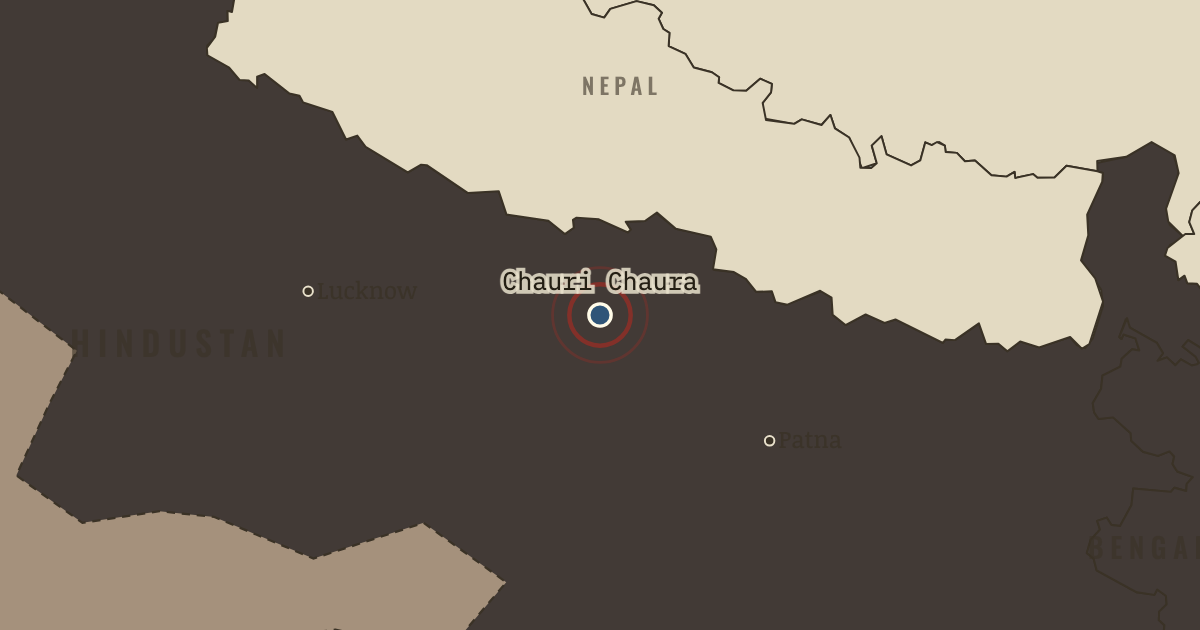
Chauri Chaura incident
4 Feb 1922 — A police firing, then a crowd burns the station with 22 constables inside. Gandhi, over furious objections, halts the whole national movement: a people not yet disciplined in non-violence, he argues, cannot be trusted with it. The halt is debated to this day.
WW2 is free — every chapter. Try chapters 1–2 of any 2 other atlases (3 with a free account). Opening a new atlas uses one of them. Membership opens all 21 — Join.
Free printable Indian independence study guide, sent by email ↓
The moment in context
Non-cooperation rested on a simple insight, that a government dependent on the participation of the governed can be paralysed the moment they withdraw it. At Nagpur in December 1920 Congress remade itself around this idea: the goal became swaraj, or self-rule, the method non-violent non-cooperation, the fee four annas so a peasant could join, and the working language each province’s own. Gandhi promised swaraj within a year if the programme held, and the programme meant total withdrawal. Lawyers such as Motilal Nehru and C. R. Das abandoned lucrative practices, students left government colleges, voters boycotted the dyarchy councils, and foreign cloth burned while the spinning wheel turned homespun khadi into the uniform of the nation. Yoked to it ran the Khilafat movement, Muslim India’s outrage at the victors’ dismemberment of Ottoman Turkey, and for two years the two currents made the widest front the struggle ever saw, with the Ali brothers on Gandhi’s platform, thirty thousand political prisoners by the end of 1921, and the visiting Prince of Wales processing through emptied, shuttered streets.
From Non-cooperation movement, chapter 7 of Indian Independence & Partition, 1857–1964 (DEC 1920).
The place: Chauri Chaura incident — map and full story →
Teach this in 5 minutes
- Why it happened — Amritsar plus Khilafat: two griefs, one front. Non-Cooperation fused the Punjab’s wound with Muslim India’s religious grievance over the Caliphate — Gandhi deliberately yoked them, judging that…
- The turn — Chauri Chaura, 4 February 1922. Twenty-two policemen burned by a nationalist crowd, and Gandhi — over the written protest of nearly every Congress leader — stops the whole engine…
- What it changed — The ebb turns communal. With the common enemy’s pressure released, the coalition’s seams opened: the mid-1920s brought waves of Hindu–Muslim riots, shuddhi and tanzeem…
Then ask the room: Was Gandhi right to halt Non-Cooperation after Chauri Chaura? The argued answer is on the chapter page →
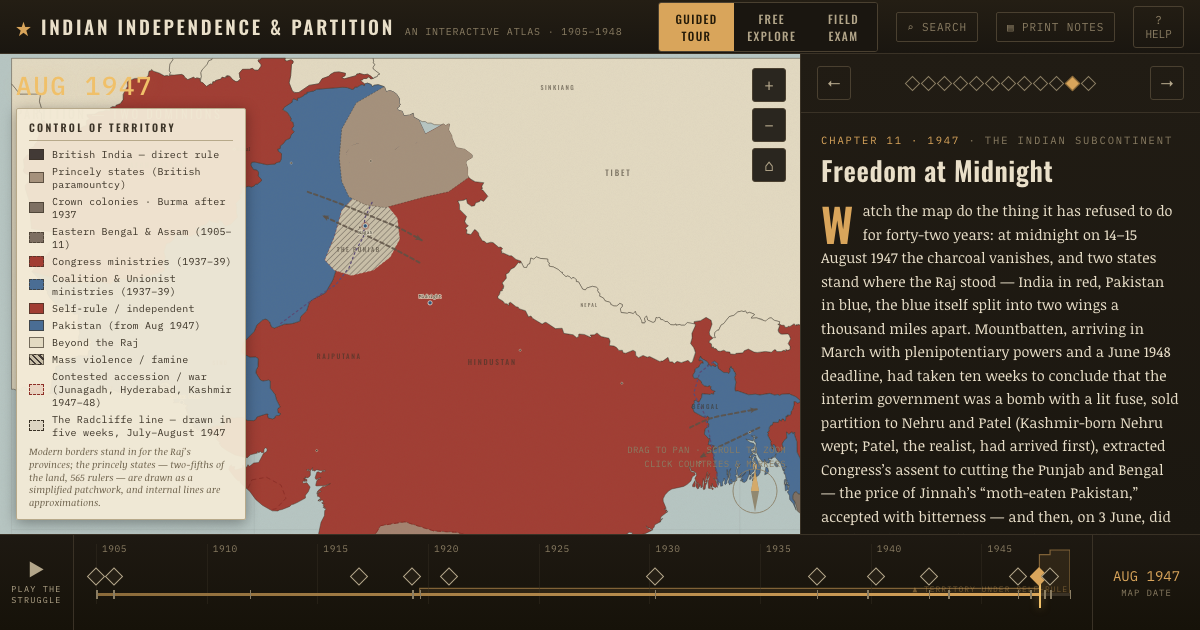
The atlas that shows it
THE FREE PRINTABLE STUDY GUIDE
Join the Dispatch — a short welcome series, then a letter when a new atlas opens — and the printable study guide for Indian Independence & Partition is yours now, free.
NO TRACKING · YOUR ADDRESS IS USED FOR THE DISPATCH AND NOTHING ELSE · UNSUBSCRIBE ANYTIME