MAPS OF HISTORY · Indian Independence & Partition · ALL CHAPTERS · CHAPTER 5
CHAPTER 5 · 1920–1922 · DEC 1920
Non-Cooperation — The Method Argued
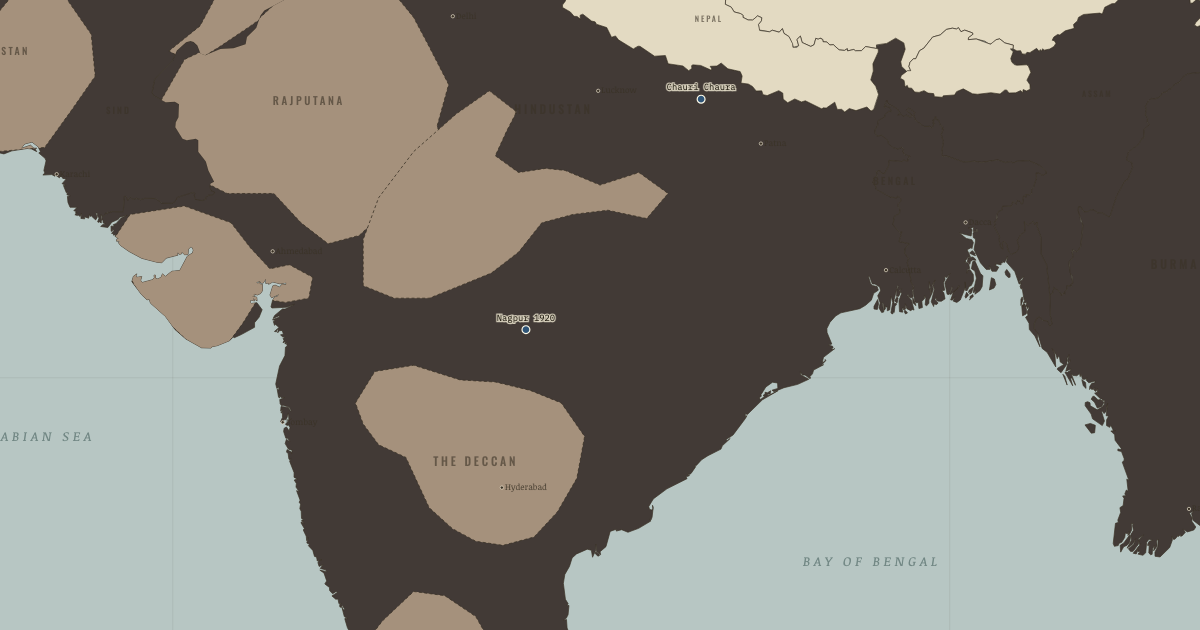
The map above is the world of AUG 1919 — Afghanistan breaks free.
BRIEF EXPLANATION — THE ESSENTIAL ARGUMENT
After Amritsar the nationalist movement stopped asking the Raj for reform and set out instead to make its rule unworkable. In 1920 Congress reorganized around swaraj, meaning self-rule, to be won by non-cooperation, and it lowered its membership fee so that peasants could join. Students left government colleges, lawyers left the courts and voters boycotted the new councils, while consumers burned foreign cloth. Gandhi tied this campaign to the Khilafat movement, Muslim India’s protest against the dismemberment of Ottoman Turkey, and the two currents together produced the broadest Hindu–Muslim mobilization the freedom struggle would ever achieve.
The campaign ended over the question that would haunt Gandhi for the rest of his life, whether a mass movement could stay non-violent. In February 1922, at Chauri Chaura, a crowd burned a police station with twenty-two constables inside after the police fired on a procession. Gandhi called off the entire national movement at its height, arguing that violence would destroy both its ethics and its strategy. The halt preserved his standard of disciplined action, yet it also sacrificed enormous momentum, divided his allies, and left unresolved whether so vast a movement could ever be centrally controlled.
GUIDED EXPLANATION
Non-cooperation rested on a simple insight, that a government dependent on the participation of the governed can be paralysed the moment they withdraw it. At Nagpur in December 1920 Congress remade itself around this idea: the goal became swaraj, or self-rule, the method non-violent non-cooperation, the fee four annas so a peasant could join, and the working language each province’s own. Gandhi promised swaraj within a year if the programme held, and the programme meant total withdrawal. Lawyers such as Motilal Nehru and C. R. Das abandoned lucrative practices, students left government colleges, voters boycotted the dyarchy councils, and foreign cloth burned while the spinning wheel turned homespun khadi into the uniform of the nation. Yoked to it ran the Khilafat movement, Muslim India’s outrage at the victors’ dismemberment of Ottoman Turkey, and for two years the two currents made the widest front the struggle ever saw, with the Ali brothers on Gandhi’s platform, thirty thousand political prisoners by the end of 1921, and the visiting Prince of Wales processing through emptied, shuttered streets.
The movement ended in the ashes of a police station. On 4 February 1922, at Chauri Chaura in the eastern United Provinces, police fired on a procession, retreated when their ammunition ran out, and a crowd burned the station with twenty-two constables inside. Gandhi’s response bewildered his own lieutenants, because he called off the entire national campaign at its height, arguing that a people capable of this were not yet ready for the non-violence that swaraj required, and he undertook a five-day penitential fast. The Raj, given room to breathe, jailed him for six years for sedition. The unity died with the momentum, since Khilafat collapsed in 1924 when Atatürk abolished the Caliphate, and the decade’s ebb brought communal rioting in its place. On the Malabar coast the ebb had already shown its darkest face in 1921, when a tenant rising under the Khilafat banner turned in part into communal slaughter and was answered with mass hangings and a wagonload of suffocated prisoners. The method had set a nation in motion, and the halt asked whether the nation could be steered.
DEEP EXPLANATION — EVIDENCE & INTERPRETATION
The Khilafat gamble and its reckoning
Yoking Indian nationalism to the Khilafat cause, the Muslim outrage at the Allied dismemberment of the Ottoman Caliphate, gave the freedom struggle its broadest Hindu–Muslim front, and it was among the most consequential tactical choices Gandhi ever made. The case for it is the mobilization itself, since for two years Muslim and Hindu India moved together on a scale never repeated. The case against was made almost at once and has grown louder in hindsight, because in building unity Gandhi had legitimized religious identity as the language of national politics, and had staked that unity on a specifically Islamic grievance with no organic connection to Indian self-rule. The gamble’s collapse exposed its fragility with cruel neatness, for the Caliphate was abolished in 1924 by Mustafa Kemal Atatürk himself, a secular Turkish moderniser, so that Indian Muslims discovered they had mobilized for an institution its own homeland had chosen to discard. Historians such as Ayesha Jalal read the Khilafat experiment as the first rehearsal of a lesson the 1940s would complete: religion could summon a mass constituency faster than any other appeal, and could not afterward be sent home.
Malabar, 1921: whose rebellion was it?
The rising on the Malabar coast in 1921 is a memorial in this atlas and a warning about how hard it can be to name an event honestly. It began as an agrarian revolt, when Mappila, or Moplah, Muslim tenants who had long been squeezed by mostly Hindu landlords rose under the Khilafat banner as the movement’s energy reached the south. British repression was ferocious, and the notorious wagon tragedy, in which more than sixty prisoners suffocated in a sealed railway van, is among its memorials. Yet the rising also turned in places into forced conversions and the killing of Hindu neighbours, and there the interpretations divide and harden. Was it an anti-colonial peasant uprising, a religious war, or a communal pogrom? It was argued as all three at the time and is argued as all three now, with present-day Hindu-nationalist writing stressing the communal atrocities and older nationalist accounts stressing the agrarian and anti-imperial roots. This atlas holds the discomfort deliberately, because a single event can be a genuine revolt against exploitation and a genuine communal atrocity at once, and a history that keeps only the convenient half has become a defacing of memory rather than a record of it.
New here? Chapters 1–2 of every atlas are free to sample, and the WW2 atlas is free in full. One membership opens all thirteen — the Cartographer’s Circle.
THE SITES
ON THIS DAY
WHY IT HAPPENED
Amritsar plus Khilafat: two griefs, one front. Non-Cooperation fused the Punjab’s wound with Muslim India’s religious grievance over the Caliphate — Gandhi deliberately yoked them, judging that Hindu–Muslim unity was worth the theological awkwardness of a Mahatma championing a Caliph. For two years it worked as nothing had: the era’s largest mobilization of Muslims into all-India politics. Critics then and historians since note the cost — mobilizing religion for unity legitimized religion as politics’ language, a coin the 1930s spent differently.
Gandhi’s wager on discipline. The method demanded something armies do not: that masses under attack absorb violence without returning it. Gandhi’s reasoning was strategic as much as saintly — violence would justify repression, split the movement, and lose the moral audience in Britain and the world. But it required training a subcontinent in months. Chauri Chaura proved the training was incomplete. The argument was whether to pause the war for it, and no one has settled that argument since.
The boycott’s real economics. Cloth imports halved between 1920 and 1922. Lawyers’ and students’ walkouts hollowed the institutions of collaboration. Council boycotts stripped dyarchy’s legitimacy at birth. Non-Cooperation demonstrated that the Raj’s machinery could be visibly, measurably starved — the practical proof of chapter 1’s arithmetic. It also showed the limits: the machine slowed but did not stop, and boycott fatigue was setting in even before the halt.
Swaraj undefined — deliberately. Gandhi kept the goal’s content vague — “swaraj in one year” named a destination without a map, letting the peasant hear land, the merchant hear tariffs, the Khilafatist hear the Caliph restored. The vagueness built the coalition and mortgaged its future: when the year passed without swaraj, each hope curdled separately. Movements that mean everything to everyone win breadth at the price of a reckoning.
THE TURN
Chauri Chaura, 4 February 1922. Twenty-two policemen burned by a nationalist crowd, and Gandhi — over the written protest of nearly every Congress leader — stops the whole engine at full steam. It is the most argued decision in the freedom struggle. Against: momentum this total never returned. The Raj recovered. Unity with Khilafat died in the pause. Swaraj was postponed a generation. For: a movement that shrugged off Chauri Chaura would have become a different movement — one the Raj could meet with pure force and the world could dismiss, and 1942 shows what leaderless violence bought. The halt is the purest statement of Gandhi’s claim that means make ends — judge it, and you have taken a side in the era’s deepest argument.
WHAT IT CHANGED
The ebb turns communal. With the common enemy’s pressure released, the coalition’s seams opened: the mid-1920s brought waves of Hindu–Muslim riots, shuddhi and tanzeem counter-mobilizations, and the poisoning of the political well. Unity, it emerged, had been an achievement of struggle, not a resting state — a finding with a long future.
Constructive work and the long game. Gandhi spent the ebb on the spinning wheel, untouchability, village sanitation — the “constructive programme” his critics called retreat and he called foundations. Khadi and the charkha turned the boycott into a daily discipline millions could keep. When the next wave came in 1930, its cadres were the people the quiet years had trained.
The Swarajists re-enter the councils. Motilal Nehru and C. R. Das, unwilling to waste the pause, entered the legislatures “to wreck dyarchy from within”. They found partial office had its own logic. The oscillation set the pattern Congress kept to the end: mass struggle, then council work, each phase feeding the other. The 1937 ministries are the Swarajist gambit at full scale.
FIELD QUESTION — Was Gandhi right to halt Non-Cooperation after Chauri Chaura?
Frame the question as strategy, and the case against is strong: the movement was at maximum pressure, the halt demobilized millions who never returned in the same numbers, Khilafat unity dissolved in the pause, and the Raj — by its own officials’ later admission badly stretched — was reprieved. Frame it as movement-building, and Gandhi’s logic bites: non-violence was not an ornament but the strategic core, the thing that made repression costly, kept the moral audience, and prevented the struggle from becoming a war it must lose against the best army in Asia. A movement that excused Chauri Chaura licensed the next mob, and the Raj would have welcomed the exchange of moral for military ground. The honest verdict is that both are right and the tension is permanent: disciplined mass movements buy legitimacy with lost momentum. Notice what the question assumes, though — that swaraj in 1922 was actually on offer. It almost certainly was not. The halt sacrificed less than its critics claimed, and taught more.
AN INTERESTING FACT
It was in these years that Gandhi assembled the visual identity the world knows. In September 1921, in Madurai, he permanently adopted the loincloth of the poorest peasant — explicitly so that no Indian could be worse-dressed than he was — and the spinning wheel he made the movement’s daily sacrament went onto the Congress flag in 1921 and survives, transformed into Ashoka’s wheel of law, on India’s tricolour today. Winston Churchill’s later sneer — “a seditious Middle Temple lawyer, now posing as a fakir” — measured the costume’s success: a London-trained barrister had made the body of the Indian poor the most photographed political argument on earth.
THE DISPATCH
One short letter when a new atlas opens — and the printable study guide for Indian Independence & Partition is yours now, free.
NO TRACKING · YOUR ADDRESS IS USED FOR THE DISPATCH AND NOTHING ELSE · UNSUBSCRIBE ANYTIME