ON THIS DAY ·
Jallianwala Bagh massacre
13 Apr 1919 — In a walled garden in Amritsar, Brigadier Dyer’s fifty rifles fire 1,650 rounds into an unarmed Baisakhi crowd until ammunition runs low. 379 dead by official count; Indian estimates near a thousand. The Raj’s claim to rule by consent dies here. Remember them.
WW2 is free — every chapter. Try chapters 1–2 of any 2 other atlases (3 with a free account). Opening a new atlas uses one of them. Membership opens all 21 — Join.
Free printable Indian independence study guide, sent by email ↓
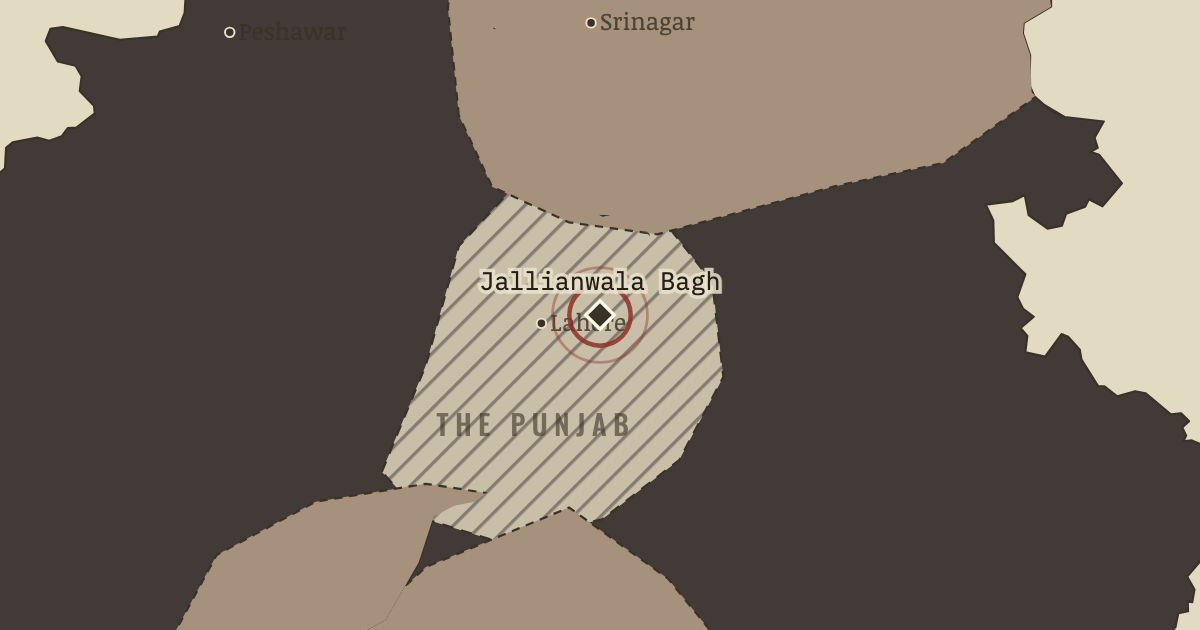
The moment in context
The Rowlatt Act was explosive mainly because of what it announced, since extending wartime emergency powers into peacetime told Indians exactly how little their sacrifice had bought. It allowed detention without trial and trial without jury for political cases. Gandhi answered with the first all-India satyagraha, a general strike, or hartal, that shut cities from Lahore to Madras and moved the whole subcontinent as one for the first time. In Amritsar, after police fired on protesters and a mob killed five Europeans, Brigadier-General Reginald Dyer arrived to restore order. On 13 April 1919, the spring festival of Baisakhi, a crowd of thousands gathered in Jallianwala Bagh, a walled garden reached by a few narrow exits, and most of them were villagers who did not know that public meetings had been banned. Dyer marched in fifty riflemen, blocked the main exit, and ordered fire without warning into the thickest of the crowd, some 1,650 rounds over ten minutes, until the ammunition ran low. The official count was 379 dead, while the Congress inquiry counted closer to a thousand. He then marched out without a glance at the wounded, and in the days that followed ordered Indians to crawl on their bellies down the lane where a missionary had been assaulted.
From Amritsar massacre, chapter 6 of Indian Independence & Partition, 1857–1964 (APR 1919).
The place: Jallianwala Bagh massacre — map and full story →
Teach this in 5 minutes
- Why it happened — Rowlatt: the insult of permanence. The Act’s practical reach was narrow — it was, in fact, never once applied. Its meaning was the offence: after a war fought, Indians were told, for…
- The turn — Jallianwala Bagh, 13 April 1919. Ten minutes of aimed fire into a walled garden, and the argument of sixty years — that British rule, whatever its costs, was rule by law — is dead.…
- What it changed — Gandhi captures the national movement. Amritsar handed Gandhi the argument his method needed: if the Raj was force dressed as law, then cooperation was complicity, and withdrawal of…
Then ask the room: The Hunter Commission censured Dyer and he was retired from active command. Why was that punishment worse than none at all? The argued answer is on the chapter page →
The atlas that shows it
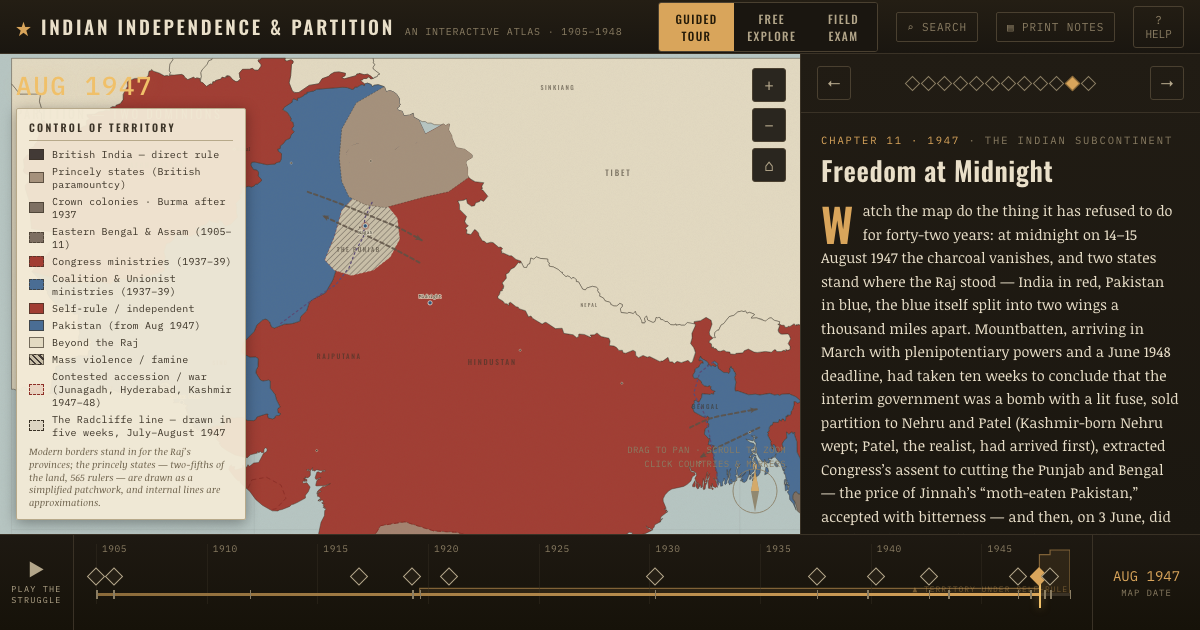
THE FREE PRINTABLE STUDY GUIDE
Join the Dispatch — a short welcome series, then a letter when a new atlas opens — and the printable study guide for Indian Independence & Partition is yours now, free.
NO TRACKING · YOUR ADDRESS IS USED FOR THE DISPATCH AND NOTHING ELSE · UNSUBSCRIBE ANYTIME