MAPS OF HISTORY · Indian Independence & Partition · ALL CHAPTERS · CHAPTER 4
CHAPTER 4 · 1919 · APR 1919
Amritsar — The End of Consent
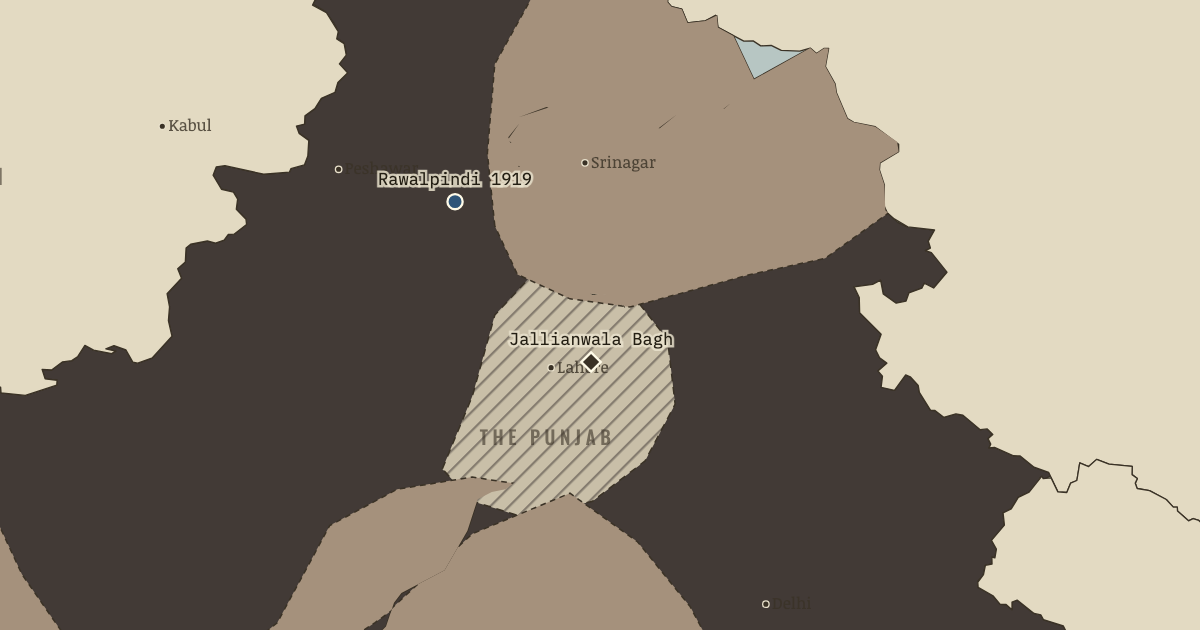
The map above is the world of APR 1919 — Martial law in the Punjab.
BRIEF EXPLANATION — THE ESSENTIAL ARGUMENT
Amritsar marks the moment the Raj lost the one claim that had justified it, the claim to rule by law. When the war ended, Indians expected the emergency powers of wartime to lapse, but the Rowlatt Act of 1919 made detention without trial permanent for political cases and so treated loyal subjects as suspects. Gandhi answered with the first all-India protest, and unrest spread across the country. On 13 April 1919, at an enclosed garden called Jallianwala Bagh in Amritsar, General Dyer marched in troops and ordered them to fire without warning into a trapped festival crowd. The official death toll was 379, while Indian estimates ran far higher.
The atlas treats the killing as a memorial, and its political force came as much from the response as from the massacre itself. Dyer told an official inquiry, without apology, that he had fired to produce a moral effect throughout the Punjab, and he faced no criminal trial while much of the British public rallied to his defence with a large public purse. Tagore returned his knighthood and Gandhi returned his war medals, each renouncing the symbols of loyalty. From these events many Indians drew a single conclusion, that a government which could defend such a killing ruled by force rather than by law, and could no longer command their cooperation.
GUIDED EXPLANATION
The Rowlatt Act was explosive mainly because of what it announced, since extending wartime emergency powers into peacetime told Indians exactly how little their sacrifice had bought. It allowed detention without trial and trial without jury for political cases. Gandhi answered with the first all-India satyagraha, a general strike, or hartal, that shut cities from Lahore to Madras and moved the whole subcontinent as one for the first time. In Amritsar, after police fired on protesters and a mob killed five Europeans, Brigadier-General Reginald Dyer arrived to restore order. On 13 April 1919, the spring festival of Baisakhi, a crowd of thousands gathered in Jallianwala Bagh, a walled garden reached by a few narrow exits, and most of them were villagers who did not know that public meetings had been banned. Dyer marched in fifty riflemen, blocked the main exit, and ordered fire without warning into the thickest of the crowd, some 1,650 rounds over ten minutes, until the ammunition ran low. The official count was 379 dead, while the Congress inquiry counted closer to a thousand. He then marched out without a glance at the wounded, and in the days that followed ordered Indians to crawl on their bellies down the lane where a missionary had been assaulted.
What turned a massacre into the collapse of an empire’s legitimacy was the aftermath. Dyer told the Hunter Commission, under oath and without apology, that he had fired to produce “a moral effect” throughout the Punjab, and that mercy would have made his force “a laughing stock.” The House of Lords passed a motion in his favour, and the Morning Post raised £26,000 for him, a fortune, from a grateful British public. Nothing the nationalists ever wrote indicted the Raj as efficiently as that purse. Tagore returned his knighthood, writing that “the time has come when badges of honour make our shame glaring,” and Gandhi, who had recruited for Britain’s war a year earlier, wrote that cooperation with “this satanic government” had become a sin. On the map almost nothing moves in 1919, except in the north-west, where the Rawalpindi treaty confirms Afghanistan’s escape from British control. The thing that broke that year does not appear on any map, because it was the belief, held on both sides for sixty years, that the Raj, whatever else it was, ruled by law.
DEEP EXPLANATION — EVIDENCE & INTERPRETATION
Two inquiries, two death tolls, two Indias
Amritsar was investigated twice, and the two inquiries are themselves evidence of a colonial order that could no longer agree with its subjects on the most basic facts. The government’s Hunter Committee censured Dyer’s tactics but split along racial lines, with its three Indian members filing a sharp minority report, and it accepted an official toll of 379 dead. The Indian National Congress ran its own inquiry, staffed by lawyers including a young Jawaharlal Nehru, gathered evidence the official body had not sought, and put the dead closer to a thousand. That gap was never going to close, because it was not really about arithmetic; it was about whose account of the event would count as the truth. This is the recurring difficulty of colonial atrocity, since the records are made by the power that committed it and the counter-record by the movement it created, so honest reconstruction lives in the space between a state that minimized and a movement with reason to maximize. What both inquiries documented beyond dispute was aimed fire into a trapped crowd, and an officer who defended it under oath.
The long afterlife of an unatoned crime
Amritsar’s political life did not end in 1919; it became a permanent test of how empires remember, and it is memorialized here partly because that test is still being taken. For a century British governments declined to apologize. The massacre was “monstrous” to Churchill in 1920 and “a deeply shameful event” to a visiting prime minister in 2013, yet the word sorry was withheld, because an apology carries legal and moral consequences a former imperial power is reluctant to accept. The centenary in 2019 passed with expressions of regret and still no apology. Historians of memory read this reticence as significant in itself, since an atrocity a state cannot bring itself to name as a crime remains, in a sense, unfinished business between the descendants of the ruled and the rulers. This atlas takes the view its house rules require, treating the dead of Jallianwala Bagh as a memorial rather than a data point, and it holds that how a killing is remembered can be as historically consequential as the killing itself, shaping relations between nations for generations after the guns fall silent.
New here? Chapters 1–2 of every atlas are free to sample, and the WW2 atlas is free in full. One membership opens all thirteen — the Cartographer’s Circle.
THE SITES
ON THIS DAY
WHY IT HAPPENED
Rowlatt: the insult of permanence. The Act’s practical reach was narrow — it was, in fact, never once applied. Its meaning was the offence: after a war fought, Indians were told, for liberty, the reward was the permanent machinery of a police state. Every Indian member of the Imperial Legislative Council voted against it. It passed anyway, demonstrating precisely what “consultation” was worth. Jinnah resigned his seat in protest. The Act radicalized constitutionalists — the hardest audience to radicalize.
The Punjab under pressure. The province that had given the army three-fifths of its men had endured quota recruitment, requisition and influenza. Its lieutenant-governor, Michael O’Dwyer, ran it as a barracks and regarded educated politics as sedition. When the hartal came, O’Dwyer saw 1857 returning — deported the local leaders, which set off the riots, and endorsed Dyer’s response. The massacre was not an aberration of one officer’s nerve. It grew from a provincial regime’s settled theory of rule.
Dyer’s theory of exemplary terror. Dyer was explicit: the crowd’s dispersal was not his object — “I was going to punish them.” This was terror as pedagogy, the frontier doctrine of collective punishment applied to a city of British India. Its exposure mattered because it forced a question the Raj had always blurred: was India governed by law, or held by force that law merely dressed? Dyer answered honestly. India believed him.
A promise already discounted. The Montagu–Chelmsford reforms were arriving in the same season — real, if grudging, steps. But Rowlatt and Amritsar re-priced them: concessions offered alongside massacre read as management, not partnership. Historians debate whether a generous 1919 settlement could have kept India inside a dominion path. What is certain is that after Amritsar, the moderates who would have championed it had nothing left to stand on.
THE TURN
Jallianwala Bagh, 13 April 1919. Ten minutes of aimed fire into a walled garden, and the argument of sixty years — that British rule, whatever its costs, was rule by law — is dead. The massacre itself might conceivably have been survived as an atrocity disowned. What could not be survived was its ratification, the oath-sworn doctrine of “moral effect,” the Lords’ motion, the public’s purse. The Raj was offered the choice between punishing exemplary terror and adopting it, and enough of Britain chose adoption to settle the question. This atlas marks it as memorial, not spectacle: 379 counted dead, perhaps a thousand, names still being recovered. What ended here does not show on the map. It decided everything the map shows after.
WHAT IT CHANGED
Gandhi captures the national movement. Amritsar handed Gandhi the argument his method needed: if the Raj was force dressed as law, then cooperation was complicity, and withdrawal of cooperation was both strategy and moral duty. Within eighteen months the man who had recruited soldiers for the Raj led the movement to boycott everything it touched.
Afghanistan slips the leash. Amid the Punjab’s convulsion, the new Afghan amir attacked British India. A month’s desultory war ended at Rawalpindi in August 1919 with Britain conceding what mattered — Afghan control of its own foreign policy. Watch the map’s north-west corner turn red: the first sovereignty on this map to break from British tutelage, in the same season consent died inside it. The empire could no longer afford even its buffers.
The Khilafat bridge. Indian Muslims were simultaneously absorbing a different blow: the victors’ dismemberment of Ottoman Turkey, whose sultan was Caliph. The Khilafat movement’s outrage and Congress’s post-Amritsar fury flowed into one channel in 1920 — the broadest Hindu–Muslim front the freedom struggle ever achieved, and, when it collapsed, the source of a bitter communal ebb.
FIELD QUESTION — The Hunter Commission censured Dyer and he was retired from active command. Why was that punishment worse than none at all?
Because it fixed the Raj in the exact posture that destroyed its legitimacy: officially disowning the deed while visibly declining to treat it as crime. Dyer faced no court, kept his pension, and was rewarded by the British public with a purse worth a fortune and a jewelled sword inscribed “Saviour of the Punjab”. The Lords voted in his favour. O’Dwyer, who ratified the massacre, was exonerated entirely. Indians could draw only one conclusion: the massacre was not an aberration the system rejected but a service the system quietly valued. A hanging would have been justice. Even full exoneration would at least have been candour. The half-measure proved the system could neither punish terror nor honestly own it. A state that cannot do either has conceded it rules by force alone. From 1920 the question in India was no longer whether British rule was legitimate, only how and when it would end.
AN INTERESTING FACT
The Rowlatt Act — the law that detonated the entire crisis — was never used. Not once, against anyone, in its three years on the statute book before repeal in 1922: the machinery of preventive detention it created sat idle while the protest against its existence reshaped the subcontinent. It is among modern history’s cleanest demonstrations that the political meaning of a law can dwarf its legal content. And the young man who watched the Amritsar aftermath most closely was Udham Singh, orphan of the city; twenty-one years later, in 1940, he shot Michael O’Dwyer dead in a London lecture hall — a coda Indian memory has never filed under either terrorism or justice, but simply under Amritsar.
THE DISPATCH
One short letter when a new atlas opens — and the printable study guide for Indian Independence & Partition is yours now, free.
NO TRACKING · YOUR ADDRESS IS USED FOR THE DISPATCH AND NOTHING ELSE · UNSUBSCRIBE ANYTIME