ON THIS DAY ·
Independence of Zimbabwe
18 Apr 1980 — Robert Mugabe, guerrilla leader turned prime minister, raises the flag over the former Rhodesia after the Lancaster House settlement. The land question is deferred — a time bomb set for later.
WW2 is free — every chapter. Try chapters 1–2 of any 2 other atlases (3 with a free account). Opening a new atlas uses one of them. Membership opens all 21 — Join.
Free printable Decolonization of Africa study guide, sent by email ↓

The moment in context
Rhodesia’s settlers could evade sanctions as long as they had friendly neighbours, routing trade through South Africa and through Portuguese Mozambique, which is why economic pressure alone did so little for so long. When Mozambique became independent and hostile in 1975, both the guerrilla war and the isolation grew much harder to contain. The Lancaster House agreement then delivered a ceasefire and one-person-one-vote elections, yet its willing-buyer, willing-seller land clause froze the colonial distribution of land for ten years. It ended the immediate war while postponing the injustice that would detonate in Zimbabwe two decades later.
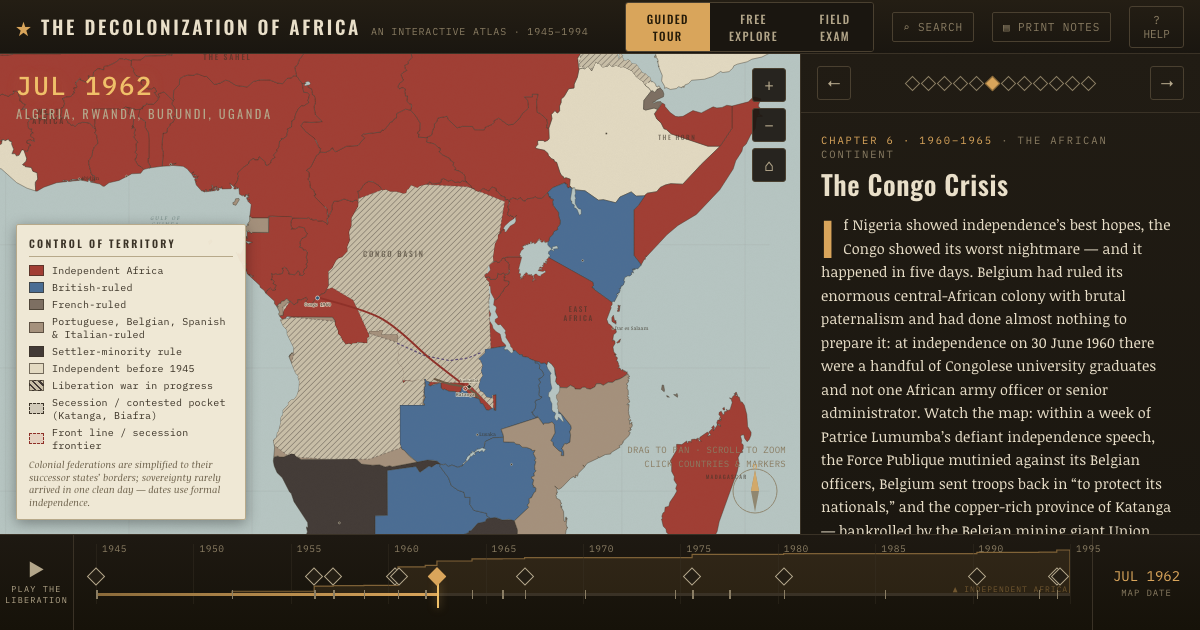
From Rhodesia, Zimbabwe and Namibia, chapter 9 of The Decolonization of Africa, 1945–1994 (APR 1980).
The place: Independence of Zimbabwe — map and full story →
Teach this in 5 minutes
- Why it happened — Settlers with nowhere to go, again. Rhodesia’s quarter-million whites and South Africa’s far larger settler population regarded southern Africa as their only home and controlled its…
- The turn — Cuito Cuanavale, 1987–88 — the hinge. South Africa commits its heaviest armour to crush the Angolan-Cuban forces and is fought to a standstill at a ruined town in the Angolan bush. The…
- What it changed — Zimbabwe, 1980 — and the deferred reckoning. The former Rhodesia became independent under Mugabe after the Lancaster House settlement. A genuine triumph of the negotiated model, and the…
Then ask the room: Why did settler rule in southern Africa survive decades longer than colonialism elsewhere — and what combination of pressures finally ended it? The argued answer is on the chapter page →
The atlas that shows it
THE FREE PRINTABLE STUDY GUIDE
Join the Dispatch — a short welcome series, then a letter when a new atlas opens — and the printable study guide for The Decolonization of Africa is yours now, free.
NO TRACKING · YOUR ADDRESS IS USED FOR THE DISPATCH AND NOTHING ELSE · UNSUBSCRIBE ANYTIME