ON THIS DAY ·
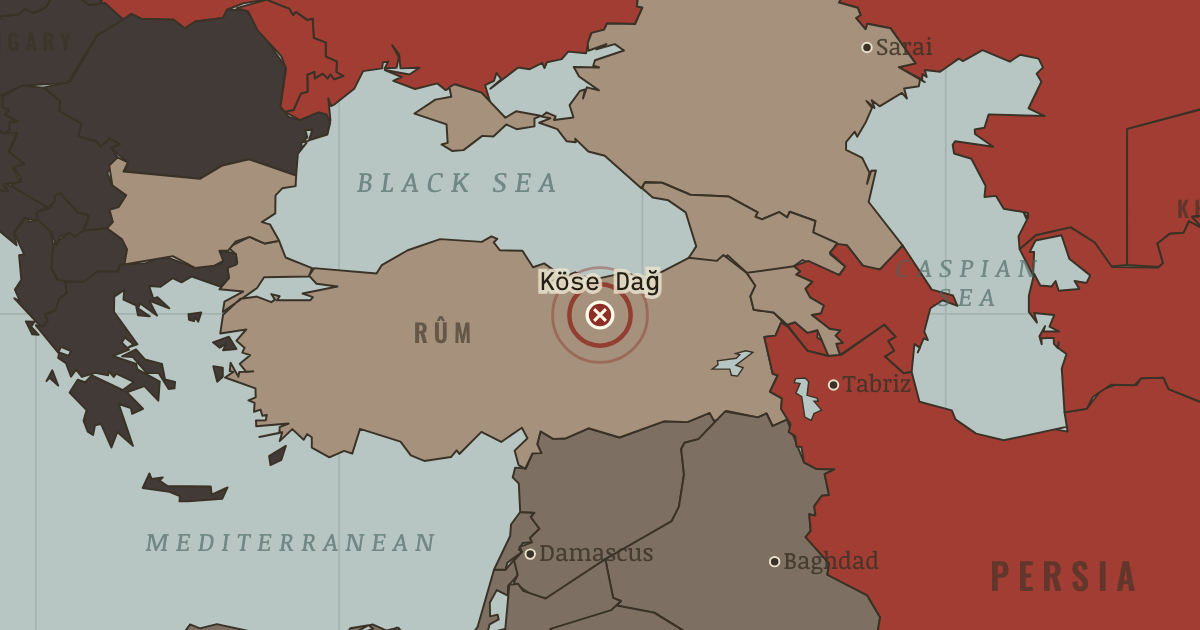
Battle of Köse Dağ
26 Jun 1243 — The Seljuk sultanate of Rûm, the great power of Anatolia, breaks against Baiju’s smaller army in a single afternoon. The sultan becomes a tax-paying vassal — the model client: no occupation, just tribute, census and obedience.
WW2 is free — every chapter. Try chapters 1–2 of any 2 other atlases (3 with a free account). Opening a new atlas uses one of them. Membership opens all 21 — Join.
The moment in context
The scale of the empire explains its methods, because no state could garrison every settlement, so the Mongols controlled the key routes and governed through existing institutions. The yam placed relay stations along the major roads, each stocked with horses, fodder and staff, so that a protected messenger could cross great distances at speed. Censuses counted households, herds and labour obligations, and a paiza, or tablet of authority, told local officials that its bearer acted in the khan’s name.
From How the Mongol Empire was governed, chapter 7 of The Mongol Empire, 1206–1294 (1255).
The place: Battle of Köse Dağ — map and full story →
Teach this in 5 minutes
- Why it happened — Steppe institutions, scaled. Nothing in the toolkit was invented from zero: the yam scales the nomad habit of remount relays; the census scales the decimal army’s muster rolls;…
- The turn — The silver fountain of Karakorum. Take Boucher’s fountain as the hinge-image of mid-century: a Parisian artisan, seized in the Hungarian catastrophe, building courtly wonders where…
- What it changed — The roads outlive the swords. Census, yam and paiza make the Silk Road briefly one jurisdiction — the precondition for Chapter 12’s whole story: the Polos’ journey, the…
Then ask the room: A million rulers, a hundred million ruled: why did the mathematically impossible occupation hold? The argued answer is on the chapter page →
The atlas that shows it
THE FREE PRINTABLE STUDY GUIDE
Join the Dispatch — a short welcome series, then a letter when a new atlas opens — and the printable study guide for The Mongol Empire is yours now, free.
NO TRACKING · YOUR ADDRESS IS USED FOR THE DISPATCH AND NOTHING ELSE · UNSUBSCRIBE ANYTIME