ON THIS DAY · 2 AUGUST 216 BC
Battle of Cannae
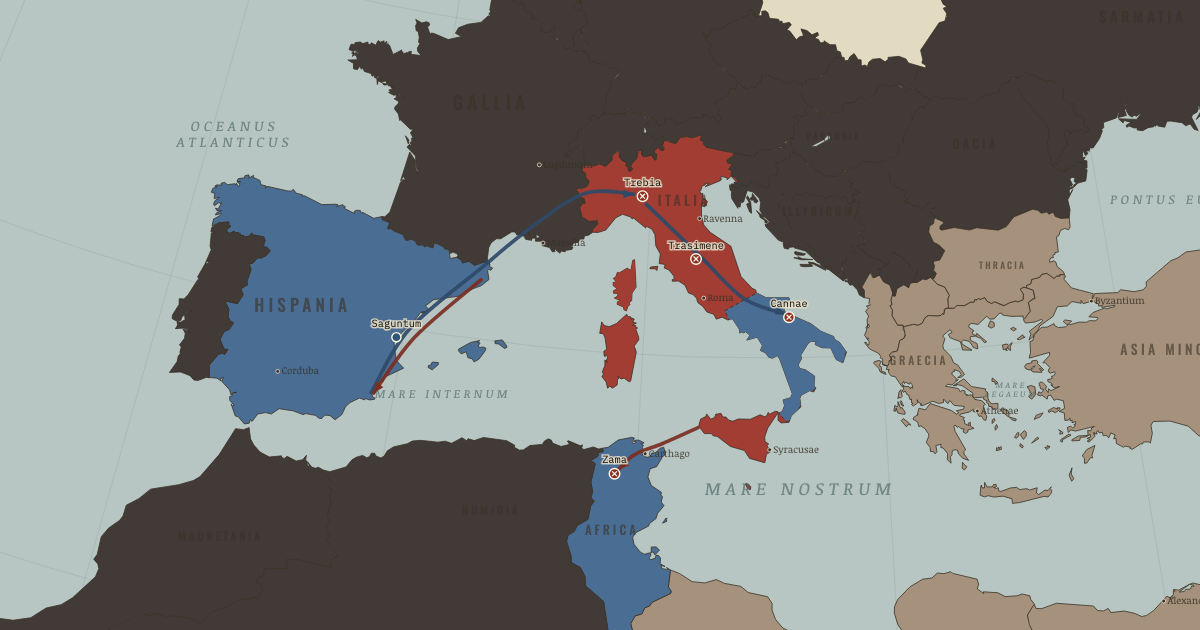
Cannae. Hannibal’s smaller army swallows eight Roman legions whole — the double envelopment every general since has dreamed of.
WW2 is free — every chapter. Try chapters 1–2 of any 2 other atlases (3 with a free account). Opening a new atlas uses one of them. Membership opens all 21 — Join.
The moment in context
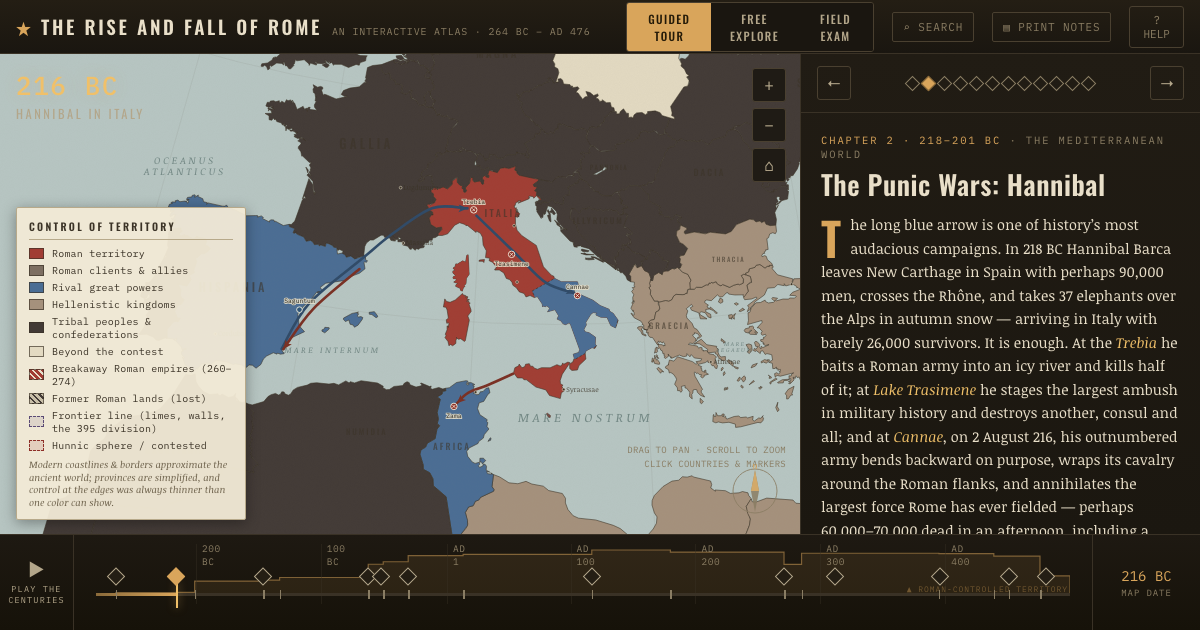
The campaign Hannibal launched in 218 BC was one of the most daring in history, and its purpose explains its shape. Leaving Carthaginian Spain with a large army, he crossed the Rhône and then the Alps in autumn snow, losing most of his men on the way and reaching Italy with perhaps 26,000 survivors. It was enough, because he did not need numbers so much as victories that would persuade Italy to abandon Rome. At the Trebia he lured a Roman army across an icy river and destroyed it; at Lake Trasimene he trapped another in fog and killed it, consul and all; and at Cannae in 216 BC he let his centre give way on purpose, closed his cavalry around the Roman flanks, and annihilated the largest force Rome had ever fielded, with ancient estimates of the dead ranging from about 48,000 to 70,000. Much of southern Italy defected to him, and by the ordinary rules of ancient warfare the war was over.
From Second Punic War, chapter 2 of The Rise and Fall of Rome, 264 BC – AD 476 (216 BC).
Teach this in 5 minutes
- Why it happened — A treaty written in resentment. The peace of 241 was harsh; the seizure of Sardinia in 238 — legally naked opportunism while Carthage fought its own mutinous mercenaries — made it…
- The turn — Cannae, 2 August 216 BC. The hinge is not the battle but the response. Any Hellenistic state that lost 60,000 men — an eighth of its adult male citizens and allies within…
- What it changed — The Mediterranean’s center of gravity moves west. Carthage’s fall to client status leaves Rome as the only major naval power west of Greece. Watch the tan of the African hinterland turn grey too:…
Then ask the room: Rome lost perhaps one adult male citizen in eight at Cannae — in one afternoon — and kept fighting. Why could it, when any contemporary state would have sued for peace? The argued answer is on the chapter page →
The atlas that shows it
THE FREE PRINTABLE STUDY GUIDE
Join the Dispatch — a short welcome series, then a letter when a new atlas opens — and the printable study guide for Rome is yours now, free.
NO TRACKING · YOUR ADDRESS IS USED FOR THE DISPATCH AND NOTHING ELSE · UNSUBSCRIBE ANYTIME