ON THIS DAY ·
Battle of Borodino
7 Sep 1812 — Some 250,000 men and 70,000+ casualties: the bloodiest single day of war until 1916. Napoleon holds the field; the Russian army survives — which is what matters.
WW2 is free — every chapter. Try chapters 1–2 of any 2 other atlases (3 with a free account). Opening a new atlas uses one of them. Membership opens all 21 — Join.
Free printable Age of Revolutions study guide, sent by email ↓
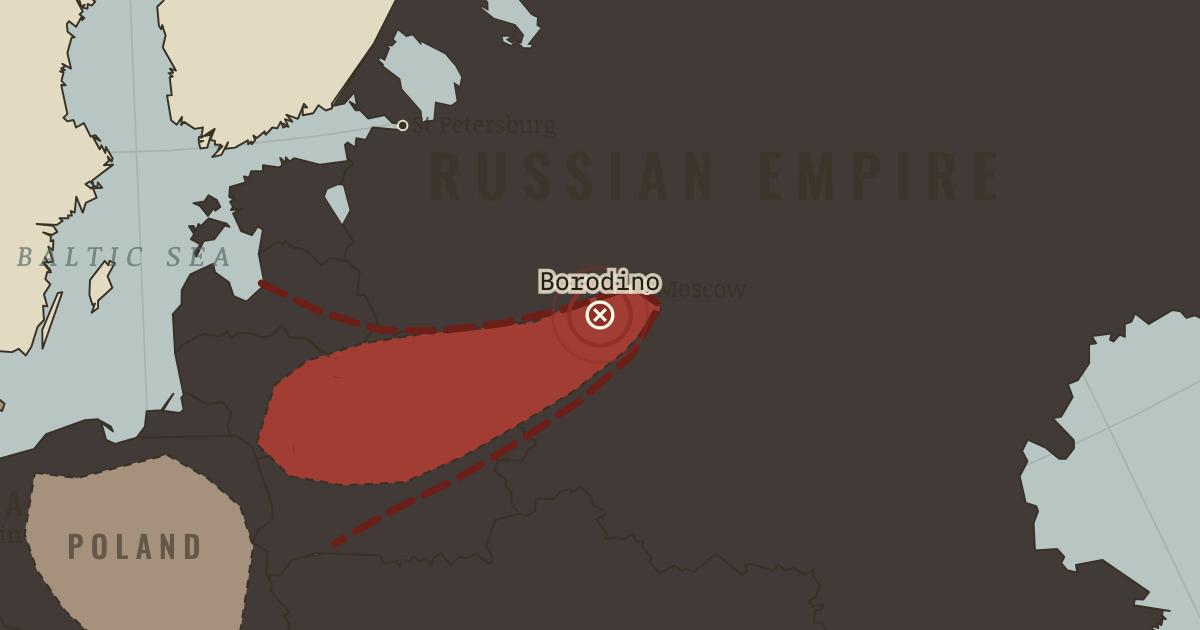
The moment in context
The invasion of Russia was built around a single expectation that failed. About 600,000 troops, many of them from allied or subject states, crossed the Niemen on 24 June 1812 so that Napoleon could trap the Russian armies in a decisive battle near the frontier. The Russians withdrew instead, whether by deliberate design or through the confusion of divided command, and every eastward march after that lengthened French supply lines and thinned the available forage. Typhus, dysentery, heat and desertion removed large numbers of men before the first major battle was even fought.
From Napoleon’s invasion of Russia, chapter 8 of The Age of Revolutions, 1775–1848 (SEP 1812).
The place: Battle of Borodino — map and full story →
Teach this in 5 minutes
- Why it happened — Logistics against arithmetic. Napoleon’s method — march fast, live off the land, win quickly — was engineered for dense, rich, road-webbed Western Europe. Russia offered sparse…
- The turn — Moscow, September–October 1812. The battle Napoleon needed never mattered as much as the letter that never came. Possessing the enemy’s ancient capital — the move that had ended…
- What it changed — The spell breaks in public. The 29th Bulletin admits catastrophe (while assuring France the Emperor’s health “has never been better”). Prussia defects within weeks, Austria…
Then ask the room: Napoleon had studied Charles XII’s 1709 disaster in Russia and carried the history books on campaign. Why did knowing the precedent not save him? The argued answer is on the chapter page →
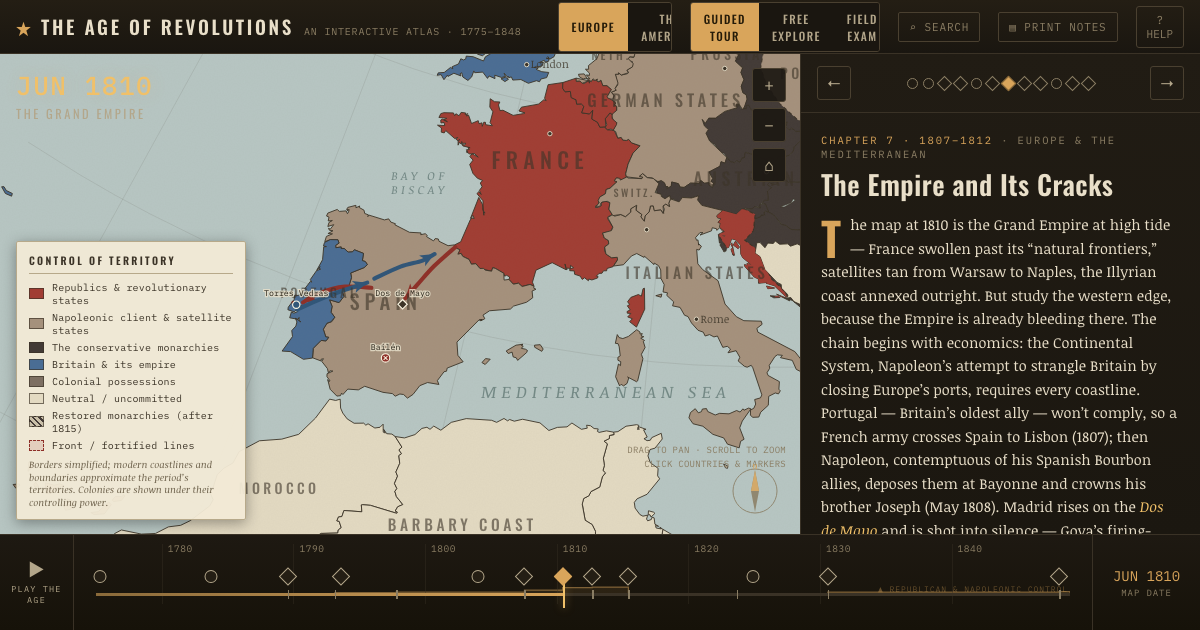
The atlas that shows it
THE FREE PRINTABLE STUDY GUIDE
Join the Dispatch — a short welcome series, then a letter when a new atlas opens — and the printable study guide for The Age of Revolutions is yours now, free.
NO TRACKING · YOUR ADDRESS IS USED FOR THE DISPATCH AND NOTHING ELSE · UNSUBSCRIBE ANYTIME