ON THIS DAY ·
Chinese Soviet Republic
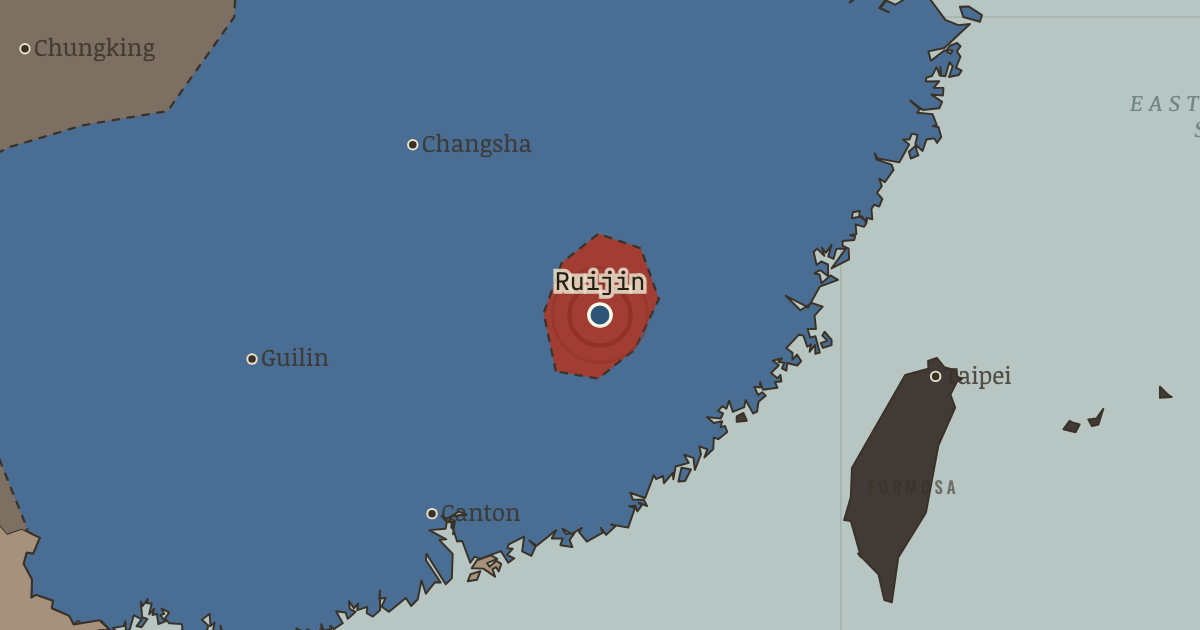
7 Nov 1931 — In a Hakka market town the CCP proclaims a state: currency, land law, conscription — three million people under red administration. Land redistribution wins the poor; the terror against “rich peasants” and internal enemies (the Futian purges) is part of the record too.
WW2 is free — every chapter. Try chapters 1–2 of any 2 other atlases (3 with a free account). Opening a new atlas uses one of them. Membership opens all 21 — Join.
Free printable Chinese Revolution study guide, sent by email ↓
The moment in context
An encirclement campaign works by isolating a base, cutting its supplies and destroying it from the outside inward. Within fourteen months two rival states were proclaimed against Nanjing, and the map now carries both. Consider the northeast first. On 18 September 1931 Kwantung Army officers bombed their own railway outside Mukden (the ● there), blamed China, and overran Manchuria in five months. They acted against Tokyo’s instructions and to loud Japanese public applause. In March 1932 the conquest was dressed up as “Manchukuo,” with the last Qing emperor Puyi installed as its puppet. In 1933 Jehol was annexed, and the Tanggu Truce, the dashed line along the Great Wall, demilitarized everything north of Peking as a concession by another name. Chiang, then mid-campaign against the Communists, ordered non-resistance and appealed to the League of Nations, whose commission duly reported the truth and changed nothing. The charcoal here records the world’s security system failing its first great test, eight years before Europe’s.
From Jiangxi Soviet and the encirclements, chapter 6 of China in Revolution, 1911–1949 (1934).
The place: Chinese Soviet Republic — map and full story →
Teach this in 5 minutes
- Why it happened — Manchuria: an army making foreign policy. The Kwantung Army acted because it could: Huanggutun had proven field officers faced no consequences. The Depression had gutted civilian government…
- The turn — Guangchang, April 1934. Mukden changed the world more, but within this chapter’s war the hinge is Guangchang: the battle that proved the Fifth Encirclement could not be…
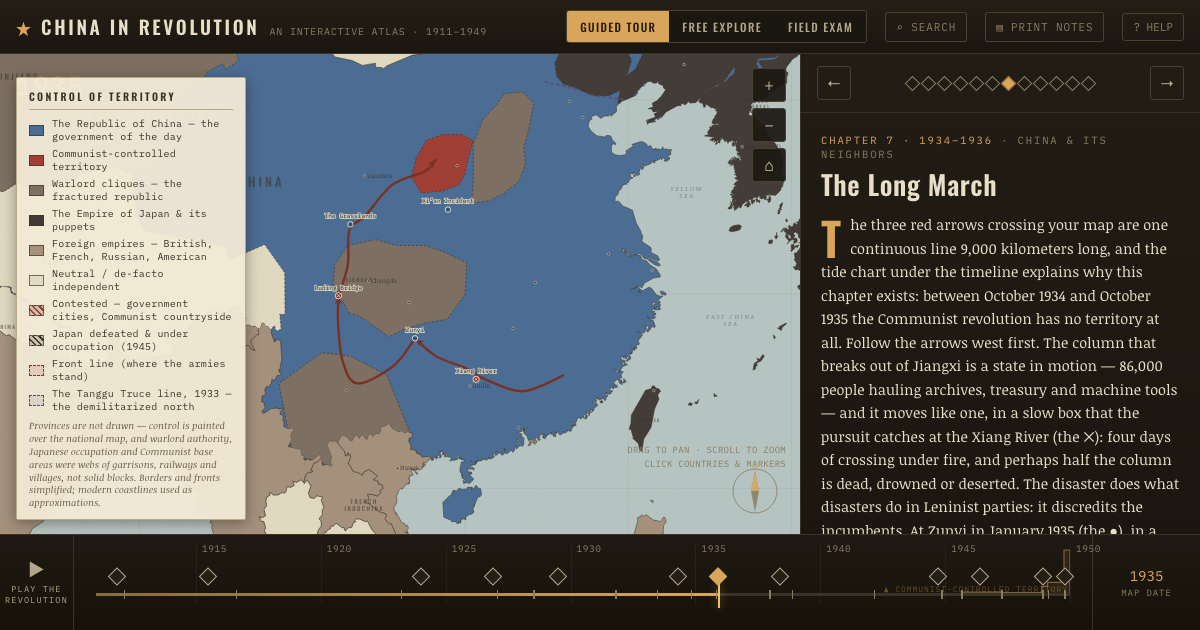
- What it changed — The breakout becomes the Long March. What leaves Ruijin in October 1934 is a moving state — printing presses, archives, an arsenal on carrying poles — headed for a defeat at the Xiang…
Then ask the room: Did the Jiangxi Soviet win its peasants by land reform — or hold them by coercion? What would evidence for each look like? The argued answer is on the chapter page →
The atlas that shows it
THE FREE PRINTABLE STUDY GUIDE
Join the Dispatch — a short welcome series, then a letter when a new atlas opens — and the printable study guide for China in Revolution is yours now, free.
NO TRACKING · YOUR ADDRESS IS USED FOR THE DISPATCH AND NOTHING ELSE · UNSUBSCRIBE ANYTIME