MAPS OF HISTORY · China in Revolution · ALL CHAPTERS · CHAPTER 6
CHAPTER 6 · 1931–1934 · 1934
The Soviet Republic and the Encirclements
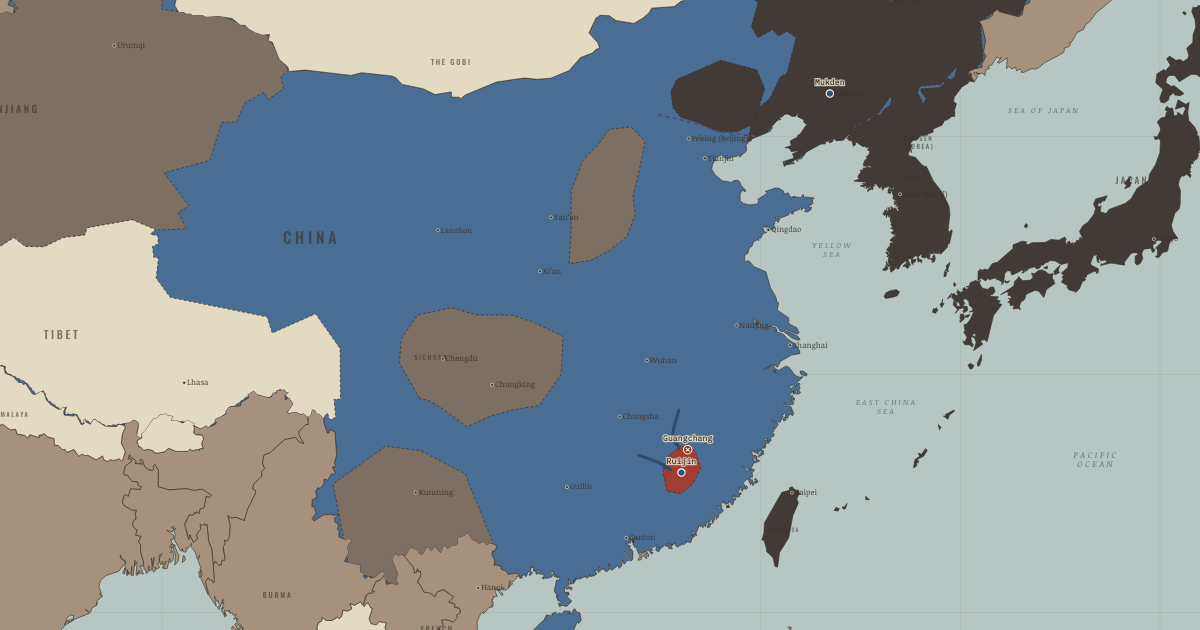
The map above is the world of 1933 — Manchukuo and the Tanggu Truce.
BRIEF EXPLANATION — THE ESSENTIAL ARGUMENT
By 1931 two rival experiments in statehood were rising against the Nationalist government at once, one imposed from outside and one from below. In the northeast Japan’s Kwantung Army seized Manchuria after staging the Mukden Incident, and the League of Nations named the aggression but would not reverse it. Chiang chose to avoid a wider war while he strengthened his own state, a calculation that preserved his forces but steadily drained his legitimacy.
In the southeast the Communists governed a rural soviet at Ruijin, holding its people through land reform, courts and currency as much as through coercion. Four mobile defenses defeated the Nationalist encirclement campaigns, but the fifth replaced pursuit with advancing blockhouses and blockade. After the costly failure at Guangchang the base could no longer survive in place, which forced the breakout later remembered as the Long March.
GUIDED EXPLANATION
An encirclement campaign works by isolating a base, cutting its supplies and destroying it from the outside inward. Within fourteen months two rival states were proclaimed against Nanjing, and the map now carries both. Consider the northeast first. On 18 September 1931 Kwantung Army officers bombed their own railway outside Mukden (the ● there), blamed China, and overran Manchuria in five months. They acted against Tokyo’s instructions and to loud Japanese public applause. In March 1932 the conquest was dressed up as “Manchukuo,” with the last Qing emperor Puyi installed as its puppet. In 1933 Jehol was annexed, and the Tanggu Truce, the dashed line along the Great Wall, demilitarized everything north of Peking as a concession by another name. Chiang, then mid-campaign against the Communists, ordered non-resistance and appealed to the League of Nations, whose commission duly reported the truth and changed nothing. The charcoal here records the world’s security system failing its first great test, eight years before Europe’s.
Turn now to the southeast, where the red patch at Ruijin (the ●) marks the Chinese Soviet Republic, proclaimed on 7 November 1931. It was a real state of some three million people, with a currency, courts, schools, conscription and a land law that took from landlords and gave to the poor, and that redistribution was its magnetism. Its terror is on the record too, since the Futian purge of 1930 had killed thousands of its own soldiers as imagined enemies. Chiang answered with the Encirclement Campaigns, and the two blue arrows show the method’s final form. The first four campaigns failed in the classic pattern. Columns lunged into the hills while the Red Army traded space, concentrated and ate them battalion by battalion. Its maxim ran that the enemy advances and we retreat, the enemy camps and we harass, the enemy tires and we attack. The fifth campaign, in 1933–34, was different, because Chiang stopped playing that game. On German advice he built thousands of blockhouses in creeping rings, advancing a few kilometers and pouring concrete, strangling the soviet’s salt, grain and trade. The set-piece defense that the party’s Moscow-trained leadership ordered at Guangchang (the ✕) failed with 5,500 casualties in April 1934. By autumn the arithmetic was final: stay and die, or break out and probably die. In October 86,000 people walked out of the map’s red patch, and the tide chart below the timeline dropped to zero.
DEEP EXPLANATION — EVIDENCE & INTERPRETATION
The Lytton Report and the limits of collective security
Manchuria was the first full test of the interwar security system, and it repays study as evidence rather than as foregone failure. The League of Nations did not ignore the crisis. It sent the Lytton Commission, whose 1932 report was a careful document that acknowledged Japan’s genuine economic interests and grievances while refusing to recognize Manchukuo as anything but the product of aggression. The League adopted the report, Japan walked out in February 1933, and Tokyo kept the territory. The mechanism this exposed is the one historians return to when they explain the 1930s. Collective security asked satisfied powers to pay real costs, in sanctions, ships and soldiers, to defend abstract rules in a region where none of them held a vital stake, and they declined. Mussolini and Hitler read the file. The defect was not that the League failed to name the aggressor, since it named him precisely. The failure was that it could not make anyone bear the price of stopping him, eight years before the same lesson was relearned in Europe.
Manchukuo: dress rehearsal for total war
The puppet state proclaimed in 1932 was far more consequential than the word “puppet” suggests. Behind the restored figurehead-emperor Puyi, Japanese reform bureaucrats and the Kwantung Army built a planned industrial economy from almost nothing, including the South Manchuria Railway’s research bureau, the Shōwa steel works at Anshan, and whole engineered cities. It served as a laboratory for state-led development free of Japan’s own parliamentary and business constraints. Historians such as Louise Young and Prasenjit Duara treat Manchukuo as the template for Japan’s wartime command economy rather than as a sideshow, and, through figures such as Kishi Nobusuke, later a Japanese prime minister, even as a template for the postwar developmental state. For this atlas the point is grimly circular. The factories built to make Manchuria the springboard for invading China proper in 1937 were captured intact by the Soviets in 1945. They then became the arsenal that helped arm the Communist armies who took China in 1948–49, so that the same industrial base served three wars, each time for a different master.
New here? Chapters 1–2 of every atlas are free to sample, and the WW2 atlas is free in full. One membership opens all thirteen — the Cartographer’s Circle.
THE SITES
ON THIS DAY
WHY IT HAPPENED
Manchuria: an army making foreign policy. The Kwantung Army acted because it could: Huanggutun had proven field officers faced no consequences. The Depression had gutted civilian government prestige in Tokyo. And Manchuria held the coal, iron and “lifeline” mythology of army planning. The conspirators (Ishiwara above all) expected — correctly — that success would be ratified. The deeper cause was constitutional: an army answerable to the throne alone, in a state where no one else could say no.
Non-resistance as a considered bet. Chiang’s “first internal pacification, then external resistance” was strategically argued, not only craven: China in 1931 had no navy, no air force to speak of, and armies that Japan had smashed in days whenever tested. Fighting then, he judged, meant losing everything. Buying time meant Germany-trained divisions, a currency, roads. The bet’s cost was paid in legitimacy — every year of non-resistance recruited for his critics, and eventually his own generals (Chapter 7’s Xi’an) called it in.
Land revolution as state-building. The soviet grew because it solved, locally and violently, rural China’s central problem: rent, debt and taxes that took half or more of a poor family’s crop. Redistribution bought the loyalty of the many with the property of the few, and conscription rode on gratitude and terror together. Note the design: the CCP was no longer organizing workers against employers but governing peasants against landlords — the strategic discovery of the entire revolution.
The Comintern line meets Chinese terrain. The soviet’s Moscow-backed leadership (the “28 Bolsheviks,” and the Comintern adviser Otto Braun) treated the base as a state to be defended at its borders — regular warfare, fixed lines. Mao’s mobile doctrine, which had beaten four campaigns, was set aside in 1932–33 with his sidelining. Against blockhouses, regular defense meant attrition China’s smaller army could only lose. Doctrine imported without terrain attached: the mistake Zunyi will spend Chapter 7 correcting.
THE TURN
Guangchang, April 1934. Mukden changed the world more, but within this chapter’s war the hinge is Guangchang: the battle that proved the Fifth Encirclement could not be out-fought by the methods the leadership insisted on, and therefore forced the breakout. Every consequence cascades from it — the Long March, Zunyi, Mao’s ascent, Yan’an. When a system fails, the pivotal moment is usually not the catastrophe but the demonstration that made the catastrophe unavoidable.
WHAT IT CHANGED
The breakout becomes the Long March. What leaves Ruijin in October 1934 is a moving state — printing presses, archives, an arsenal on carrying poles — headed for a defeat at the Xiang River that will kill half of it and discredit the leadership that ordered the column to march as a convoy. The road to Zunyi begins at Guangchang.
Manchukuo industrializes for the next war. Japan pours investment into Manchuria — railways, the Shōwa steel works, whole planned cities — building the industrial base from which it will invade China proper in 1937 and which, captured in 1945, will arm the Communists in 1946–48. The same factories serve three different wars in this atlas.
The League’s failure is filed for reference. Japan walks out of Geneva in 1933 and keeps Manchukuo. The powers accept it in practice. Mussolini and Hitler both read the file. For IB purposes this is the cleanest early case study of collective security’s core defect: it asked status-quo powers to pay real costs for abstract rules, and they declined.
FIELD QUESTION — Did the Jiangxi Soviet win its peasants by land reform — or hold them by coercion? What would evidence for each look like?
The land-reform reading has strong support: recruitment soared where redistribution ran deepest, and Nationalist restoration of landlords behind the advancing blockhouses re-taught the difference village by village. But the coercion evidence is not deniable: the Futian purge killed thousands of Red Army men as “AB League” infiltrators on confessions extracted by torture. Grain levies and conscription in the blockaded years grew as heavy as any warlord’s. And flight from the soviet rose as the ring closed. The methodological point is the valuable one: both readings draw on sources with agendas — party memoirs sanctify, Nationalist reports demonize, and the soviet’s own archives record what cadres wished to report. Chen Yung-fa and others have shown consent and coercion were not alternatives but instruments used together, in proportions that shifted with military pressure. Write that sentence into any essay on revolutionary support: mass support is rarely a fact about hearts. It is a fact about options.
AN INTERESTING FACT
The Chinese Soviet Republic behaved like a state to a degree that still surprises: it issued its own silver coins and banknotes (the “National Bank” was run out of a courtyard by Mao’s economist Lin Boqu with a staff counted on two hands), sold state bonds, and legislated. Its 1931 marriage regulations were among the most radical on earth — marriage by mutual consent, divorce on demand by either party, a ban on bride-prices — and were enforced enough to be complained about, especially by soldiers’ families. However short its life, the Ruijin state was the CCP’s dress rehearsal in currency, taxation and family law for governing a fifth of humanity.
THE DISPATCH
One short letter when a new atlas opens — and the printable study guide for China in Revolution is yours now, free.
NO TRACKING · YOUR ADDRESS IS USED FOR THE DISPATCH AND NOTHING ELSE · UNSUBSCRIBE ANYTIME