MAPS OF HISTORY · China in Revolution · ALL CHAPTERS · CHAPTER 1
CHAPTER 1 · 1911–1912 · 1911
The Fall of the Qing
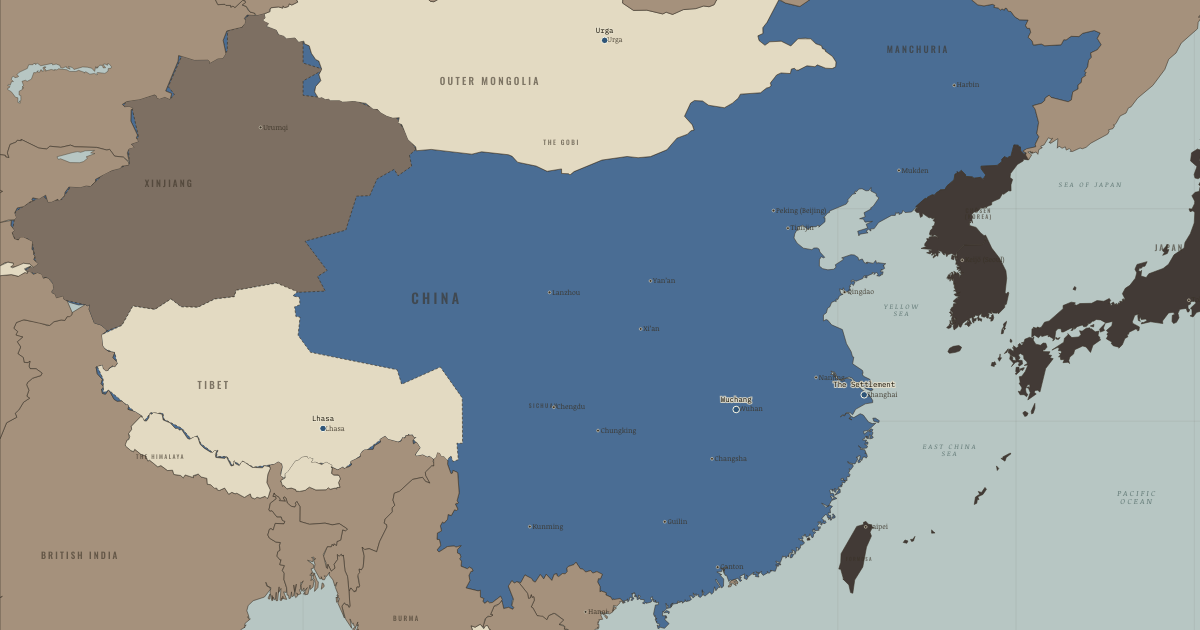
The map above is the world of 1912 — The abdication — the edges break away.
BRIEF EXPLANATION — THE ESSENTIAL ARGUMENT
This atlas turns on the difference between sovereignty, the legal right to rule a territory, and control, the practical power to enforce that rule. By 1911 the Qing dynasty, the Manchu house that had governed China since 1644, still claimed a vast empire. Yet seventy years of defeat by foreign powers, of indemnities paid from its own customs revenue, and of legal privileges surrendered to Britain, France, Russia and Japan had drained away any confidence that it could protect what it ruled. That weakness turned fatal when a conspiracy was exposed by accident at Hankou. The soldiers implicated in it mutinied at Wuchang rather than wait to be executed, and within six weeks fifteen provinces abandoned the throne, because almost no one judged the dynasty worth defending.
The child emperor Puyi abdicated in February 1912, but replacing a dynasty with a republic did not by itself create a government able to rule. Outer Mongolia declared its independence and Tibet expelled the Qing garrison, so the new republic inherited the Qing map as a legal claim rather than as settled control. That gap between what the state could assert on paper and what it could actually enforce is the problem the next thirty-eight years exist to resolve. It explains why the era must run through warlord fracture, foreign invasion and civil war before any single power can finally make the claim good.
GUIDED EXPLANATION
The distinction that governs this whole atlas is the one between sovereignty, the legal right to rule a territory, and control, the practical power to enforce that rule. The single blue expanse of 1911 concealed a state that had almost lost the second. The Qing was the oldest continuous empire in the world, yet it had been defeated by Britain twice and by France and Japan besides. It had been carved into foreign spheres of influence and forced to pay the Boxer indemnity out of customs revenue that foreigners collected on its behalf. The tan rim around China marks that external pressure, from British India and Burma to French Indochina and the Russian empire along the northern arc. The charcoal marks the sharpest threat of all in Japan, which had annexed Taiwan in 1895 and Korea in 1910 and now watched Manchuria for its opening. Foreign power reached inside the country as well, since parts of Shanghai (the ● of the International Settlement) were governed by foreign councils and exempted from Chinese law. Every movement in this atlas grew out of the determination to undo that condition.
The dynasty then fell almost by accident, which is itself the clearest measure of how little control it retained. On 10 October 1911 a bomb detonated prematurely in a revolutionary cell at Hankou (the ✕ at Wuchang). The police seized its membership rolls, and the New Army soldiers named on them mutinied that night rather than wait to be shot. Fifteen provinces declared for a republic within six weeks, less from the strength of the plotters than from the near-total absence of anyone willing to fight for the throne. The child emperor Puyi abdicated on 12 February 1912. As the center let go, the empire’s edges detached with it. Outer Mongolia declared its independence under its own Buddhist theocrat (the ● at Urga), and Tibet expelled the Qing garrison and governed itself. This is why the parchment wedge in the southwest represents a fact of power rather than a courtesy of the mapmaker. The republic had inherited the Qing’s claims without its control, and measuring how wide that gap really was is the work of the next thirty-eight years.
DEEP EXPLANATION — EVIDENCE & INTERPRETATION
Who actually ended the dynasty
The revolutionaries lit the fuse, but the decisive charge was laid by men who wanted reform rather than revolution, and recognizing this changes what 1911 was. The provincial assemblies elected in 1909 were dominated by reform-minded gentry who had spent two years petitioning the throne for a faster move toward constitutional government. When the court answered in May 1911 with a so-called imperial family cabinet, one that was heavily Manchu, bent on centralizing power, and committed to pledging the provincial railways to foreign banks, those same assemblies swung from petition to secession. Historians such as Joseph Esherick and Ichiko Chūzō therefore locate the era’s decisive actors in this constitutionalist gentry rather than in Sun Yat-sen’s revolutionary societies, because the throne had lost the very class that had always administered and financed it. What remains genuinely uncertain is how much popular discontent mattered beneath that elite defection, since the sources are richest exactly where the literate gentry wrote and nearly silent where the peasantry did not.
A Han nation inheriting a Manchu empire
The republic’s mobilizing slogan was racial, a call to expel the Manchu conquerors, and yet the territory the new state claimed was precisely Manchu imperial property. Mongolia, Tibet and Xinjiang had been held not through ordinary Chinese administration but through the Qing emperor’s separate personal relationships with each, much as a single monarch might hold several distinct crowns in one pair of hands. The moment the republic exchanged its anti-Manchu nationalism for the reassuring formula of “Five Races Under One Union” (五族共和), it exposed a contradiction it never resolved, because a nation-state was now resting its claim on an empire’s map. Outer Mongolia and Tibet, ruled through the throne rather than through China proper, reasonably judged the contract void once the contractor had abdicated. The legal disputes that followed, from the 1913–14 Simla Convention and the McMahon Line to Mongolia’s Soviet-backed autonomy, were not settled so much as postponed, and the parchment wedges on this map are that postponement made visible.
New here? Chapters 1–2 of every atlas are free to sample, and the WW2 atlas is free in full. One membership opens all thirteen — the Cartographer’s Circle.
THE SITES
ON THIS DAY
WHY IT HAPPENED
Defeat as a system, not an event. From the Opium War (1839–42) to the Boxer Protocol (1901), every generation of Qing statesmen lost a war and paid for it in ports, tariffs and legal immunities for foreigners. The humiliations compounded: customs revenue pledged to indemnities could not build a navy. A navy built in the 1880s was sunk by Japan in 1895. By 1911 the dynasty’s core claim — that it could protect the civilization it governed — had been falsified in public, repeatedly, for seventy years.
Reform that armed its own gravediggers. After 1901 the Qing tried everything at once: abolished the ancient examination system (1905), built New Armies on the German model, promised a constitution. Each reform manufactured enemies. The examination’s end orphaned a scholar class and sent students to Japan, where they met revolutionaries. The New Armies gave provinces modern soldiers who owed the throne nothing — Wuchang was a New Army mutiny. States are most fragile mid-reform, when the old legitimacy is dismantled and the new one not yet built.
The railway fuse. In May 1911 the court nationalized the provincial railway companies and pledged the lines to foreign lenders — expropriating the gentry investors of Sichuan and Hunan at a stroke. The Railway Protection movement put respectable provincial elites in the streets months before Wuchang. The troops sent to suppress Sichuan’s protests came from the very Hubei garrisons that then rose. The dynasty’s last act was to teach its natural supporters that Peking was the enemy.
A revolutionary idea already in place. Sun Yat-sen’s alliance had staged and lost ten risings since 1895, and its real work was elsewhere: in student journals, in overseas Chinese remittances, in the New Army cells that turned a police raid into a mutiny. Republicanism in 1911 was thin — few Chinese had voted for anything. But the alternative had simply expired. As one revolutionary put it, the dynasty was not overthrown. It collapsed.
THE TURN
Wuchang, 10 October 1911. The hinge is not the bomb but the response: fifteen provinces seceded from the dynasty in six weeks, almost bloodlessly, because provincial elites and New Army officers everywhere made the same private calculation — nothing was worth defending. When a state falls that easily, the revolution has not won power. It has found power lying in the street. Who actually picks it up (an army-builder, not the republicans) is Chapter 2, and the whole era follows from that answer.
WHAT IT CHANGED
A republic without republicans. The provisional government at Nanjing has a flag, a calendar and Sun Yat-sen. It has no army. Within six weeks it trades the presidency to Yuan Shikai, the one man whose Beiyang Army can compel the abdication. The revolution’s first act is to hand itself to a general. The pattern will repeat.
The empire’s edges detach. Mongolia (1911) and Tibet (1912–13) leave with the dynasty that had ruled them, and no Chinese government accepts either departure. Every later regime — warlord, Nationalist, Communist — inherits the claim to the whole Qing map. The gap between claim and control on these edges runs to 1951 and beyond.
Japan takes notes. Tokyo watches a great empire dissolve into provinces and concludes that China is not a state but an opportunity — a lesson it applies in Shandong in 1914 and in the Twenty-One Demands of 1915. The strongest single force in the next four decades of this map is the Japanese army’s reading of Chinese weakness.
FIELD QUESTION — Was 1911 a revolution at all — or the collapse of a dynasty that revolutionaries happened to be standing near?
The case for collapse is strong: the risings Sun’s movement actually planned all failed. Wuchang succeeded by accident. Power passed not to republicans but to provincial elites and the Beiyang generals — continuity of local power wearing a new flag. But Joseph Esherick and others point out what changed underneath: the monarchy, the cosmology of the Mandate of Heaven, and the Confucian examination elite all ended within a decade, and no one seriously tried to restore them (Yuan’s attempt, Chapter 2, was laughed and fought off the stage in months). A useful formulation: 1911 was a thin political revolution that opened the door to the thick social ones — May Fourth, the party-states, land revolution. This took four more decades to walk through it. Judge revolutions less by the day power changes hands than by what can no longer be said or restored afterward.
AN INTERESTING FACT
Sun Yat-sen learned of the Wuchang rising from a newspaper — in Denver, Colorado, mid-way through a fundraising tour of overseas Chinese communities. Rather than sail straight home he went the long way, via London and Paris, trying to secure diplomatic recognition and a halt to foreign loans for the Qing. He reached Shanghai on 25 December 1911, was elected provisional president four days later, and held the office for six weeks before trading it away to Yuan Shikai for the abdication. The republic’s founding father spent its founding abroad — a fair emblem of how far the revolution ran ahead of the revolutionaries.
THE DISPATCH
One short letter when a new atlas opens — and the printable study guide for China in Revolution is yours now, free.
NO TRACKING · YOUR ADDRESS IS USED FOR THE DISPATCH AND NOTHING ELSE · UNSUBSCRIBE ANYTIME