MAPS OF HISTORY · China in Revolution · ALL CHAPTERS · CHAPTER 2
CHAPTER 2 · 1912–1916 · 1915
Yuan Shikai’s Republic
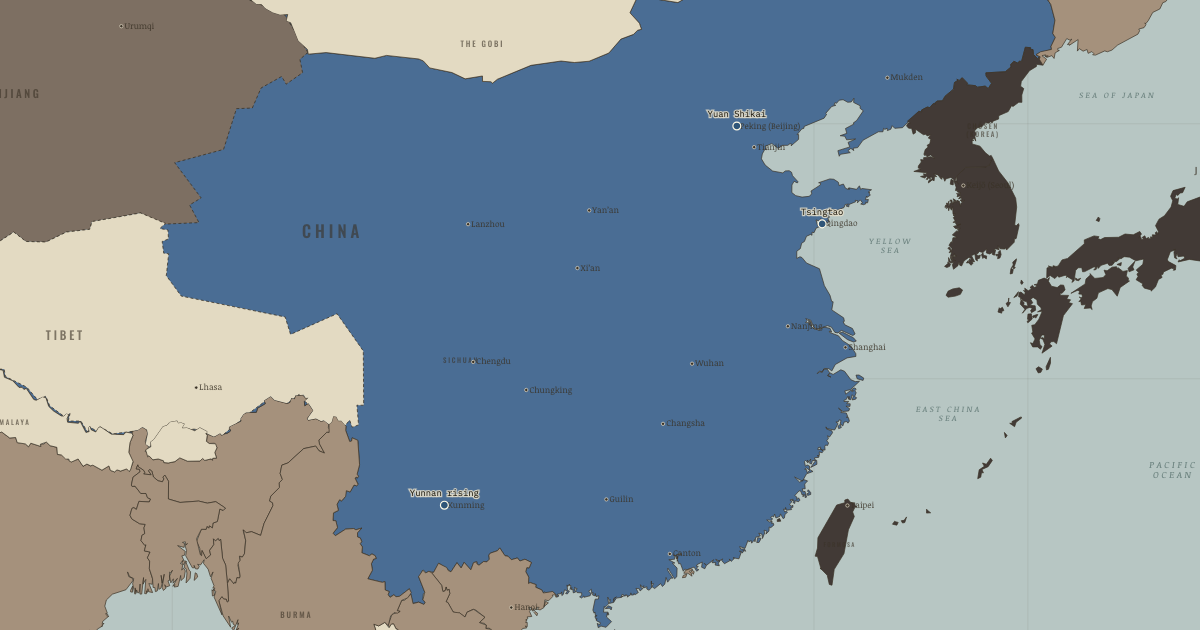
The map above is the world of 1912 — The abdication — the edges break away.
BRIEF EXPLANATION — THE ESSENTIAL ARGUMENT
Yuan Shikai dominated the early republic because the Beiyang Army, the modern force he had built for the Qing, answered to him personally rather than to any institution. He used that power to crush the Nationalists, dissolve parliament and rewrite the constitution, which produced a kind of order for a time. The order proved brittle, however, because it tied the whole state to a single patron instead of to rules and offices that could outlast him.
Japan exposed China’s weakness in 1915 with the Twenty-One Demands, a bid to turn the country into a protectorate that Yuan partly resisted and partly conceded. He then overreached by trying to restore monarchy, which provoked the National Protection War from Yunnan; provinces deserted him, his own officers withheld their support, and the new empire collapsed after only eighty-three days. When Yuan died in 1916 his personal system died with him, and the fracture into rival military cliques that followed set the shape of the next decade.
GUIDED EXPLANATION
The blue on this map stayed a single piece through these years, yet that unity was already a fiction, and the reason lies in how power was actually held. Yuan Shikai (the ● at Peking) was the most powerful man in China because the Beiyang Army belonged to him personally, its officers owing their careers to him rather than to the republic, and an army built on personal loyalty can guarantee order only for as long as its one patron lives. He used it without restraint. When Sun Yat-sen’s new Nationalist Party won the republic’s first genuine election in 1913, its parliamentary leader Song Jiaoren was shot at Shanghai station, with the trail of telegrams running embarrassingly close to Yuan’s own premier, and the party’s armed “Second Revolution” that summer was crushed within weeks. Parliament was then dissolved and the constitution rewritten, so that by 1914 the republic had become a presidency for life served by a legislature of appointees. Government now rested on one man’s army, which meant it could last only as long as that one man did.
Two shocks then destroyed him. In 1914 Japan entered the World War, seized Germany’s Shandong concession at Tsingtao (the ● on the coast), and in January 1915 presented Yuan with the Twenty-One Demands, a program for reducing China to a protectorate through claims on Manchuria, mining and ports, together with a final group of “wishes” that would have placed Japanese advisers inside the Chinese state itself. Yuan leaked the demands to the foreign press, won a measure of world sympathy, dropped the worst group and accepted the rest, and the date of signature, 9 May, is still taught in schools as National Humiliation Day. He then reached for the throne, proclaiming a new dynasty in December 1915, and the southwest answered with war (the ✕ at Kunming) as Yunnan’s generals marched their National Protection Army north, province after province defected, and his own Beiyang lieutenants declined to save him. He cancelled the monarchy after 83 days and died in June 1916, and from the next snapshot onward the map became a market of rival armies, because the state had rested on him alone.
DEEP EXPLANATION — EVIDENCE & INTERPRETATION
The parliamentary road, and its murder
It is tempting to read Yuan’s dictatorship backward as inevitable, but the winter of 1912–13 held a real alternative that his own choices closed off. China’s first national elections returned a plurality for the Nationalists under Song Jiaoren, a gifted man of thirty who campaigned openly for a cabinet answerable to parliament, which was the one moment when representative government had genuine institutional traction. His assassination at Shanghai station in March 1913 is among the most forensically argued events in Republican history, and the telegraph trail led to Yuan’s premier Zhao Bingjun and, most historians conclude, no further than plausible deniability from Yuan himself. The evidentiary detail matters for judging the man, because a strongman who inherits chaos and reluctantly centralizes is one kind of ruler, while a president who has his likely successor shot before parliament can even convene is another. The bullet rather than the ballot tells us which China Yuan was building, and it was fired a year and a half before he reached for a throne.
How a diplomatic defeat became a ritual
The Twenty-One Demands failed as an act of annexation and succeeded as a lesson, and tracing how a defeat hardens into a ritual explains much of what follows. Yuan’s decision to leak the secret ultimatum to the foreign press was a distinctly modern tactic, mobilizing both world opinion and domestic outrage against Tokyo, and the date on which he signed the reduced version, 9 May 1915, entered China’s school calendar as National Humiliation Day, one of the first state-sponsored anniversaries of grievance in the country’s history. Historians of nationalism such as Paul Cohen and Henrietta Harrison mark the reorientation it produced, since a movement that had defined itself against the Manchus, and had remained ambivalent about the West, now acquired a single concrete external enemy in Japan together with a public ritual for remembering it. Every boycott, strike and student march later in this atlas drew on the emotional vocabulary those demands created, so that the injury outlived the injury’s original cause.
New here? Chapters 1–2 of every atlas are free to sample, and the WW2 atlas is free in full. One membership opens all thirteen — the Cartographer’s Circle.
THE SITES
ON THIS DAY
WHY IT HAPPENED
An army with a state attached. The Beiyang Army was built by Yuan in the 1890s–1900s as the Qing’s modern force, and its loyalty was structured like a patronage firm: commanders promoted by Yuan, paid through Yuan, married into Yuan’s network. When the republic put this firm at its center, it inherited the firm’s logic — authority flowed from the paymaster, not the constitution. Every warlord of Chapter 3 is a Beiyang alumnus or a provincial imitator of the model.
A constitution nobody would die for. The 1912 settlement was a bargain among elites, not a mass conviction: 40 million men were nominally enfranchised in the 1912–13 elections, but the electorate that mattered wore uniforms. When Yuan broke the rules — Song’s murder, the dissolved parliament — no institution could impose a cost on him. Only another army could, which is precisely the lesson the provinces learned and applied in 1915–16.
Japan moves into the vacuum. The World War withdrew every European restraint at once: Britain needed Japan’s navy, Russia was drowning, Germany was the enemy. The Twenty-One Demands were opportunism with a timetable. Although the worst clauses failed, Shandong stayed Japanese, and the precedent stood: China’s sovereignty was negotiable whenever the world was busy. The next time the world was busy would be 1931.
The monarchy miscalculation. Yuan’s advisers (including an American constitutional scholar, Frank Goodnow, whose memo on monarchy was quoted well past its intent) told him China needed a throne’s legitimacy. But 1911 had not transferred the Mandate of Heaven — it had abolished it. The provincial risings of 1915–16 were not republican idealism. They were provincial militarism discovering it could veto the center. That discovery, not the monarchy’s failure, is the chapter’s real event.
THE TURN
The National Protection War, 25 December 1915. When Cai E’s Yunnan armies rose against the monarchy and won, they proved something more dangerous than Yuan’s unpopularity: that a coalition of provincial armies could unmake a central government. Every clique on the next chapter’s map is an application of that theorem. The hinge of 1912–16 is not that Yuan failed to found a dynasty — it is that the price of stopping him was teaching the provinces their own strength.
WHAT IT CHANGED
The fracture becomes the system. Yuan’s lieutenants — Duan Qirui, Feng Guozhang, Cao Kun — inherit pieces of the Beiyang machine and fight each other for the husk of the Peking government, whose recognition and customs revenue are worth capturing. The grey-tan plates of the next snapshot are his estate in probate.
Nationalism finds its grievance. The Twenty-One Demands and the Shandong seizure give the new nationalism a date, an enemy and a vocabulary. When Versailles confirms Japan in Shandong in 1919, the students who march (Chapter 3) are marching against this chapter’s unfinished business.
Sun Yat-sen starts over. Exiled again, Sun concludes that parliaments without armies are theater, and begins looking for a patron who will fund a party with a gun. The search fails with the Western powers and succeeds, in 1923, with Moscow — the decision from which Chapters 4 and 5 descend.
FIELD QUESTION — Was Yuan Shikai the republic’s betrayer — or the only man who could have held it together, destroyed by an impossible job?
The betrayal case writes itself: a murdered opposition leader, a dissolved parliament, a purchased emperorship. The revisionist case deserves a hearing: Yuan inherited a bankrupt state whose provinces had just discovered they could secede, with Japan probing every weakness, and he was the only actor with an instrument of national power. His fiscal and administrative centralization was what any state-builder would have attempted. But the two cases converge on the same verdict: by locating all authority in his person and none in institutions, he guaranteed that his death — from natural causes, at 56 — would be a constitutional catastrophe. Compare him with contemporaries who built parties rather than patronage networks: strongman rule is not a form of state-building. It is a substitute for it, and the bill arrives with the strongman’s obituary. That is the IB paradigm case for evaluating authoritarian “stability.”
AN INTERESTING FACT
Yuan’s empire was cancelled so fast that its artifacts outran it. The reign was to be called Hongxian — “Constitutional Abundance” — and it existed officially for 83 days, from 1 January to 22 March 1916, without a coronation ever taking place. But the machinery of monarchy had already been set in motion: Hongxian coins and stamps had been struck and printed, and a porcelain works at Jingdezhen produced “Hongxian” marked wares. The leftovers of the 83-day dynasty are now collectors’ items — a museum case of how much easier it is to manufacture an emperor’s objects than an emperor’s legitimacy.
THE DISPATCH
One short letter when a new atlas opens — and the printable study guide for China in Revolution is yours now, free.
NO TRACKING · YOUR ADDRESS IS USED FOR THE DISPATCH AND NOTHING ELSE · UNSUBSCRIBE ANYTIME