ON THIS DAY ·
National Protection War
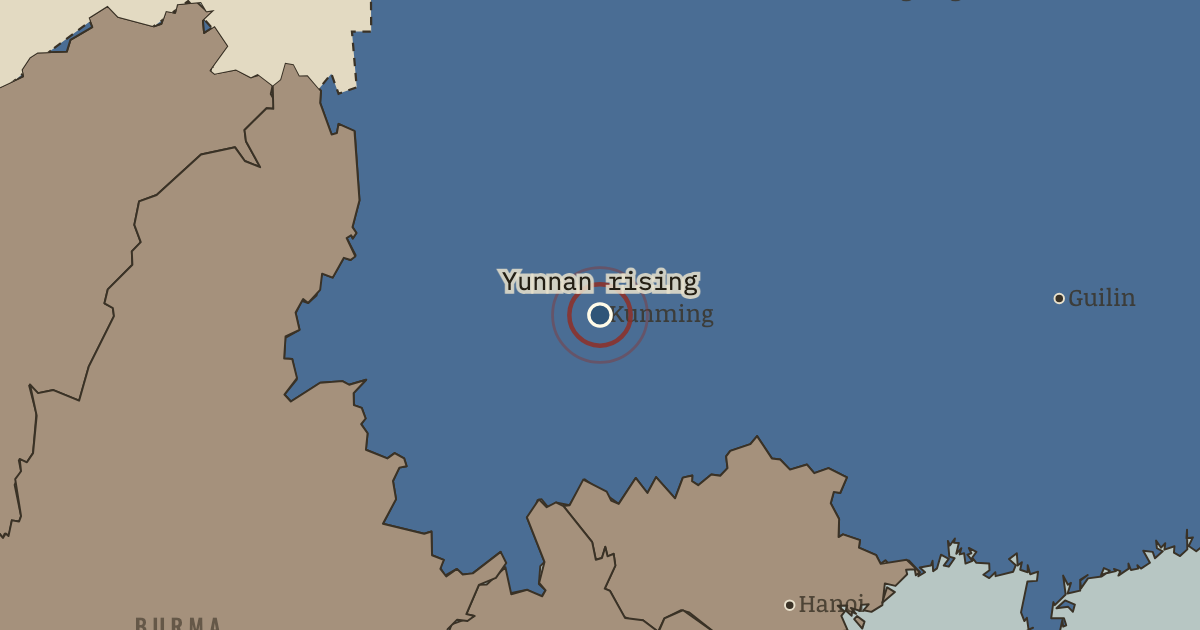
25 Dec 1915 — Yunnan’s generals declare war on Yuan’s monarchy, and the southwest follows. They win — but the precedent is fatal: provincial armies have unmade a central government, and they will remember that they can.
WW2 is free — every chapter. Try chapters 1–2 of any 2 other atlases (3 with a free account). Opening a new atlas uses one of them. Membership opens all 21 — Join.
Free printable Chinese Revolution study guide, sent by email ↓
The moment in context
The blue on this map stayed a single piece through these years, yet that unity was already a fiction, and the reason lies in how power was actually held. Yuan Shikai (the ● at Peking) was the most powerful man in China because the Beiyang Army belonged to him personally, its officers owing their careers to him rather than to the republic, and an army built on personal loyalty can guarantee order only for as long as its one patron lives. He used it without restraint. When Sun Yat-sen’s new Nationalist Party won the republic’s first genuine election in 1913, its parliamentary leader Song Jiaoren was shot at Shanghai station, with the trail of telegrams running embarrassingly close to Yuan’s own premier, and the party’s armed “Second Revolution” that summer was crushed within weeks. Parliament was then dissolved and the constitution rewritten, so that by 1914 the republic had become a presidency for life served by a legislature of appointees. Government now rested on one man’s army, which meant it could last only as long as that one man did.
From Yuan Shikai and the early republic, chapter 2 of China in Revolution, 1911–1949 (1915).
The place: National Protection War — map and full story →
Teach this in 5 minutes
- Why it happened — An army with a state attached. The Beiyang Army was built by Yuan in the 1890s–1900s as the Qing’s modern force, and its loyalty was structured like a patronage firm: commanders…
- The turn — The National Protection War, 25 December 1915. When Cai E’s Yunnan armies rose against the monarchy and won, they proved something more dangerous than Yuan’s unpopularity: that a coalition of…
- What it changed — The fracture becomes the system. Yuan’s lieutenants — Duan Qirui, Feng Guozhang, Cao Kun — inherit pieces of the Beiyang machine and fight each other for the husk of the Peking…
Then ask the room: Was Yuan Shikai the republic’s betrayer — or the only man who could have held it together, destroyed by an impossible job? The argued answer is on the chapter page →
The atlas that shows it
THE FREE PRINTABLE STUDY GUIDE
Join the Dispatch — a short welcome series, then a letter when a new atlas opens — and the printable study guide for China in Revolution is yours now, free.
NO TRACKING · YOUR ADDRESS IS USED FOR THE DISPATCH AND NOTHING ELSE · UNSUBSCRIBE ANYTIME