MAPS OF HISTORY · Indian Independence & Partition · ALL CHAPTERS · CHAPTER 1
CHAPTER 1 · 1905 · JAN 1905
The Raj at High Noon
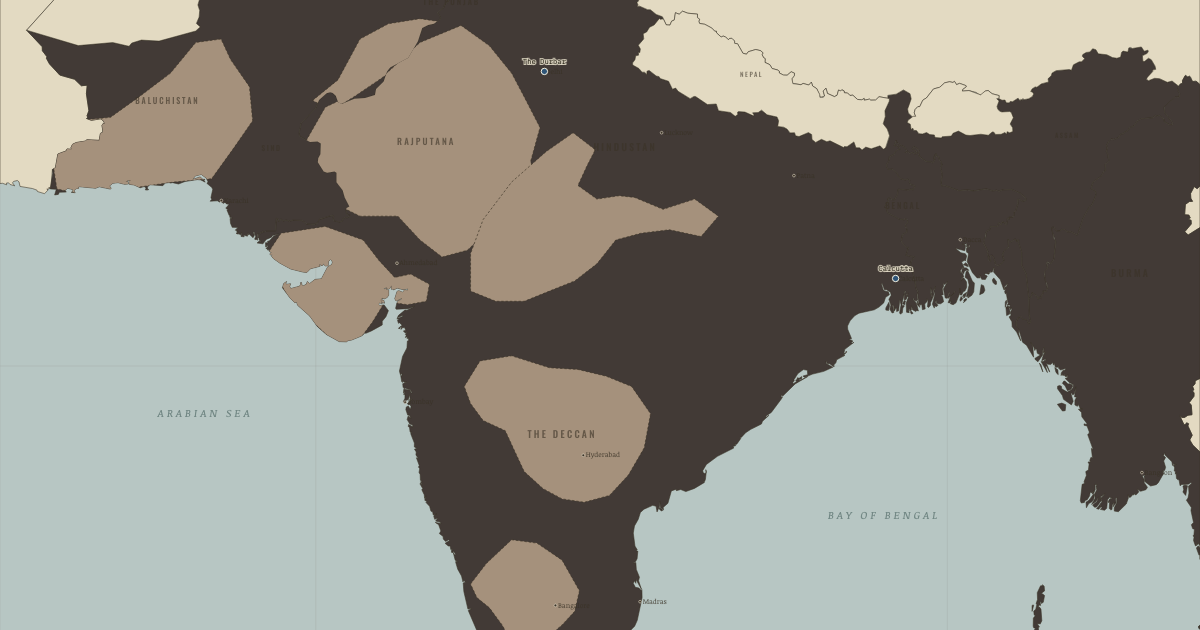
The map above is the world of 1905 — The Raj at high noon.
BRIEF EXPLANATION — THE ESSENTIAL ARGUMENT
The question this atlas sets out to answer is how the largest colony in history came to free itself, and the answer begins with the Raj at its most confident. In 1905 the British claimed authority over roughly 300 million people, about a fifth of humanity. Yet direct British administration covered only part of the map. Alongside the governed provinces lay some 565 princely states, two-fifths of the land, each left under its own maharaja, nawab or nizam. These were bound to the Crown by a relationship called paramountcy, in which Britain controlled a state’s army and foreign affairs while leaving its internal rule untouched, much as a dominant power today can direct a client government abroad without running its daily business at home.
This patchwork was possible only because the Raj governed far more by consent than by force. A few thousand British officials could never have held the subcontinent otherwise, and the whole apparatus depended on Indian soldiers, clerks, taxpayers, princes and professionals to work at all. In 1905 that cooperation still held, and the Indian National Congress was a cautious annual gathering of educated men asking for a larger share in their own government. The argument of the atlas is that this dependence was the Raj’s hidden weakness, because a system built on the participation of the ruled can be dismantled the moment they withdraw it.
GUIDED EXPLANATION
The scale of the Raj becomes intelligible only through its arithmetic. A single viceroy, answerable to London, governed some 300 million people through only about 1,100 covenanted civil servants and an army that Indians themselves largely paid for. Lord Curzon, the ablest and most self-assured of the viceroys, had staged that apparent permanence at the Delhi durbar of 1903, a Mughal-style pageant in which 173 princes rode past in strict order of gun-salute so that empire could perform its own eternity. Yet the pageant concealed how little of the map the Crown actually ruled directly. Two-fifths of the land was the tan patchwork of the princely states, ranging from Hyderabad — larger than France, with sixteen million subjects — down to estates of a single village, each under its own maharaja, nawab or nizam through the relationship of paramountcy. The Raj was therefore many legal arrangements at once: direct provinces, treaty princes, leased tracts and frontier agencies. Grasping that unevenness is the first step to understanding how it later came apart.
The system’s deepest secret was that it ran on Indian participation at every level. Indians filled the clerical grades of the civil service, served in the army and collected the land revenue, while perhaps 150,000 Britons lived among 300 million Indians. Empire therefore depended on Indian consent, Indian salaries and Indian collaboration, and its own officials understood the dependence exactly. “As long as the educated Indian is with us,” one wrote, “we are safe.” Those educated Indians had founded the Indian National Congress in 1885, and twenty years on it remained a decorous yearly conference of lawyers petitioning for a larger share in their own government. In 1905 that consent still held firm. The rest of this atlas explains how it was withdrawn, until the charcoal of British rule, having stood almost unchanged for forty years, ceased to exist in a single August.
DEEP EXPLANATION — EVIDENCE & INTERPRETATION
The thin white line and the puzzle of collaboration
The arithmetic that opens this chapter — a few thousand Britons ruling three hundred million people — is more than a striking statistic, because it set a puzzle that has shaped the history ever since. If the Raj rested on Indian participation, then explaining both its long endurance and its eventual fall requires explaining Indian behaviour rather than British policy alone. The historians Robinson and Gallagher described empire as a system of “collaborating elites,” Indians who cooperated because the colonial state served their local interests. The Cambridge School that followed, associated with Anil Seal and Gordon Johnson, pushed this hard, reading Indian nationalism substantially as elite competition for the offices and patronage the state dispensed. Nationalist historians objected that this drained the freedom struggle of conviction, and the Subaltern Studies scholars led by Ranajit Guha answered from below, insisting that peasants and workers pursued a politics of their own that no elite controlled. The debate remains open, and this atlas keeps all three explanations in view, because a map that changed as much through consent withdrawn as through force applied needs each of them.
The Drain: an argument still being counted
Dadabhai Naoroji’s charge that Britain drained wealth from India in a one-way transfer began as a political weapon in 1901 and remains a live quantitative dispute more than a century later. The mechanism itself is not in doubt: India ran large export surpluses whose proceeds were absorbed in London as “Home Charges” — pensions, army costs, guaranteed railway dividends and the India Office’s expenses — instead of returning to India as payment. What historians argue about is the scale and the counterfactual. Nationalist and recent revisionist economists, among them Utsa Patnaik, treat the transfer as the engine of India’s impoverishment and put it in the trillions over two centuries, while sceptics reply that the annual flow was a modest share of national income and that railways and irrigation returned some value. The firmer related finding is deindustrialization, since India’s share of world manufacturing output fell steeply across the nineteenth century as British machine cloth displaced its handlooms. The precise ledger is contested, yet the basic fact is not: the empire was run so as to be paid for by the very people it governed.
New here? Chapters 1–2 of every atlas are free to sample, and the WW2 atlas is free in full. One membership opens all thirteen — the Cartographer’s Circle.
THE SITES
ON THIS DAY
WHY IT HAPPENED
Conquest completed, confidence at its peak. By 1905 the conquest phase was a half-century past — the Mutiny of 1857 crushed, the Crown ruling directly since 1858, the frontier fixed against Russia in the Great Game. Curzon could tell himself the Raj was “the miracle of the world” because no serious challenge had yet been mounted. The confidence mattered: it made the government careless of Indian opinion at the exact moment Indian opinion was organizing.
The quilt, not the monolith. Britain deliberately preserved the princely states after 1857 — loyal buffers, cheap to run, a firewall of tradition against nationalism. The result was the patchwork this map paints in tan: two-fifths of the land and a quarter of the people outside British India proper, with no elections, no Congress branches, and rulers whose treaties ran to the Crown personally. In 1947 that legal firewall would become the era’s last crisis: 565 separate sovereignties to be gathered in ten weeks.
An educated class with nowhere to rise. The universities Britain founded in 1857 produced graduates faster than the Raj would employ them: by 1905 the ICS remained almost entirely white at the top, and the “statutory Indian” faced examinations held only in London. Congress was born of this blocked elite — English-speaking lawyers and editors who took the Raj’s own liberal rhetoric seriously and asked for its application. Refusing that modest ask radicalized a generation.
Land revenue and the drain. The Raj paid for itself from the Indian land tax and paid Britain a “Home Charge” besides — pensions, army costs, guaranteed railway dividends flowing to London. Nationalist economists (Dadabhai Naoroji’s Poverty and Un-British Rule, 1901) named this the Drain, and tied it to the famines of the 1890s that had killed millions. The economic critique preceded the political one, and outlasted it.
THE TURN
The Delhi durbar, 1 January 1903. Curzon’s durbar is the hinge because nothing happens: an empire at its absolute zenith stages a Mughal ceremony to declare itself eternal, with the princes arranged by gun-salute and the Indian masses as audience. Historians read it two ways — as the Raj’s high noon, or as the moment its theatricality outran its consent. Both are true. Every chapter that follows is the unravelling of what this pageant claimed was permanent, and the durbar ground itself sits ten miles from where Nehru will raise the tricolour in 1947.
WHAT IT CHANGED
Curzon overreaches within the year. The same confidence that staged the durbar partitioned Bengal in 1905 — an administrative stroke Curzon believed too obviously rational to resist. It detonated the first mass movement of Indian nationalism and cost him his office. Hubris, then nemesis, in twenty-four months.
The princes are bound to the Crown, not to India. Paramountcy meant the princely treaties ran to the King-Emperor personally — so when Britain left, the lawyers could argue the states reverted to full sovereignty. That doctrine, harmless in 1905, is the loaded gun of 1947: Hyderabad, Junagadh and Kashmir will each fire it.
Consent becomes the battlefield. Because the Raj ran on Indian cooperation, the nationalist discovery of the era was that consent could be withdrawn — by boycott, by resignation, by sitting down. Every campaign in this atlas, from Swadeshi to Quit India, is a variation on that single insight, and the Raj’s answer — force — spent its legitimacy a little further each time.
FIELD QUESTION — The Raj governed 300 million people with a few thousand British officials. Was that a sign of strength or of fragility?
Both, in sequence. As long as no coordinated challenge existed, thinness was strength: it made empire cheap, and the visible collaboration of princes, landlords and clerks made rule look consensual. But the arithmetic meant the Raj had no reserve against a genuine withdrawal of cooperation — it could coerce a district, not a subcontinent. The nationalist movement’s core discovery, made in stages from Swadeshi to Non-Cooperation to Quit India, was precisely this: the Raj was a confidence trick that required Indians to keep performing it. Once tens of millions stopped — stopped buying, stopped clerking, stopped obeying — Britain faced a choice between mass repression it could not afford (financially after 1918, morally after Amritsar, strategically after 1945) and withdrawal. The lesson travels: systems that rule through collaboration are strongest-looking exactly when they are most brittle.
AN INTERESTING FACT
The durbar’s official guest of honour was not the King-Emperor at all: Edward VII declined to come, sending his brother the Duke of Connaught, so Curzon — to widespread comment — took the royal salute himself from the dais. The viceroy also used the occasion to announce a remission of taxes, and privately fumed that the princes’ jewels outshone the government’s display; the Gaekwad of Baroda arrived with the famous seven-strand diamond necklace. Within three years Curzon had resigned after losing a bureaucratic duel with Kitchener over control of the army — the most powerful man in Asia, undone not by nationalism but by another Englishman.
THE DISPATCH
One short letter when a new atlas opens — and the printable study guide for Indian Independence & Partition is yours now, free.
NO TRACKING · YOUR ADDRESS IS USED FOR THE DISPATCH AND NOTHING ELSE · UNSUBSCRIBE ANYTIME