MAPS OF HISTORY · Indian Independence & Partition · ALL CHAPTERS · CHAPTER 8
CHAPTER 8 · 1939–1941 · MAR 1940
The War Claims India
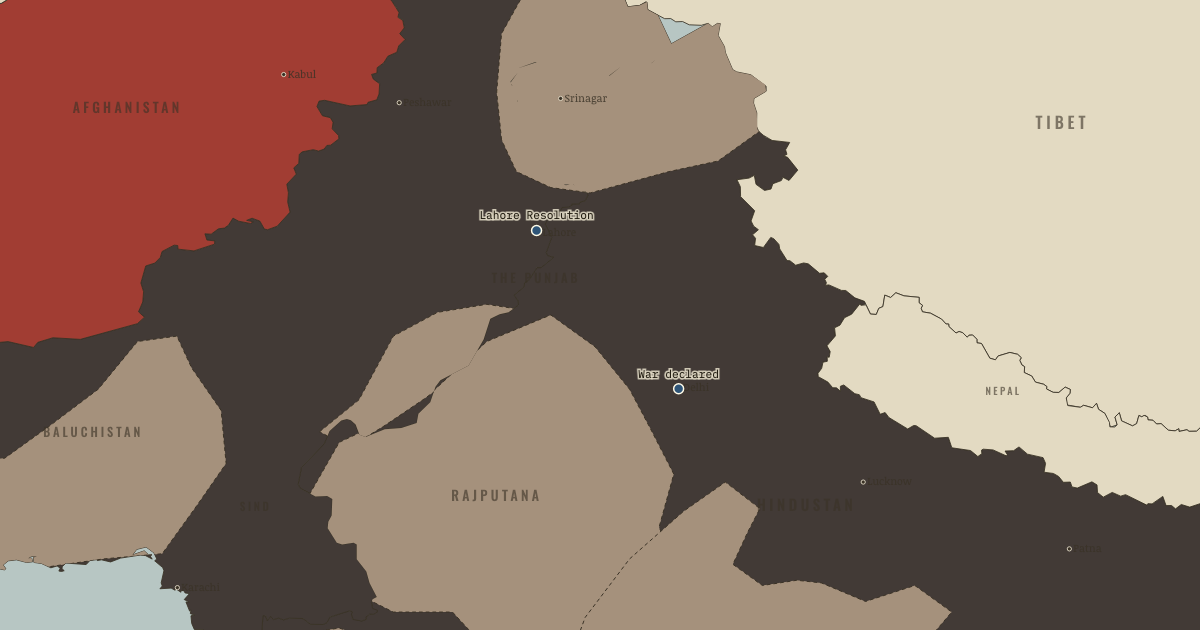
The map above is the world of NOV 1939 — The ministries resign.
BRIEF EXPLANATION — THE ESSENTIAL ARGUMENT
The Second World War hardened the divide between Congress and the League by exposing how little Indian consent the Raj actually required. In September 1939 the Viceroy declared India at war with Germany without consulting a single elected Indian leader, and the Congress provincial ministries resigned in protest, arguing that a war proclaimed for freedom could not be waged through an unfree India. The Muslim League drew the opposite lesson, staying engaged and marking the resignations as a “Day of Deliverance” from Congress rule. Each choice widened the political gap that the rest of the war would deepen.
In 1940 the League answered the empty political stage with the Lahore Resolution, which demanded autonomous Muslim-majority units in the north-west and north-east while leaving their final form deliberately vague. At the same time Subhas Chandra Bose broke with Gandhi’s timetable and went abroad to seek foreign help against Britain by force. The war strengthened the Raj’s coercive power in the short term, since the army grew tenfold, yet it also made one question impossible to postpone any longer, which was who now had the right to speak for India.
GUIDED EXPLANATION
The war opened by demonstrating the exact grievance that the war’s own rhetoric of freedom made indefensible, power exercised without consent. On 3 September 1939 Viceroy Linlithgow declared that India was at war with Germany, consulting no Indian because constitutionally he needed no one’s agreement. Congress’s position was intricate and honest, since its leaders loathed fascism yet would cooperate only in exchange for a clear price, a promise of independence after victory and a share of power at the centre now. London, soon led by Churchill, refused to buy that cooperation with the dissolution of the empire. So in the autumn of 1939 the eight Congress ministries resigned, and elected India walked out of office, emptying the political stage for whoever would fill it. Jinnah proclaimed a “Day of Deliverance” from Congress rule, and the Viceroy discovered a priceless wartime ally in a Muslim League whose support cost only recognition and usefully divided the demand for freedom.
The League filled the vacated stage with the most consequential resolution of the era. On 23 March 1940, at Lahore, it resolved that the Muslim-majority zones of the north-west and north-east should be grouped as independent states whose constituent units would be autonomous and sovereign. The text was a lawyer’s masterpiece of ambiguity, leaving unclear how many states were meant and inside what larger structure, and the word Pakistan appeared nowhere in it. Jinnah’s speech supplied the theory, arguing that Islam and Hinduism were “different and distinct social orders” rather than religions in the ordinary sense, so that Muslims formed a nation and a nation was owed a state. Historians still dispute what Lahore was, with Ayesha Jalal reading it as the opening bid of a bargainer who wanted parity inside a union, and others reading its ambiguity as cover for exactly the partition that followed. On the map nothing moved, yet in the argument everything had, because from March 1940 the question was no longer whether India would be free but whether it would remain one country.
DEEP EXPLANATION — EVIDENCE & INTERPRETATION
Bose: the armed road, and how much it mattered
Every account of Indian freedom is shadowed by the road Subhas Chandra Bose tried to take. Twice elected Congress president, a socialist impatient with Gandhi’s pace and Britain’s good faith, Bose broke with the leadership, escaped house arrest in 1941, and made his way to Berlin and then Tokyo to raise the Indian National Army from prisoners of war under Axis patronage. Militarily the venture failed, since the INA was broken alongside the Japanese at Kohima and Imphal in 1944. Its afterlife was another matter. The 1945 trials of INA officers at the Red Fort produced a wave of sympathy that crossed communal lines as little else did, and the mutinies that followed, above all in the Royal Indian Navy, helped convince London that the loyalty of the Indian armed forces, the ultimate foundation of the Raj, could no longer be assumed. This has fed a durable counter-thesis, popular in India and taken seriously by some historians, that it was Bose’s soldiers rather than Gandhi’s satyagrahis who finally made India ungovernable. The measured view keeps both, because mass non-violence had hollowed the Raj’s legitimacy for decades, while the visible cracking of its sword arm in 1945–46 supplied the final and decisive fright.
Two nations: discovered, or declared into being?
Jinnah’s Lahore claim that Hindus and Muslims were “different and distinct social orders,” two nations owed two states, is usually debated as a factual proposition, true or false about Indian society. The more searching question is whether it described a reality at all or helped to create the one it claimed to observe. Against the descriptive reading stands a mountain of counter-evidence: centuries of shared language, shrines, music and locality; a Muslim quarter of the population dispersed across the whole subcontinent rather than gathered in one homeland; and the Frontier’s Muslim mass movement voting for a united India. In favour of the second reading stands the modern understanding, associated with Benedict Anderson, that nations are imagined into being rather than found lying ready in the demographic data. On this view the two-nation theory summoned a division rather than reporting one, and every later act of the drama, the separate electorate, the mass campaign, the ballot fought as a profession of faith, thickened the imagined line until it could be drawn on the ground. The theory’s truth, in short, was manufactured by the act of believing it.
New here? Chapters 1–2 of every atlas are free to sample, and the WW2 atlas is free in full. One membership opens all thirteen — the Cartographer’s Circle.
THE SITES
ON THIS DAY
WHY IT HAPPENED
One signature, four hundred million people. Linlithgow’s declaration was legal and catastrophic — a constitutional formality that told India its elected governments were decoration. Even the Raj’s friends winced. The ministries’ resignations followed as night follows day. The war thus opened by demonstrating the exact grievance — power without consent — that the war’s own rhetoric of freedom made indefensible.
Congress’s impossible position. Anti-fascist but anti-imperial, Congress could neither support the war unconditionally (that ratified the Raj) nor oppose it outright (that allied it with fascism). The conditional offer — freedom for cooperation — was coherent, and its refusal left only degrees of abstention. Critics note what abstention cost: office, influence over the war state, and the ground the League occupied. Between conscience and leverage, Congress chose conscience and paid in leverage.
The Raj discovers the League’s uses. War government needed quiet, recruits (the army grew tenfold, to two million — the largest volunteer force in history, and disproportionately Punjabi Muslim) and a counterweight to Congress. The League supplied all three, and the Viceroy paid in the currency Jinnah valued: the “August Offer” of 1940 promised no future constitution would be imposed against the will of “large elements” of Indian life — a communal veto in embryo. The war years made the League a co-author of India’s future without its ever winning an election.
From minority to nation: the doctrine assembled. The two-nation theory drew on old materials — Sir Syed’s anxieties, Iqbal’s 1930 address sketching a Muslim north-west, Rahmat Ali’s 1933 pamphlet coining “Pakistan”. But 1937–40 supplied the political chemistry: a mass League, a majority-rule scare, and a war that made Britain bid for Muslim support. Lahore fused them into a claim majoritarian arithmetic could not answer: a nation cannot be outvoted.
THE TURN
Lahore, 23 March 1940. Three sentences of deliberately ambiguous prose, and the freedom struggle becomes two struggles. Lahore is the hinge not because it made Partition certain — Jalal’s bargaining-chip reading remains powerful, and Jinnah accepted a united-India scheme as late as June 1946. But because it changed what every subsequent negotiation was about. After Lahore, any settlement had to price sovereignty for Muslim-majority zones: the Cripps offer’s provincial opt-out, the Cabinet Mission’s grouping, Mountbatten’s partition are all answers to the question this resolution put. Whether its author wanted the answer he got is the era’s finest historical puzzle. That he made the question unavoidable is not.
WHAT IT CHANGED
The map of the demand precedes the map of the state. Look back at the 1937 snapshot: the blue coalition provinces — Punjab, Bengal, Sind — plus the red NWFP are almost exactly the zones Lahore names. The demand traced the electoral geography, which is why the Unionists and Huq, who actually governed those provinces, resisted the League’s claim to speak for them — until war, decay and 1946 delivered their voters to it. Pakistan was drawn on this map before it was drawn on any other.
Deadlock becomes policy. With Congress out of office and the League inside the war state, the Raj settled into a strategy of balance: every move toward one party checked against the other, every proposal (Cripps, 1942) built around the veto Lahore implied. The deadlock was comfortable for wartime London. It compounded, at compound interest, the bill that came due in 1946–47.
Bose walks out of the frame. Subhas Chandra Bose, twice Congress president, despaired of both Gandhi’s method and Britain’s good faith, escaped house arrest in 1941, and raised the Indian National Army under Japanese patronage — 40,000 strong, with a women’s regiment named for the Rani of Jhansi. Militarily it failed at Kohima. Politically its afterlife was enormous: the INA trials of 1945 would unite Indian opinion, and mutinies would follow, as no Congress campaign quite had.
FIELD QUESTION — The Lahore Resolution never mentions “Pakistan” and calls for “independent states,” plural, of ambiguous sovereignty. Does the ambiguity support the view that Partition was a bargaining position rather than a goal?
The ambiguity is real and load-bearing. But ambiguity serves more than one master. Jalal’s case is formidable: Jinnah refused to define Pakistan for years, accepted the Cabinet Mission’s united-India scheme in June 1946, and needed a demand big enough to make Congress and Britain pay parity — logic that fits a bargainer, not a separatist. The counter-case: bargaining chips wager other people’s emotions. A decade of mass mobilization around a holy destination made the demand unretractable by its own author (watch Direct Action Day escape everyone’s control), and the plural “states” reads as easily as cover for maximalism as for federalism. The synthesis most historians now accept: the demand’s content was genuinely open until remarkably late, and the process of demanding it — electoral, confessional, escalatory — progressively destroyed every outcome except the literal one. The lesson is transferable and severe: in mass politics, positions taken instrumentally do not remain instruments. Constituencies collect on promises their leaders meant as leverage.
AN INTERESTING FACT
The word “Pakistan” was coined not at Lahore but in a Cambridge boarding house: in January 1933 a graduate student named Choudhry Rahmat Ali issued the pamphlet Now or Never, assembling the name from Punjab, Afghania (the NWFP), Kashmir, Sind and Baluchistan — an acronym that is also Persian-Urdu for “land of the pure,” and which pointedly contains no letter for Bengal, the province that held most of the future state’s population. Rahmat Ali’s scheme was dismissed as a student fantasy by the League’s own delegates in 1933; he lived to denounce the Pakistan of 1947 as a betrayal of it, was expelled from the country he named, and died in Cambridge in 1951, his rent unpaid.
THE DISPATCH
One short letter when a new atlas opens — and the printable study guide for Indian Independence & Partition is yours now, free.
NO TRACKING · YOUR ADDRESS IS USED FOR THE DISPATCH AND NOTHING ELSE · UNSUBSCRIBE ANYTIME