MAPS OF HISTORY · Indian Independence & Partition · ALL CHAPTERS · CHAPTER 9
CHAPTER 9 · 1942–1944 · AUG 1942
Quit India — and the Famine
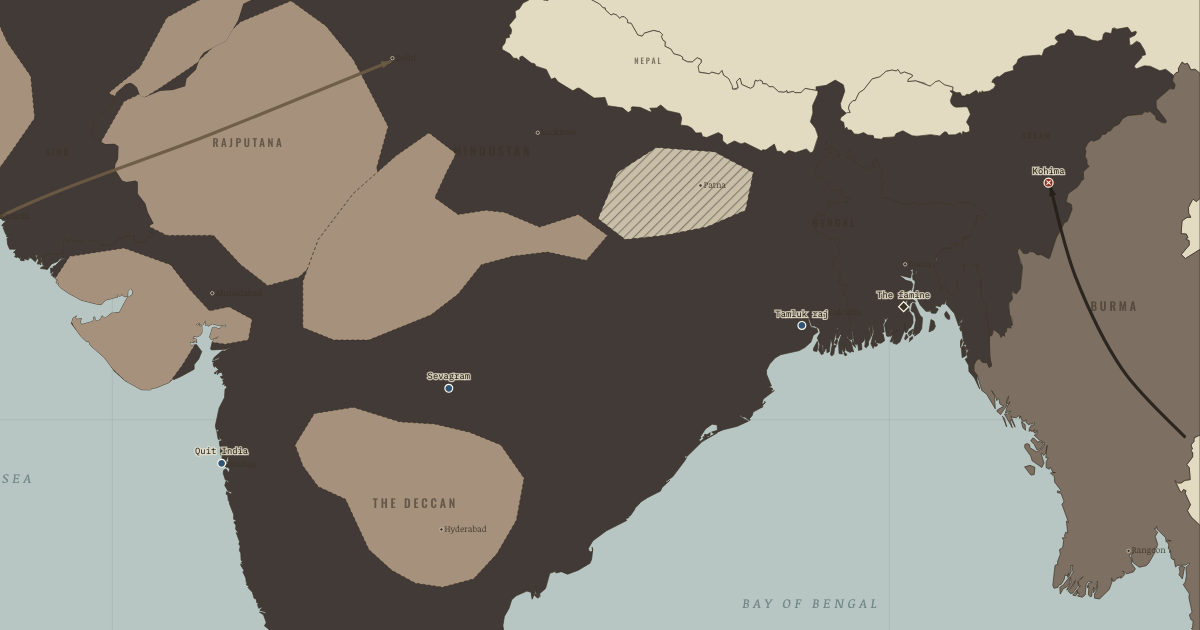
The map above is the world of AUG 1942 — Quit India.
BRIEF EXPLANATION — THE ESSENTIAL ARGUMENT
By 1942 the collapse of British power in Asia convinced Congress that there was no longer any point in waiting for reform. The Cripps Mission offered dominion status after the war and let any province opt out, but conceded no share of power during it, so Congress rejected it. In August Congress launched Quit India, demanding immediate British withdrawal, and the authorities jailed its entire leadership within hours. The leaderless protest became strikes, sabotage and short-lived parallel governments, and the Raj restored control only through mass detention and force on a wartime scale.
The same year brought a catastrophe the political story must not push into the background. In Bengal the loss of Burmese rice imports, wartime inflation, requisition policies, a damaged harvest and unequal access to food combined into famine in 1943. A widely used estimate is around three million dead, though the totals remain debated. This atlas treats the famine as a memorial rather than as scenery, because it exposed how a wartime state able to imprison a national movement overnight could prove unable, or unwilling, to keep its poorest subjects alive.
GUIDED EXPLANATION
Quit India demanded that Britain leave at once, during the war, rather than promise reform after it, and the demand followed directly from the empire’s collapse in Asia. Singapore fell in February 1942 with 60,000 Indian troops among the captured, and Rangoon followed in March, so waiting for British protection began to look like waiting with the doomed. London sent Sir Stafford Cripps with an offer of post-war dominion status and a provincial opt-out but no Indian control of defence, and the mission failed within three weeks. In August, at Gowalia Tank in Bombay, Congress passed the Quit India resolution and Gandhi told the country to “do or die.” By dawn the British had imprisoned the national leadership without trial, and the movement continued without any central control. Railways were cut, police stations burned, and local parallel governments formed, one at Tamluk in Midnapore lasting two years, until the Raj answered with shootings, collective fines and sometimes aircraft. Official figures record about 2,500 dead and 90,000 arrested, while nationalist estimates of the dead ran much higher.
The Bengal famine, marked on the map as a memorial, grew from the same war. The fall of Burma removed rice imports, military purchasing drove up demand, and “denial” policies seized coastal boats and rice to hinder a possible Japanese invasion. A cyclone then damaged the autumn crop, inflation destroyed the purchasing power of the poor, and Calcutta’s war economy was given priority over the countryside. Both the provincial government and New Delhi failed to halt the crisis, and Churchill’s war cabinet refused some of the shipping and relief that were requested. Between 1943 and 1944 perhaps 2.1 to 3 million Bengalis died of starvation and disease, some of them near shops that were stocked, because the food existed but they could no longer afford it, the mechanism the economist Amartya Sen later called a collapse of entitlement. Historians still weigh the shares of shortage, market panic, provincial failure and imperial policy, but the famine shows a state that could jail a national movement in a night and yet fail to protect Bengal’s poorest from a foreseeable chain of policy, price and distribution failures.
DEEP EXPLANATION — EVIDENCE & INTERPRETATION
The war that put India on the world’s conscience
Quit India and the Cripps Mission unfolded inside a world war fought, in its own rhetoric, for freedom and self-determination, and that contradiction became a weapon in Indian hands. The Atlantic Charter of 1941 had proclaimed the right of all peoples to choose their government, until Churchill insisted, to Roosevelt’s visible discomfort, that it did not apply to the British Empire. The Cripps Mission of 1942 owed much to American pressure, since Roosevelt urged Churchill to conciliate India, sent his own emissary Louis Johnson to Delhi, and privately regarded British obstinacy as a strategic liability as Japan advanced. Historians such as Christopher Bayly and Tim Harper stress how thoroughly the war internationalized the Indian question, which the empire could no longer treat as a purely domestic matter once its chief ally, and the anti-fascist cause itself, had made self-determination the war’s stated purpose. The Raj could jail Congress, but it could not silence the argument that a war against tyranny abroad sat awkwardly with an empire ruling without consent at home. The clock the war started on the Raj ran partly in Washington.
Bengal 1943: the famine the war tried not to see
The Bengal famine is memorialized here, and part of that memorial is the struggle to make it visible at all. Under wartime censorship the government suppressed the word famine and the images that went with it, so that the Communist artist Chittaprosad’s book of famine drawings, “Hungry Bengal,” was seized and almost all copies burned, leaving a single surviving sketchbook as the record. What did get through shaped how the catastrophe entered memory, and how nearly it did not: Theodore White’s reporting, the photographs the Calcutta newspaper The Statesman finally printed in 1943 against official pressure, and Bijon Bhattacharya’s play “Nabanna.” In Britain the famine remained for decades almost absent from the public story of the war, and its recovery is recent, driven by historians and by writers such as Madhusree Mukerjee who forced it back into the argument about Churchill and empire. The lesson pairs with the chapter’s own, that a famine is made by what a wartime state permits to be seen as much as by prices and policy. What a power will not let its citizens witness, it need not answer for, until the witnesses it failed to silence are finally read, generations too late.
New here? Chapters 1–2 of every atlas are free to sample, and the WW2 atlas is free in full. One membership opens all thirteen — the Cartographer’s Circle.
THE SITES
ON THIS DAY
WHY IT HAPPENED
1942: the empire’s prestige collapses in Asia. Singapore was the imperial catastrophe Curzon’s durbar had made unthinkable — the fortress surrendered, white prisoners marched by Asian soldiers, the fleet gone. For Indian politics it dissolved the last premise of patience: if Britain could not defend Asia, waiting for Britain looked like waiting with the doomed. Quit India’s timing — demand withdrawal now, negotiate with whoever holds power after — follows from that collapse of credit.
Cripps: too little for Congress, too late for trust. The offer conceded the post-war endgame (dominion status, constituent assembly) while conceding nothing during the war, and its provincial opt-out clause armed Pakistan. Historians debate who killed it — Churchill and Linlithgow undercut Cripps from behind, Gandhi from in front. But the failure’s effect is unambiguous: it convinced Congress that only pressure, not negotiation, moved wartime Britain, and convinced Britain that Congress could be governed around. Both conclusions led directly to August.
The rising without leaders. With the leadership jailed in the first hours, Quit India became what Gandhi had spent twenty years preventing: spontaneous, local, and frequently violent. Students, peasants and underground cells (Jayaprakash Narayan’s escape and sabotage network. Usha Mehta’s secret Congress Radio) improvised a rebellion. Its suppression proved the Raj still commanded force. Its scale proved the Raj commanded nothing else. Officials’ own assessments after 1942 stop asking whether Britain would leave and start asking how.
Famine: policy inside the catastrophe. Nature supplied a cyclone. Everything else was choices. Denial policy stripped the delta’s boats (the fishing economy died at a stroke). Provincial trade barriers trapped rice where money was, not where hunger was. Calcutta was ring-fenced with subsidized shops while the districts starved. London refused Canadian and Australian wheat offers shipping-space arguments that somehow never applied to military cargo. The Famine Inquiry Commission (1945) and Sen’s Poverty and Famines (1981) between them turned Bengal 1943 into the textbook case that famines are made by entitlement failure, not food shortage — a finding that begins as history and ends as a standing indictment of governments that let markets starve the poor.
THE TURN
Gowalia Tank, 8 August 1942. “Do or die”. By morning the entire national leadership is behind wire, leaving the Raj facing India with no negotiating partner at all. The turn looks like a defeat: the rising is crushed in months, Congress sits out three war years while the League organizes freely under official favour (the wilderness years reversed). But the deeper ledger runs the other way. 1942 taught the officials who wrote the post-war assessments that India was governable only as an occupation. It taught Washington, watching its ally jail Asia’s democrats while proclaiming the Atlantic Charter, to press London for a timetable. And it left, in every district, the memory that the Raj’s answer to “quit” had been the machine-gun. Quit India lost every battle and settled the war’s only question: there would be no British India after the peace.
WHAT IT CHANGED
The League’s free run. While Congress sat in jail, the League held office in Bengal, Sind and Assam, built its machine under a benevolent Raj, and made “Pakistan” the one word of Muslim mass politics. The 1946 election result — League: 87% of Muslim seats, from under 5% in 1937 — was manufactured in exactly these years. The cost of Quit India was paid in this currency.
The famine breaks the Raj’s last claim. An empire’s final argument is always order — the trains run, the granary holds. Three million dead within rail distance of full godowns ended that argument in Bengal forever, radicalized a generation of Bengali politics, and hangs over every retrospective defence of the Raj. When Attlee’s cabinet weighed withdrawal in 1946–47, the working assumption was that Britain could no longer feed, police or hold India — Bengal was the proof text.
Kohima decides the war’s shape, not the peace’s. At Kohima and Imphal (the battle marker) the largely Indian Fourteenth Army broke the Japanese invasion in 1944 — the Japanese army’s largest defeat on land to that date. It settled that India’s future would be decided by politics, not conquest, and it built something else: two million Indians under arms who expected a country worth the service. The INA trials and the RIN mutiny would shortly show what that expectation was worth to the Raj’s survival.
FIELD QUESTION — Amartya Sen showed Bengal in 1943 had enough food. What, then, actually killed three million people — and who, if anyone, is answerable?
Entitlement collapse killed them: war inflation tripled rice prices while rural wages stood still, so the landless — fishermen first (their boats seized by denial policy), then labourers, then artisans — simply lost the ability to buy food that visibly existed. Answerability then distributes across a chain, and the argument is about weights, not facts. The provincial government (League-led, under Huq then Nazimuddin) fumbled procurement and hid the famine’s scale. New Delhi subordinated relief to the war. The market’s hoarders did what unregulated markets do in shortage. And London — the debate’s hardest edge — refused repeated shipping requests while stockpiling food in the Mediterranean theatre, with Churchill’s recorded remarks supplying the tone. Historians range from Bayly and Harper’s “callous neglect” to Mukerjee’s charge of something nearer policy. Almost none now accept the old alibi of pure natural disaster. The transferable finding is Sen’s other one: no famine of this kind has occurred in a functioning democracy with a free press — accountability, not agronomy, is the difference. Bengal starved, at bottom, because nobody who governed it answered to it.
AN INTERESTING FACT
The Fourteenth Army that held Kohima called itself the “Forgotten Army,” and its memorial at the Kohima war cemetery carries the epitaph that became the twentieth century’s best-known soldier’s verse: “When you go home, tell them of us and say: for your tomorrow, we gave our today.” It was the most multinational army of the war — Indian, Gurkha, British, East and West African — and its commander, William Slim, judged his Indian divisions the finest troops he had. In 2013 a poll of British historians voted Kohima–Imphal Britain’s greatest battle, above D-Day and Waterloo: a distinction won, in largest part, by soldiers whose country was jailing its own leadership as they fought.
THE DISPATCH
One short letter when a new atlas opens — and the printable study guide for Indian Independence & Partition is yours now, free.
NO TRACKING · YOUR ADDRESS IS USED FOR THE DISPATCH AND NOTHING ELSE · UNSUBSCRIBE ANYTIME