MAPS OF HISTORY · The Age of Revolutions · ALL CHAPTERS · CHAPTER 11
CHAPTER 11 · 1815–1847 · AUG 1830
The Age of Restoration
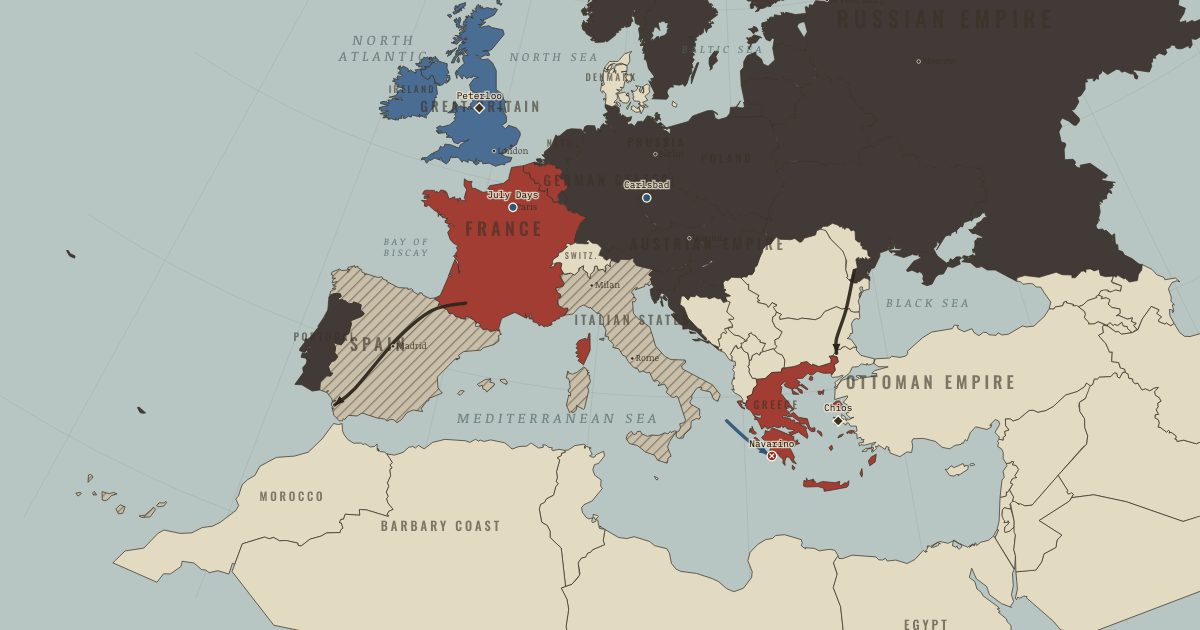
The map above is the world of AUG 1830 — The barricades return.
BRIEF EXPLANATION — THE ESSENTIAL ARGUMENT
After 1815 the great powers tried to prevent another 1789 through censorship, surveillance and intervention. Austria crushed constitutions in Italy; France restored Spanish absolutism in 1823; Russia defeated the Decembrists. Even Britain used violence at Peterloo before choosing gradual parliamentary reform.
The system could suppress organizations but not social and national change. Greek independence exposed its inconsistency: public sympathy and great-power rivalry overrode respect for Ottoman legitimacy. France and Belgium then revolted in 1830 without a general intervention. The question shifted from whether Vienna’s map would change to whether governments would reform before barricades forced them.
GUIDED EXPLANATION
Metternich’s system treated revolution in one state as a threat to all. The Carlsbad Decrees censored German universities and newspapers after a political murder. Austria ended constitutional movements in Naples and Piedmont. France invaded Spain in 1823 to restore Ferdinand VII’s full power. Russia crushed the Decembrist officers in 1825. These measures protected regimes, but they also closed legal routes for moderate change.
Greece exposed the system’s limits. A revolt against Ottoman rule began in 1821. The massacre and enslavement at Chios in 1822 became a European cause through reports, art and philhellenism. When Ottoman-Egyptian forces threatened to end the revolt, British, French and Russian fleets destroyed their fleet at Navarino in 1827. Strategic rivalry and public pressure outweighed the principle of non-revolution, leading to Greek independence. In July 1830 Charles X’s emergency ordinances brought Paris to the barricades and removed him in three days. Belgium rose soon afterward and gained independence. The powers managed both changes instead of reversing them. Britain’s 1832 Reform Act offered another path: limited concession that preserved the system by changing it.
The contrast between the 1823 intervention and the changes of 1830 exposes what the system really defended. In Spain the powers still agreed that restoring an absolute monarch protected them all, while in France and Belgium intervention now risked a wider war and no longer served every power’s interest, so the doctrine quietly changed the moment its enforcement grew expensive. Britain followed a separate path altogether, since expanding representation in 1832 satisfied no one entirely yet gave the opposition a legal route and drained the appeal of revolt. Repression and concession were, in the end, rival strategies for the same goal of preserving order.
DEEP EXPLANATION — EVIDENCE & INTERPRETATION
Peace between states, policing within them
The Concert combined two projects often treated as one. Consultation, buffers and balance managed disputes among great powers. Censorship and intervention protected domestic rulers. Leaders linked them because they interpreted revolution as the start of international war, but the connection was a choice rather than a logical necessity. Britain participated in external balance while resisting a general right of continental intervention and eventually reforming at home. Greece and Belgium were managed without a new general war once the powers preferred negotiation to reversal. These cases suggest that the peace did not require every police measure. Repression bought short-term control and raised long-term radicalization by denying moderates a legal route to change. The map records the result. Explanation must also keep institutions, material pressure and political choice visible, because none of those forces worked alone.
Why Greece became the exception
Greek rebels benefited from several forces that did not align for Italian or Spanish liberals. Classical education encouraged European identification with ancient Greece; Christian solidarity shaped public sympathy; reports of Chios and Byron’s death made the revolt a mass media cause. Great-power interest was decisive. Russia sought influence over Ottoman affairs, Britain feared unilateral Russian gains and France wanted a role in the settlement. Supporting a managed Greek state became preferable to letting a rival dominate the crisis. The intervention therefore joined humanitarian feeling, cultural imagination and strategic competition. Calling it only altruism hides power politics; calling public opinion irrelevant misses the pressure that narrowed governments’ acceptable choices. Systems reveal priorities when principles conflict, and Ottoman legitimacy ranked below management of the Eastern Question. That distinction prevents a dramatic moment from becoming a single-cause story. Revolutionary outcomes emerged through interacting interests, constraints and decisions over time.
New here? Chapters 1–2 of every atlas are free to sample, and the WW2 atlas is free in full. One membership opens all thirteen — the Cartographer’s Circle.
THE SITES
ON THIS DAY
WHY IT HAPPENED
Order as trauma response. The men of Vienna had watched a lawyer’s revolution consume a million lives and every throne but Britain’s; to them, censorship was cheap compared to Valmy’s sequel. Grant the premise its force — then observe the flaw: the system could suppress conspiracies but not causes, and treated literacy, railways and factory towns (all growing exponentially) as police problems. A settlement that requires history to stop is a settlement with a countdown.
The counter-current: an economy that would not hold still. Between 1815 and 1848 steam, cotton and rail double and redouble the cities; a middle class that reads and lends grows everywhere, and a working class packs into quarters no guild remembers. The Restoration restored thrones but not the world of 1789 — its subjects were new people. Peterloo’s crowd were handloom weavers; the Lyon silk risings (1831, 1834) previewed a social question no dynastic map addressed.
Nationalism goes underground and abroad. Carbonari lodges, Mazzini’s Young Italy, Polish exiles after the crushed rising of 1830-31, German gymnasts and student Burschenschaften: repression converted national feeling from parade to conspiracy and scattered its apostles across Europe’s capitals. The Restoration’s emigration is the revolution’s postal system.
Greece: the exception that revealed the rule. Christian victims, classical memory, and — decisive — the Eastern Question: Russia wanted the Straits weakened, Britain wanted Russia contained, and both preferred managing a Greek state to watching the other sponsor it. Where ideology and interest pointed the same way, the Concert acted; where they diverged, principle lost. File under: systems reveal their real ranking of values only under conflict.
THE TURN
Paris, 27–29 July 1830. Charles X’s July Ordinances — muzzling the press, dissolving the chamber, shrinking the franchise — were absolutism’s test of whether 1815 had truly reset the clock. The answer took three days: the army would not massacre Paris (the Bastille’s lesson, replayed), the dynasty fell, and — the true turn — Europe’s powers, weighed down by Belgium, Poland and their own publics, let it stand. The Restoration’s core doctrine, intervention against any revolution, was quietly buried with full honors. After July 1830, the question is not whether the settlement of 1815 will be revised, but whether by reform or by barricade.
WHAT IT CHANGED
Two Europes, visibly. West of the Rhine: constitutional monarchies with narrow franchises (France’s “citizen king” enfranchises one man in 170 — the pays légal). East of it: Metternich’s system intact, Poland’s 1830 rising crushed with 250,000 Russian troops and its constitution abolished. The 1848 explosion will follow this fault line exactly.
Britain’s alternative posted. The 1832 Reform Act — enlarging the franchise ~50% and abolishing rotten boroughs — passes after two years of near-revolutionary crisis, and is followed by slavery abolition (1833) and factory acts. Timely, partial, self-interested concession: Britain alone among the great states will pass through 1848 without barricades. The control experiment the continent declined to run.
Belgium: the new nation prototype. A revolution, a great-power conference to bless it, a borrowed king, a model constitution (1831) that liberals across Europe copy by hand, and guaranteed neutrality (the “scrap of paper” of 1914). The age invents the procedure for adding states without general war — Greece and Belgium are its proofs of concept.
The social question takes the stage. July’s barricade fighters got a banker’s monarchy. Lyon’s weavers answered in 1831 with the age’s starkest banner, “Live working or die fighting.” From then on, two revolutions were braided together. One was political, seeking constitutions and nations. The other was social, demanding bread, wages and the right to work. They would collide in 1848.
FIELD QUESTION — Metternich called his system the “repose” Europe needed, and it did prevent great-power war for a generation. Was repression the price of peace?
No. Peace between great powers depended on balance, consultation and restraint; censorship of students and armed restoration of absolutism addressed a separate goal, domestic regime security. Leaders connected the two because they remembered 1792, but Britain and the managed outcomes in Greece and Belgium show alternatives. Repression preserved governments temporarily while blocking moderate reform and encouraging underground movements. The peace was real; the claim that police rule was its necessary price is not supported by the available comparisons.
AN INTERESTING FACT
Navarino was the last great battle fought entirely under sail: two hours of point-blank broadsides in a crowded bay destroyed some sixty Ottoman and Egyptian ships and thousands of their crews, without the loss of a single allied vessel. London was so embarrassed by its own victory that the King’s Speech of 1828 called the annihilation of a friendly power’s navy “an untoward event” — and Codrington, the admiral who had won it, was recalled to explain himself. Diplomats apologizing for a triumph: the Concert’s whole predicament in a single sentence.
THE DISPATCH
One short letter when a new atlas opens — and the printable study guide for The Age of Revolutions is yours now, free.
NO TRACKING · YOUR ADDRESS IS USED FOR THE DISPATCH AND NOTHING ELSE · UNSUBSCRIBE ANYTIME