MAPS OF HISTORY · The Age of Revolutions · ALL CHAPTERS · CHAPTER 12
EPILOGUE · 1848–1849 · MAR 1848
1848: The Springtime of Peoples
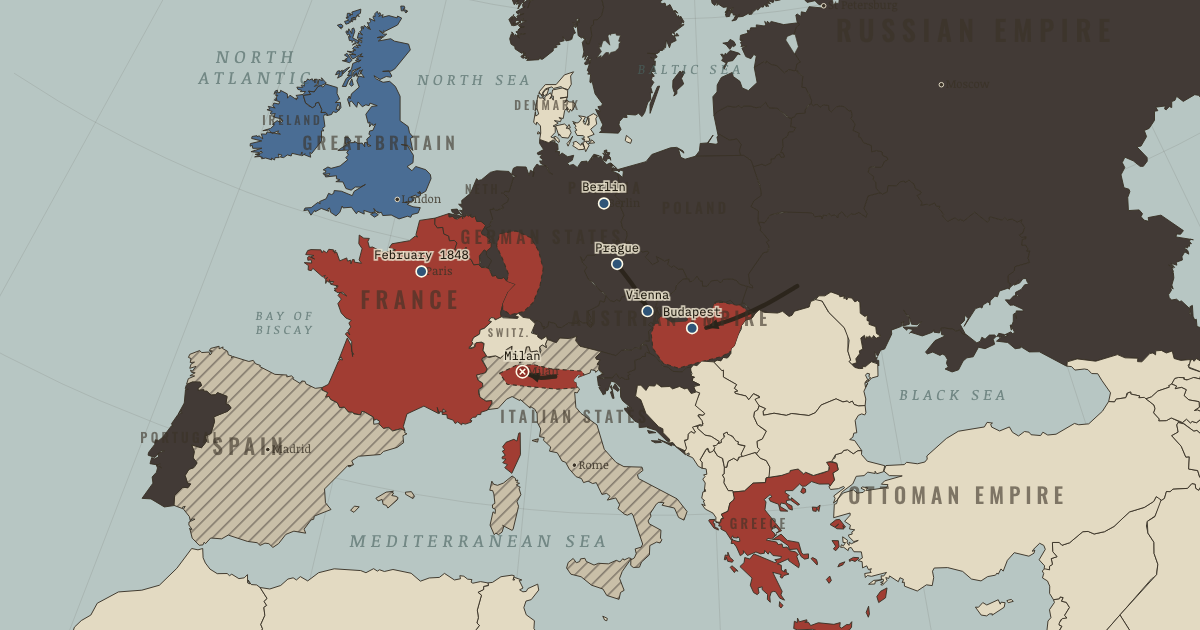
The map above is the world of MAR 1848 — The springtime of peoples.
BRIEF EXPLANATION — THE ESSENTIAL ARGUMENT
A convergence of harvest failure, urban unemployment and decades of blocked reform set off revolutions across Europe in 1848, spreading from Palermo and Paris to Vienna, Berlin, Milan and Budapest. Railways, cheap print and the telegraph synchronized expectations from one city to the next. Monarchies conceded constitutions, Metternich fled Vienna, and the Habsburgs abolished serfdom.
The coalitions then divided. Liberals and workers fought over social policy; German, Magyar, Czech, Croat and other national projects made conflicting territorial claims. Armies remained loyal and recovered, while Russia helped defeat Hungary. Most regimes returned, but serfdom’s abolition, constitutions in several states and mass politics survived. Failure changed the route to later reform and unification.
GUIDED EXPLANATION
The wave began in economic distress — failed harvests, high food prices, a credit crisis and urban unemployment. Paris’s rising in February overthrew the July Monarchy and established universal male suffrage, and the news moved so rapidly that within weeks Vienna had risen and Metternich had fled, Budapest had won the April Laws, Berlin’s king had conceded after street fighting, and Milan had driven out its Austrian garrison. Frankfurt’s delegates began writing a constitution for a Germany that did not yet exist. Habsburg authorities abolished serfdom, lifting obligations from more than forty million people.
Revolutionary unity did not last. In Paris, closing the National Workshops led workers to the June Days, which the republic crushed with thousands killed or deported. National movements also conflicted: Frankfurt claimed territories with Polish or Czech populations, while Hungary resisted autonomy for Croats and Romanians. Habsburg leaders used those divisions while loyal armies regrouped. Radetzky defeated Piedmont, Windischgrätz retook Prague and Vienna, and Russian intervention ended Hungary in 1849. France destroyed the Roman Republic; Venice fell after siege and cholera. Yet restoration was selective. Serfdom stayed abolished, Prussia and Piedmont kept constitutions, and France retained mass suffrage. The revolutions failed to hold power but changed what governments could safely reverse.
The red zones fade from the map far more slowly than the first capitals had risen, and the reason is instructive. The revolutionaries had synchronized their protests without building a shared command or settling their overlapping national claims, while the monarchies kept disciplined armies and eventually coordinated across borders, most dramatically in Russia’s 1849 intervention in Hungary. Military recovery explains the defeat, and selective reform explains the aftermath. Governments rolled back the institutions that shared sovereign power yet kept the changes that weakened feudal obligations or modernized administration. The failure was therefore political without amounting to a complete return to 1847.
DEEP EXPLANATION — EVIDENCE & INTERPRETATION
Communication synchronized possibility
Earlier revolutions also traveled through print and rumor, but 1848 combined larger cities with railways, steam transport, telegraph lines and a cheap press. News that one monarchy had conceded lowered the perceived risk of action elsewhere. This produced rapid imitation without central coordination. Synchronization was powerful because regimes could not immediately send aid to one another. It was also a weakness. Local movements rose before agreeing on programs, command or territorial compromises. Similar slogans concealed different aims: constitutional government, national independence, protection of property, employment and social equality. Communication coordinated the moment of revolt more effectively than it coordinated rule afterward. The wave demonstrates that fast information can align expectations while leaving institutions fragmented. The map records the result. Explanation must also keep institutions, material pressure and political choice visible, because none of those forces worked alone.
A failed revolution that fixed the agenda
No major revolutionary government of 1848 remained secure for long, and armies restored dynastic control. Judged only by immediate regime survival, the revolutions failed. Second-order effects give a different result. Serfdom’s abolition altered Central European society permanently; constitutions and parliaments remained in several states; universal male suffrage made mass electoral politics unavoidable in France. Conservative leaders also learned that national aims could be used rather than simply suppressed. Cavour and Bismarck later pursued Italian and German unification through monarchy, diplomacy and war. This was not the liberal method imagined at Frankfurt, so later unification can be read as both fulfillment and defeat. 1848 set the agenda while changing who would execute it and by what means. That distinction prevents a dramatic moment from becoming a single-cause story. Revolutionary outcomes emerged through interacting interests, constraints and decisions over time.
New here? Chapters 1–2 of every atlas are free to sample, and the WW2 atlas is free in full. One membership opens all thirteen — the Cartographer’s Circle.
THE SITES
ON THIS DAY
WHY IT HAPPENED
Hunger, credit, and the last old-regime famine. The potato blight and failed harvests of 1845–47 doubled food prices, detonated a credit crash and mass urban unemployment — Europe’s last subsistence crisis arriving inside its first industrial one. As in 1789, the philosophy chose the targets and the bread prices supplied the crowds; note that the revolutions ebbed almost exactly as the 1848 harvest came in good.
Thirty years of postponed questions. Every demand of 1848 — constitutions, press freedom, national unification, emancipation of serfs and Jews — had been raised and suppressed since 1815. The Restoration had ensured there was no legal channel; so the demands arrived together, everywhere, illegally. Chapter 11’s mechanism, matured to harvest.
News at machine speed. 1789 spread at the pace of a horse. 1848 moved by railway, steamship, telegraph and cheap press through cities twice the size — Paris’s February reached Vienna in five days, and each rising lowered the perceived cost of the next. The first revolution of modern communications was also the first to synchronize a continent — and synchronization, note, was its greatest tactical asset and strategic weakness at once: everyone rose together and no one had prepared.
The armies stayed loyal. The structural difference from 1789: no 1848 monarchy suffered its army’s collapse. Radetzky’s, Windischgrätz’s and Nicholas’s regiments — recruited from peasants, insulated from the cities, often ethnically foreign to those they shot — obeyed. Revolutions succeed when the soldiers won’t fire (Bastille, July 1830) and fail when they will; nearly everything else is commentary.
THE TURN
Paris, 22–24 February 1848. A banned banquet, a volley on the Boulevard des Capucines, corpses paraded by torchlight, and by the third morning the July Monarchy — the compromise of 1830 — was gone. Paris’s February matters as the age’s proof of contagion: within thirty days, absolutism was suspended from the Rhine to the Danube without a single army marching between countries. The idea had become continental infrastructure. That the same city gave the counter-revolution its June template — and then elected an emperor’s nephew president by five million votes — completes the turn: 1848 demonstrated simultaneously that the peoples could take power in a week, and had not yet agreed what to do with it.
WHAT IT CHANGED
What survived the defeat. The permanent ledger: serfdom abolished in Central Europe (40+ million people); constitutions retained in Piedmont, Prussia, Denmark, the Netherlands, Switzerland (whose 1848 federal constitution stands, amended, today); universal male suffrage in France; parliaments, however weak, as the normal furniture of European states. Counter-revolutions kept the reforms that made governing easier and cancelled the ones that shared power — a pattern worth recognizing in every failed revolution since.
Realism replaces romanticism. The lesson elites drew: national unification was possible, parliaments of professors were not the instrument — armies and diplomacy were. Cavour and Bismarck (a furious young conservative in 1848’s Prussian assembly) built Italy and Germany within 23 years by exactly that method: 1848’s ends, achieved by 1815’s means. Whether that substitution — nation without liberty — was 1848’s deferred victory or its deepest defeat is the next century’s question.
The exiles carry it onward. The defeated scattered: Kossuth to tour America, Mazzini to plot, Carl Schurz to a Union general’s commission, a quarter-million Forty-Eighters to the United States, and a German journalist named Marx to the British Museum — his verdict on the bourgeois revolutions of this chapter becoming the operating manual for the next age’s. The age of revolutions ends by shipping its arguments to the twentieth century.
The ledger of the age. Close the account below: from Lexington to Világos, the age cost several million lives — and left behind the republic as a normal form of government, slavery abolished or besieged across half the hemisphere it had built, the rights-declaration as the standard constitutional genre, and the nation-state as the default dream of peoples without one. Every entry was paid for on the battlefields this atlas has mapped. Whether the price bought the ideas or the ideas exacted the price is the Field Question this whole atlas has been preparing you to argue.
FIELD QUESTION — “1848: the turning point at which modern history failed to turn.” Is the famous verdict right?
The verdict is half right. The revolutionary governments fell, liberal national unification by consent failed and restored armies emerged strong. Yet serfdom ended across much of Central Europe, constitutions survived in several states and mass politics could not be removed. Italy and Germany pursued 1848’s national goals within a generation through monarchs and armies. The turning point was therefore not immediate control of states but the agenda governments now had to answer: constitution, nation and the social question.
AN INTERESTING FACT
The age’s most consequential pamphlet appeared in the very week the age broke open: the Communist Manifesto came off a German émigré press in Bishopsgate, London, around 21 February 1848 — Paris rose on the 22nd. The timing was pure coincidence: a first printing of a few hundred copies, in German, it played no part whatever in the revolutions it seemed to prophesy, then sank into such obscurity that it was scarcely reprinted for twenty years. Its real career began only in the 1870s — the age’s books, like its revolutions, are dated by their births and measured by their afterlives.
THE DISPATCH
One short letter when a new atlas opens — and the printable study guide for The Age of Revolutions is yours now, free.
NO TRACKING · YOUR ADDRESS IS USED FOR THE DISPATCH AND NOTHING ELSE · UNSUBSCRIBE ANYTIME