ONE LAND · 12 ATLASES
History of Tunisia in maps
Tunisia as it appears in 12 interactive history atlases, from 264 BC to 2015: Africa, Ifriqiya, Tunisia. Each era below lists who ruled the land and when control changed, linked to the dated map that shows it.
WW2 is free — every chapter. No sign-up.
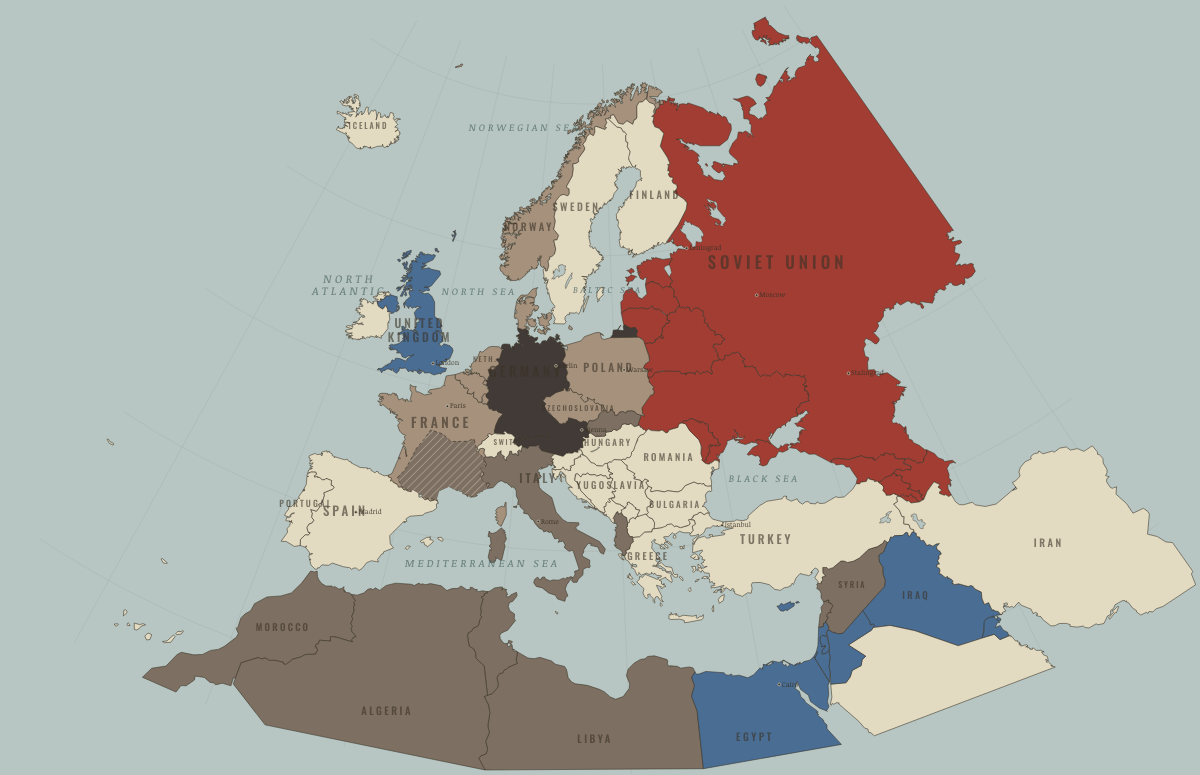
What was Tunisia before it was Tunisia? Below, every era of this land in the Maps of History atlases — who ruled it, what it was called, and when control changed — each line linked to the dated map that shows it. Modern borders stand in as an honest approximation; every atlas says so on the map itself.
Africa (mod. Tunisia) · Ancient Rome
Carthage — the rival. A Phoenician merchant thalassocracy older and richer than Rome, undone in three wars by the strait it shared with Italy (Chs. 1–2). Razed in 146 BC, cursed, and refounded a century later as Roman Africa: the empire’s breadbasket, so vital that its loss to the Vandals in 439 is the best single explanation for the fall of the West (Ch. 11). Few territories on this map decide the story twice.
| 264 BC | Rival great powers — the opening position |
| 201 BC | Roman clients & allies |
| 146 BC | Roman territory |
| Tribal peoples & confederations |
ANCIENT ROME: EVERY CHAPTER AND MAP →
Ifriqiya (mod. Tunisia) · Crusades
| The Islamic powers — Seljuk, Zengid, Ayyubid, Mamluk — the opening position |
CRUSADES: EVERY CHAPTER AND MAP →
Tunisia · Industrial Revolution
| Colony or dependency — the opening position | |
| Colony or dependency |
INDUSTRIAL REVOLUTION: EVERY CHAPTER AND MAP →
Tunisia · Age of Revolutions
| Neutral / uncommitted — the opening position |
AGE OF REVOLUTIONS: EVERY CHAPTER AND MAP →
Tunisia · Meiji Japan and post-Soviet Russia
MEIJI JAPAN AND POST-SOVIET RUSSIA: EVERY CHAPTER AND MAP →
Tunisia · WWI
| Entente-aligned & imperial territories — the opening position | |
| Entente-aligned & imperial territories |
Tunisia · Road to WW2
| Colonial empires & possessions — the opening position |
ROAD TO WW2: EVERY CHAPTER AND MAP →
Tunisia · WW2
| Western Allies — the opening position | |
| Axis allies & puppets | |
| Axis-occupied | |
| Western Allies |
Tunisia · Cold War
| NATO & core Western allies — the opening position | |
| Non-aligned & neutral | |
| Non-aligned & neutral |
COLD WAR: EVERY CHAPTER AND MAP →
Tunisia · Decolonization of Africa
Tunisia won independence from France in March 1956, led by Habib Bourguiba’s Neo-Destour party in a largely negotiated exit — France sacrificing its protectorates to hold Algeria. Bourguiba built a secular, modernizing one-party state and ruled for three decades. A comparatively peaceful decolonization, decided by the absence of a mass settler population.
| French-ruled — the opening position | |
| Independent Africa |
DECOLONIZATION OF AFRICA: EVERY CHAPTER AND MAP →
Tunisia · Feminism and the Tunisian Revolution
Seen from the Atlantic, Tunisia was already a pioneer: its 1956 Personal Status Code abolished polygamy, women voted nationally from 1959, and abortion became legal on request in 1973, two years before France. It ratified CEDAW on 20 September 1985, with reservations on family law and nationality that it lifted only after the 2011 revolution. Its story continues on the TUNISIA map.
| Authoritarian, one-party or colonial rule — the opening position | |
| Right won in law | |
| Partial or unequal; treaty signed only; transition | |
| No reform yet / outside this story | |
| Right won in law |
FEMINISM AND THE TUNISIAN REVOLUTION: EVERY CHAPTER AND MAP →
Tunisia · Refugee crises
| Western bloc or democracy — the opening position |
REFUGEE CRISES: EVERY CHAPTER AND MAP →
Related
THE FREE PRINTABLE STUDY GUIDE
Join the Dispatch — a short welcome series, then a letter when a new atlas opens — and a printable atlas study guide of your choice is yours now, free.
NO TRACKING · YOUR ADDRESS IS USED FOR THE DISPATCH AND NOTHING ELSE · UNSUBSCRIBE ANYTIME