Crusades · 1212
What had a crusade come to mean by 1220?
The seminar question: “By 1220, with crusades called against Spanish Muslims, Baltic pagans and French heretics, what did “crusade” actually mean?”
Once a crusade meant any holy war carrying an indulgence, popes aimed it far from the Levant. In Iberia the victory at Las Navas de Tolosa in 1212 broke Almohad power; in the Baltic the Teutonic Knights conquered and forcibly converted pagan peoples; and the Albigensian Crusade killed thousands at Béziers in 1209.
Chapter 9 is part of membership. WW2 is free — every chapter. Try chapters 1–2 of any 2 other atlases (3 with a free account). Opening a new atlas uses one of them. Membership opens all 21 — Join.
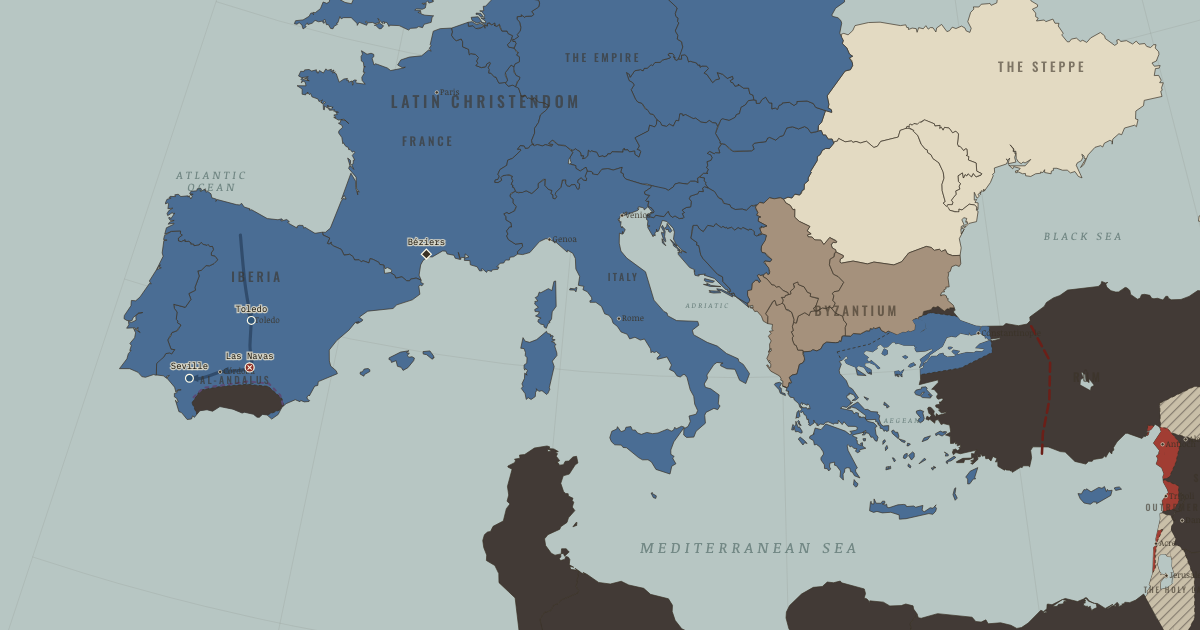
Crusade had by now become a legal and spiritual package rather than a single destination, consisting of a vow, an indulgence, organized preaching and Church-authorized fundraising, and popes could attach that package to wars far from the Levant. In Iberia the rulers used it to reinforce an expansion that predated the crusades entirely, and the frontier war against al-Andalus, which had already taken Toledo in 1085, acquired the rewards and privileges of a holy one. When several Christian kings combined at Las Navas de Tolosa in 1212 they shattered Almohad power, and in the following decades Córdoba and Seville fell, reducing Muslim Iberia to the tributary emirate of Granada. The western crusade was winning at the very moment the eastern one was failing.
The short answer
- The indulgence, generalized. The spiritual reward that Urban attached to Jerusalem was gradually detached from it. Once popes could grant crusade indulgences for any war they deemed holy, the institution became a portable instrument — available against Muslims in Spain, pagans in the Baltic, heretics in France, and eventually the papacy’s political enemies in Italy.
- Frontier ambition, sanctified. Iberian kings wanted al-Andalus’s land and cities; Baltic lords wanted territory and souls. Crusade did not create these ambitions — it blessed them, converting ordinary conquest into meritorious holy war and drawing in men and money from across Europe.
- Heresy treated as mortal threat. The Church came to see Cathar dissent as a spiritual cancer more dangerous than any external enemy, and licensed war to cut it out. Once holy war could be aimed at fellow Christians, the idea had travelled a very long way from aiding the churches of the East.
THE TURNING POINT
Las Navas de Tolosa, 16 July 1212. The hinge of the peninsula. The Almohad defeat here breaks Muslim power in Iberia for good; within four decades Córdoba and Seville fall and al-Andalus is reduced to the tributary emirate of Granada. It is the crusade movement’s one unambiguous, lasting territorial success — achieved in the same years the crusade in the East is collapsing into the debacle of Constantinople.
What it changed
Iberia reconquered. Córdoba falls in 1236 and Seville in 1248 (the arrow); only mountain Granada survives, as a tributary, until 1492. The western front of the crusade succeeds precisely because it was a contiguous land war with settlers behind it — everything Outremer was not.
A German Baltic. The Teutonic state that crusade built in Prussia and Livonia shapes centuries of northern European history and leaves borders and grievances that echo into the modern age.
Crusade turned inward. Béziers legitimized holy war against Christians and helped bring forth the Inquisition. It is the clearest sign that the idea had become an instrument of power as much as of piety — a precedent with a long and grim future.
The full answer, argued
It had become less a specific expedition to the Holy Land than a legal and spiritual instrument that the papacy could deploy against any enemy it defined as a threat to Christendom. That elasticity was a source of enormous power — it could mobilize men, money and zeal on multiple fronts at once — and of obvious danger, because it let religious authority sanctify wars of conquest (Iberia, the Baltic) and repression (Languedoc) that served very worldly ends. The Iberian and Baltic crusades also reveal why the eastern one failed by contrast: they were contiguous, settler-backed land wars a society could sustain, whereas Outremer was a distant, thinly held coast. The broader lesson is what happens when a moral licence becomes a political tool — the temptation to expand its use until “crusade” means little more than “a war the powerful have declared holy.”
An interesting fact
The paperwork of Las Navas teaches you how to read crusade numbers. Alfonso VIII’s victory letter to Innocent III — the pope had ordered processions through Rome that spring to pray for the campaign — claims that barely twenty-five or thirty Christians of the whole army fell in the battle; no historian accepts it, and the letter is best read as what it is, persuasion from a king who needed continued papal backing. With it went the captured standard of the caliph al-Nasir, hung in St Peter’s in Rome; al-Nasir himself fled to Marrakesh and was dead within eighteen months.
This is the study layer of Crusades beyond the Holy Land, chapter 9 of The Crusades, 1095–1291; the full index of the atlas is here.
Related questions
THE FREE PRINTABLE STUDY GUIDE
Join the Dispatch — a short welcome series, then a letter when a new atlas opens — and the printable study guide for The Crusades is yours now, free.
NO TRACKING · YOUR ADDRESS IS USED FOR THE DISPATCH AND NOTHING ELSE · UNSUBSCRIBE ANYTIME