Crusades · 1150
Was Outremer a colonial society or a frontier society?
The seminar question: “Was Outremer a colonial society, a frontier society, or something for which we have no clean word?”
For nearly two centuries the four crusader states of Outremer formed a thin coastal ribbon where a small Latin elite ruled larger Muslim and Eastern Christian populations. The Franks relied on castles such as Krak des Chevaliers and on Italian fleets paid with self-governing quarters, and lived by truces, taxes and trade.
Chapter 3 is part of membership. WW2 is free — every chapter. Try chapters 1–2 of any 2 other atlases (3 with a free account). Opening a new atlas uses one of them. Membership opens all 21 — Join.
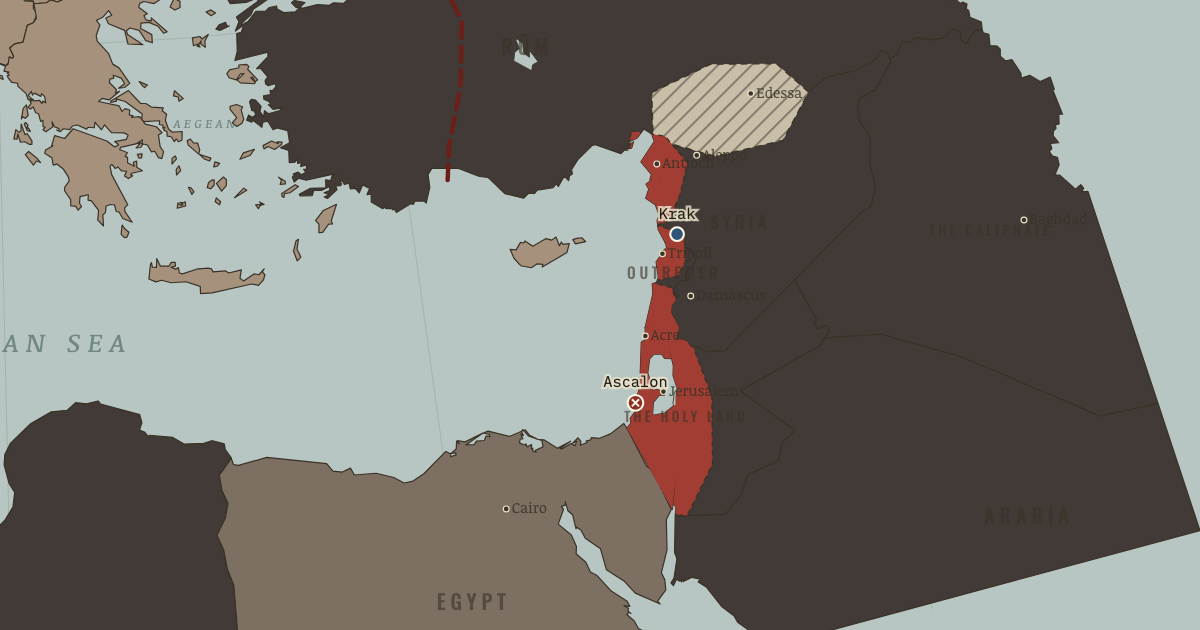
The crusader states held their ground through concentration rather than numbers, and every one of their strengths and weaknesses traces back to that single fact. There were never more than a few hundred thousand Franks spread across all four states, ruling a far larger native population, so they could not settle the countryside densely and instead dominated it from strongpoints. A network of great castles such as Krak des Chevaliers allowed a small body of knights to control roads and frontiers, forcing any attacker into long and costly sieges. The whole society was organized around holding what it had rather than expanding, and its energy went into defence rather than conquest.
The short answer
- The tyranny of numbers. The Franks were always a minority — perhaps a few hundred thousand across all four states, over a much larger native population. They could not settle the land densely, so they held it thinly: from castles, with hired and native troops, in a permanent posture of defence. Every strategic weakness of Outremer traces back to this one fact.
- The maritime bargain. Lacking ships, the crusaders sold their independence to the Italian republics in exchange for naval power. The merchant quarters of Acre and Tyre were self-governing enclaves that took their cut whether the kingdom won or lost. Outremer’s economy — and its wars — ran on Italian terms.
- Coexistence as necessity. Holy-war rhetoric notwithstanding, the states could only function by pragmatic accommodation: taxing Muslim farmers, trading through Muslim middlemen, allying with one emir against another. Daily life on the frontier was less a clash of civilizations than a tense, negotiated intimacy — punctuated by raid and massacre. Both truths held at once.
THE TURNING POINT
Ascalon, 1153 — the high-water mark. The fall of the last Fatimid fortress on the coast is Outremer at its largest and most confident. But it is a peak reached just as the ground shifts underneath: Nur al-Din is welding Aleppo and Damascus into a single hostile power. From this line, the map only shrinks. Note the pattern for later: the crusaders’ success is the trigger for their enemies’ unity.
What it changed
A brittle strength. On the map Outremer looks solid; underneath it is hollow. A society organized entirely around defence can be undone by a single lost field army, because it has no depth to trade for time. Hold that thought until Hattin.
The orders fill the gap. Who garrisons the great castles when the kingdom has too few knights and no standing troops? The military orders — monks who fight and never go home. They are the subject of the next chapter.
A culture that outlasts the states. The lasting yield of Outremer is not territory but exchange: sugar, textiles, trade routes, and a two-way traffic in techniques and ideas that persisted after the last castle fell. Weigh it, carefully, in the epilogue.
The full answer, argued
“Colonial” tempts us — a settler elite extracting from a subject majority, backed by a distant metropole — and the parallel is not worthless. But it imports assumptions (a nation-state, a racial ideology, an economic system) that did not exist in the twelfth century, and it misses how thoroughly the Franks were absorbed into a Levantine world, dependent on local allies and local labour, often at war with fellow Christians and at peace with Muslim neighbours. “Frontier society” captures the negotiated, hybrid, violent intimacy better. The honest move is to hold the useful part of the colonial analogy — extraction and settlement by a minority — while refusing to flatten a strange medieval reality into a modern template. Naming the discomfort is part of the analysis.
An interesting fact
Usama ibn Munqidh left a scene that catches this hybrid world exactly. In Jerusalem he would pray in a small oratory beside al-Aqsa — the Templars, whom he calls his friends, kept it open for him — until a newly arrived Frank twice seized him and wrenched him round to face east, insisting that this was how one prayed. The Templars threw the man out and apologized: he had only just landed, they explained, and had never seen anyone pray toward Mecca. Usama’s dry verdict — that Franks long settled in the East were far better company than the fresh arrivals — is the “poulain” phenomenon, observed from the other side.
This is the study layer of Crusader states (Outremer), chapter 3 of The Crusades, 1095–1291; the full index of the atlas is here.
Related questions
THE FREE PRINTABLE STUDY GUIDE
Join the Dispatch — a short welcome series, then a letter when a new atlas opens — and the printable study guide for The Crusades is yours now, free.
NO TRACKING · YOUR ADDRESS IS USED FOR THE DISPATCH AND NOTHING ELSE · UNSUBSCRIBE ANYTIME