Crusades · 1147
Why did the Second Crusade achieve nothing?
The seminar question: “Why did the Second Crusade — two kings, two great armies — achieve nothing, when the amateur First Crusade took Jerusalem?”
In 1144 Zengi of Mosul and Aleppo captured Edessa, the most exposed crusader state, and his son Nur al-Din invoked jihad to unite Syria. The Second Crusade, preached by Bernard of Clairvaux in 1146 and led by Conrad III and Louis VII, was worn down in Anatolia and abandoned its siege of Damascus after four days in 1148.
Chapter 5 is part of membership. WW2 is free — every chapter. Try chapters 1–2 of any 2 other atlases (3 with a free account). Opening a new atlas uses one of them. Membership opens all 21 — Join.
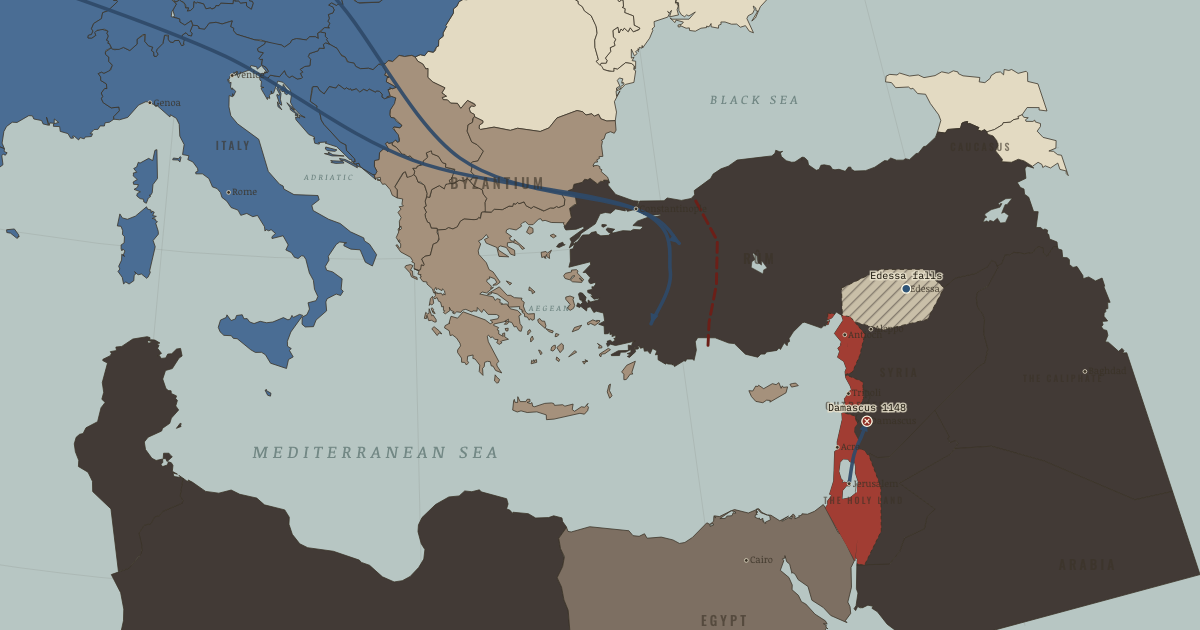
Edessa fell because it was always the most vulnerable of the four states, lying far inland beyond the reach of the Italian fleets and dependent, like all of Outremer, on its enemies staying divided. Its capture on Christmas Eve 1144 was both a strategic loss and a political opportunity, because it gave the emerging Muslim counter-crusade its first great victory and its first martyr-city. The idea that fighting the Franks was a religious duty rather than a local war did not arise on its own, however, but was deliberately built by poets, jurists and rulers, above all by Nur al-Din. He patronized scholars, preaching and public monuments that tied his own expansion to the defence of Islam and the recovery of Jerusalem, so that religious mobilization served at once to justify war on the Franks and to unite Muslim rivals under his rule.
The short answer
- Edessa’s fatal exposure. Of the four states, Edessa lay furthest from the coast and the Italian fleets, deepest in Muslim territory, and most dependent on a divided enemy. It was always the likeliest to fall first, and its loss in 1144 was the crack that started the long collapse.
- The counter-crusade, constructed. Read the Arabic sources and the jihad against the Franks looks less like a spontaneous reaction than a political project. Nur al-Din patronized scholars, revived the cult of Jerusalem, minted the language of holy war, and used it to justify uniting Muslim Syria under himself. Ideology here is a tool of state-building — the mirror image of Urban’s crusade.
- Distrust, Latin and Greek. The crusading armies destroyed themselves as much as the Turks destroyed them: poor coordination between Conrad and Louis, mutual suspicion with the Byzantines whose lands they crossed, and no shared command. The First Crusade’s enemies had been divided; now it was the crusaders who could not combine.
THE TURNING POINT
Edessa, 24 December 1144. The fall of the first crusader state does double work: it removes Outremer’s northern shield, and it hands the Muslim world a cause. Everything that follows — the Second Crusade’s summons, Nur al-Din’s rise, the making of Saladin — flows from this one storming. It is the moment the century turns from Frankish advance to Muslim recovery.
What it changed
Damascus lost to the enemy. The bungled siege drove the last friendly Muslim power into Nur al-Din’s hands; by 1154 he holds it, and Outremer is ringed by a single unified Syria. The crusade meant to strengthen the kingdom did the precise opposite.
Crusading discredited. The humiliation battered even Bernard’s towering reputation and produced a wave of recrimination and cynicism at home. When failure could no longer be blamed on the enemy, it was blamed on the crusaders’ sins — a corrosive habit of thought that would recur for a century.
The road to Saladin. Nur al-Din’s unified Syria will send an expedition to Egypt, and with it a young Kurdish officer named Yusuf — Saladin. The Second Crusade’s failure sets the stage on which the kingdom’s nemesis will step forward.
The full answer, argued
Because the strategic situation had inverted. The First Crusade exploited a divided enemy and enjoyed surprise and Byzantine help; the Second faced a Muslim Syria that was learning to combine, a Byzantium now alienated by the memory of Antioch, and its own fatal lack of coordination between the German and French kings. The disaster then compounded itself with the choice to attack friendly Damascus — a blunder that only makes sense as the product of divided counsels and ignorance of local politics, and which pushed the one useful Muslim ally into the enemy camp. The lesson the crusaders drew was the wrong one — that God was punishing their sins — when the real lesson was that holy zeal is no substitute for unity of command and knowledge of the ground.
An interesting fact
Zengi did not live to build on Edessa. In September 1146, while besieging the Euphrates fortress of Qalat Jabar — held by fellow Muslims — he was stabbed in his sleep by a servant named Yarankash whom, Ibn al-Athir reports, the atabeg had caught drinking his wine and had threatened with punishment come morning. The great Mosul chronicler’s obituary refuses to simplify: Zengi was a tyrant feared by his own people, he writes, and yet under him the lands knew order and the strong could not devour the weak — an assessment as double-edged as the counter-crusade he began.
This is the study layer of Second Crusade, chapter 5 of The Crusades, 1095–1291; the full index of the atlas is here.
Related questions
THE FREE PRINTABLE STUDY GUIDE
Join the Dispatch — a short welcome series, then a letter when a new atlas opens — and the printable study guide for The Crusades is yours now, free.
NO TRACKING · YOUR ADDRESS IS USED FOR THE DISPATCH AND NOTHING ELSE · UNSUBSCRIBE ANYTIME