WW2 · FEB 1945
Could and should the Allies have taken Berlin first?
The seminar question: “Could the Western Allies have taken Berlin first — and should they have?”
Germany’s last offensive in the west, through the Ardennes in December 1944, failed within weeks, and in January 1945 the Red Army drove from the Vistula to the Oder. Allied armies liberated camps including Auschwitz, Buchenwald and Bergen-Belsen, exposing the Holocaust. Germany surrendered unconditionally on 8 May.
WW2 is free — every chapter. No sign-up.
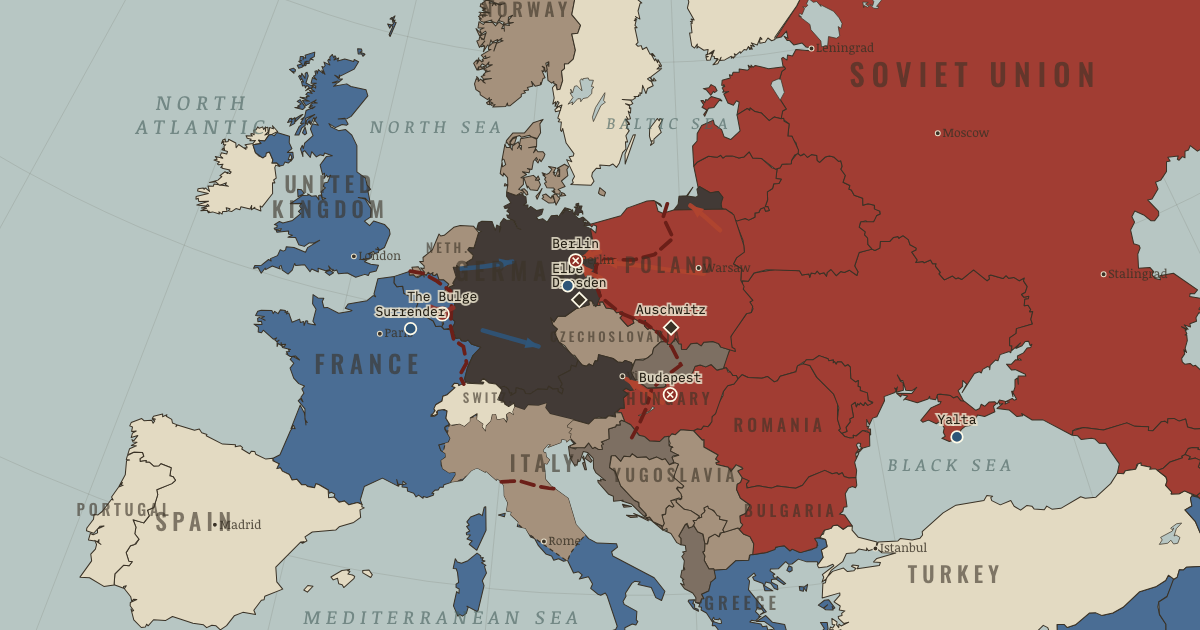
Germany’s final offensive in the west opened in the Ardennes in December 1944, when Hitler gambled on splitting the British and American armies, seizing the port of Antwerp, and forcing a political rupture among the Allies. The attack achieved surprise but lacked the fuel, transport, and reserves its objective demanded, so it failed within weeks and consumed forces that Germany desperately needed for its own defence. In January the Soviet Vistula–Oder offensive advanced roughly 500 kilometres in three weeks, carrying the Red Army to the threshold of the German heartland.
The short answer
- Why fight to annihilation?. No 1918-style armistice was possible: the Allies demanded unconditional surrender (Casablanca, 1943), the regime’s crimes left its leaders nothing to negotiate for, Goebbels’ propaganda made “Bolshevik vengeance” the alternative to resistance, and the terror apparatus hanged “defeatists” from lampposts to the last week. States rarely fight to the death; regimes that cannot survive peace do.
- The Bulge’s false premise. Hitler believed the “unnatural alliance” of capitalists and communists would shatter if struck hard enough. It was projection: the Axis was the alliance that never coordinated. The West and the USSR distrusted each other deeply — and still never stopped cooperating operationally.
- Yalta: drawing the after. In February 1945 Roosevelt, Churchill and Stalin agreed on occupation zones, a United Nations, and “free elections” in liberated Europe — words each side heard differently. The map at war’s end, not the communiqué, would decide what they meant.
THE TURNING POINT
Berlin, 16 April–2 May. Stalin sets his two marshals racing each other into the capital — 2.5 million men against a garrison of old men, boys and broken divisions. It costs the Red Army ~80,000 dead to take the city. On 30 April, as Soviet troops storm the Reichstag, Hitler kills himself; the Thousand-Year Reich survives him by eight days.
What it changed
The Holocaust enters the world’s conscience. The camps’ liberation makes the crime undeniable and demands new words and new law: “genocide” (coined 1944), the Nuremberg trials’ “crimes against humanity” (1945–46), the Genocide Convention (1948), and Israel’s founding context (1948). “Never again” becomes the postwar world’s moral yardstick — endlessly invoked, imperfectly honored.
Europe, Year Zero. Forty million dead, tens of millions displaced or expelled (including twelve million ethnic Germans from the East), cities of rubble, borders shifted west — Poland’s whole territory slides 200 km, as your map’s modern outlines quietly reflect. From this ruin: the welfare states, the UN, and eventually the European project, all built by people determined that this must never repeat.
Where the armies stand. The Elbe handshake line is not just a photo op — it is tomorrow’s border. Scrub forward one snapshot and see Chapter 15.
The full answer, argued
A western advance was militarily possible, but Eisenhower expected high casualties for territory assigned to the Soviet occupation zone. Churchill placed greater weight on postwar leverage. The judgment depends on uncertain casualty estimates, whether possession could have changed agreed zones, and how unavoidable one considers the coming Cold War.
An interesting fact
The victims documented the crime themselves. In the Warsaw ghetto, the historian Emanuel Ringelblum’s secret Oyneg Shabes group — teachers, rabbis, economists, writers — gathered tens of thousands of pages of testimony, diaries, underground press, even candy wrappers and tram tickets, and buried them in milk cans and tin boxes so the world would learn what happened from the murdered rather than the murderers. Ringelblum was executed in 1944; two caches were dug from the rubble in 1946 and 1950, and a third has never been found. The archive is inscribed today in UNESCO’s Memory of the World register.
This is the study layer of End of WW2 in Europe, chapter 13 of The War Room — WW2, 1936–1945; the full index of the atlas is here.
Related questions
THE FREE PRINTABLE STUDY GUIDE
Join the Dispatch — a short welcome series, then a letter when a new atlas opens — and the printable study guide for WW2 is yours now, free.
NO TRACKING · YOUR ADDRESS IS USED FOR THE DISPATCH AND NOTHING ELSE · UNSUBSCRIBE ANYTIME