WW2 · DEC 1941
Why did the Soviet Union not collapse in 1941?
The seminar question: “Every military expert — including most Allied ones — predicted Soviet collapse within weeks. Why were they all wrong?”
On 22 June 1941 Germany invaded the Soviet Union, driving on Leningrad, Moscow and Ukraine and taking over three million prisoners by winter. It was also a war of racial annihilation: the Einsatzgruppen shot Jews in their hundreds of thousands. The Soviet state did not break, and in December fighting reached Moscow’s gates.
WW2 is free — every chapter. No sign-up.
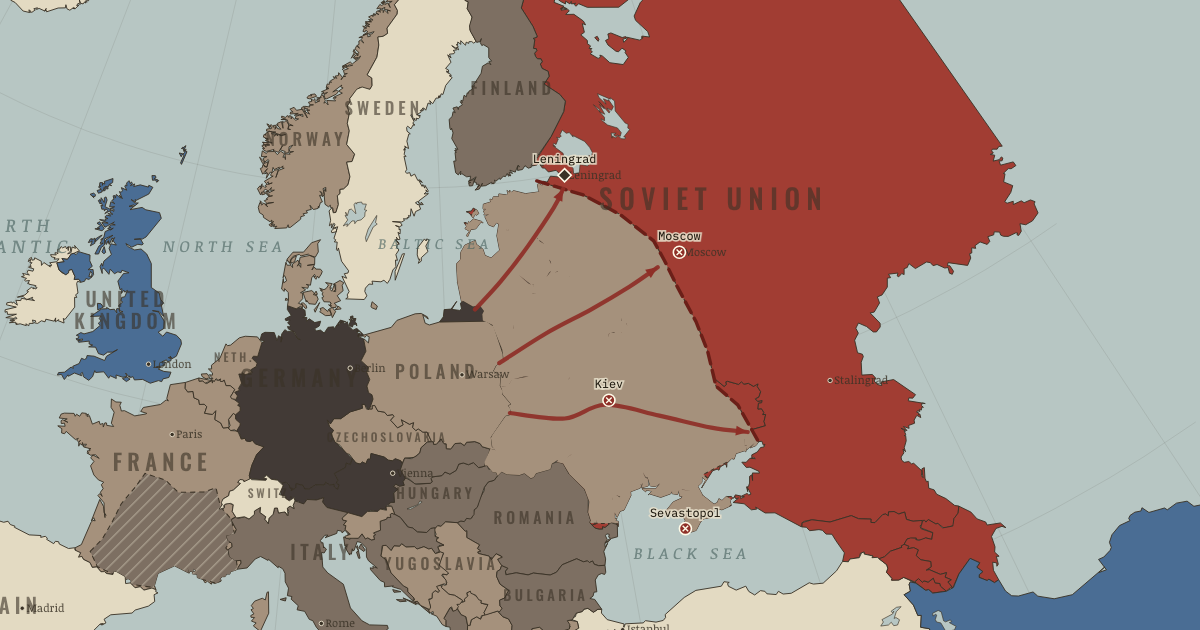
The German plan rested on a single gamble, which was that the Soviet state would collapse if its frontier armies were destroyed quickly enough. Around 3.6 million Axis troops crossed the border in the largest invasion in history, and three army groups drove toward Leningrad, Moscow, and Ukraine. German mobile formations trapped and destroyed enormous Soviet forces at Minsk, Smolensk, and Kiev, taking more than three million prisoners by winter. Each victory seemed to confirm the plan, yet the state behind those armies did not break, and the deeper the Germans advanced, the more clearly the limits of their own supply became a problem they could not solve.
The short answer
- Ideology: Lebensraum and the “Jewish-Bolshevik” enemy. For Hitler this was always the real war — colonial conquest of the East, enslavement of Slavs, annihilation of Jews and communists. The economic and strategic arguments were rationalizations layered on a fixed racial-imperial goal. You cannot explain 1941 without ideology.
- “Kick in the door and the whole rotten structure comes down”. The purges (Stalin had shot most of his own senior officers in 1937–38) and Finland’s Winter War convinced Berlin the Red Army would collapse in weeks. German intelligence undercounted Soviet divisions by half — the greatest intelligence failure of the war.
- Britain’s last hope. With invasion impossible (Ch. 4), Hitler reasoned Britain fought on only in hope of Russia and America. Destroy Russia, and Britain must make peace before America was ready. The eastern war was also, in his mind, the fastest way to end the western one.
THE TURNING POINT
The gates of Moscow, 5 December. Zhukov — informed by his Tokyo spy Richard Sorge that Japan would strike south, not at Siberia — has quietly massed reserve armies. Their winter counteroffensive throws the frozen, exhausted Wehrmacht back 100–250 km. Germany has lost the only kind of war it knew how to win: a short one.
What it changed
A war of attrition Germany cannot win. From December 1941 the contest becomes factories, oil and manpower — categories in which the USSR (plus Lend-Lease) dwarfs the Axis. Every later German offensive is a search for a shortcut out of this arithmetic.
The Holocaust escalates to genocide. Mass shootings in the East — over a million dead by end of 1941 — lead to the Wannsee Conference (Jan 1942) coordinating a continent-wide “Final Solution”: deportation of Europe’s Jews to extermination camps in occupied Poland. This map’s grey zones hide the war’s deepest crime.
The Grand Alliance forms. Churchill, the arch anti-communist, pledges aid to Stalin the same day the invasion begins (“If Hitler invaded Hell…”). Days after Pearl Harbor, Hitler gratuitously declares war on the USA too — personally completing the coalition that will destroy him.
The full answer, argued
They projected early Soviet defeats forward and underestimated regeneration. Strategic depth, factory evacuation, mass mobilization, coercion, patriotism, and a war for survival kept the USSR fighting. German supply systems could not sustain the same tempo over vast distances. Visible battlefield losses concealed the Soviet state’s remaining capacity.
An interesting fact
Inside besieged Leningrad stood the world’s largest seed bank: the Vavilov Institute, hundreds of thousands of samples of wheat, rice and potato collected from five continents. Through the starvation winter of 1941–42 its scientists guarded the collection and refused to eat it — at least nine died of hunger at their posts, the rice curator among them, found beside full sacks of grain. The institute’s founder, the geneticist Nikolai Vavilov, was starving at the same time in an NKVD prison, where he died in 1943. The seeds were being kept for the harvests after the war — a quiet, absolute answer to a war of annihilation.
This is the study layer of Operation Barbarossa, chapter 6 of The War Room — WW2, 1936–1945; the full index of the atlas is here.
Related questions
THE FREE PRINTABLE STUDY GUIDE
Join the Dispatch — a short welcome series, then a letter when a new atlas opens — and the printable study guide for WW2 is yours now, free.
NO TRACKING · YOUR ADDRESS IS USED FOR THE DISPATCH AND NOTHING ELSE · UNSUBSCRIBE ANYTIME