WW2 · AUG 1940
Why was bombing London a war-losing mistake for Germany?
The seminar question: “Why was switching the bombing from airfields to London a war-losing mistake?”
After France fell in 1940, the Luftwaffe tried to destroy RAF Fighter Command so that Germany could invade Britain. Britain’s integrated system of radar, observers and control rooms held, and after the Luftwaffe shifted its main effort to London on 7 September, Hitler postponed the invasion on 17 September.
WW2 is free — every chapter. No sign-up.
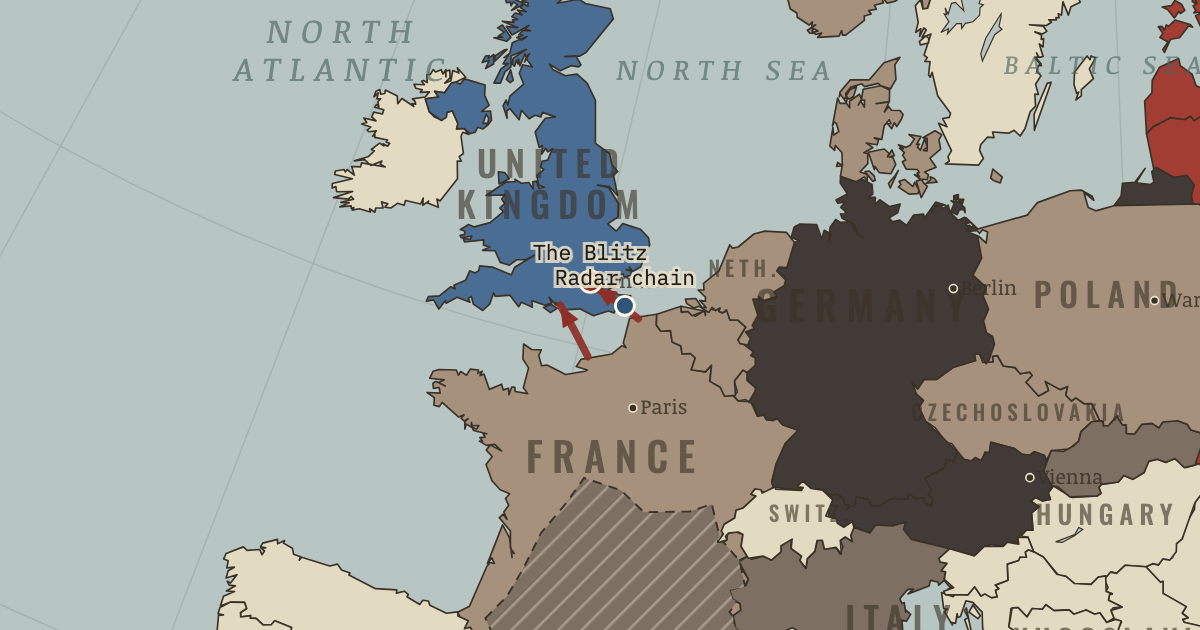
Operation Sea Lion, the German plan to invade Britain, depended entirely on winning control of the air. The German navy, battered in the Norwegian campaign, could not shield a slow invasion fleet from the Royal Navy while RAF Fighter Command remained effective, so the Luftwaffe set out to destroy that force. It struck at shipping, radar stations, sector airfields, and aircraft factories. Britain’s advantage lay in more than radar alone, because information gathered by radar and observers flowed into control rooms that then directed limited fighter forces to intercept incoming raids where they mattered most.
The short answer
- Sea Lion’s impossible arithmetic. Germany’s navy, gutted off Norway, could never protect an invasion fleet from the Royal Navy — unless the Luftwaffe owned the sky completely. Air superiority wasn’t one condition; it was the only condition.
- Hitler expected a deal. He never planned a war with Britain and half-hoped a show of force would bring negotiation. The air campaign was improvised, with no clear target priorities — and it showed.
- The world’s first integrated air defense. Chain Home radar, ground observers, and sector control rooms let Fighter Command see raids forming over France and meet them with exactly enough force. Germany never understood the system it was fighting — it kept attacking the planes and ignoring the network.
THE TURNING POINT
The system holds, 15 September. On “Battle of Britain Day” the Luftwaffe mounts its maximum effort against London — and radar-guided squadrons meet every wave. Losing 2:1, Berlin concludes the RAF is unbreakable. Two days later, invasion is postponed indefinitely.
What it changed
The first hinge. Britain’s survival keeps a western front possible — the aircraft carrier off Europe’s coast from which everything in 1944 will be launched.
Hitler turns east early. If Britain won’t fall, Hitler reasons, her last hope is Russia — so destroy Russia and Britain must yield. Barbarossa planning begins in earnest that autumn, in strategic frustration as much as ideology.
America starts to lean in. Britain’s stand — broadcast nightly into US living rooms during the Blitz — shifts American opinion. Destroyers-for-bases, then Lend-Lease (March 1941): the “arsenal of democracy” starts arming the fight it hasn’t joined.
The full answer, argued
Fighter Command was the military system blocking invasion. Sustained attacks on its airfields and trained pilots threatened that system. The shift toward London dispersed German effort and gave parts of the defense time to recover. Bombing civilians caused immense harm but did not create surrender. The judgment needs caution: Fighter Command was under pressure, not certainly days from collapse.
An interesting fact
Nearly one in five of the “Few” was not British: Fighter Command’s roll that summer includes 145 Poles, 88 Czechoslovaks, and pilots from a dozen other nations — among them a handful of Americans who had slipped into Canada to enlist while their own country was still neutral. No. 303 (Polish) Squadron, committed to battle only on 31 August, finished as one of the highest-scoring units of the entire battle. The airmen of the country partitioned in Chapter 2 helped save the island from which its liberation would one day be staged.
This is the study layer of Battle of Britain, chapter 4 of The War Room — WW2, 1936–1945; the full index of the atlas is here.
Related questions
THE FREE PRINTABLE STUDY GUIDE
Join the Dispatch — a short welcome series, then a letter when a new atlas opens — and the printable study guide for WW2 is yours now, free.
NO TRACKING · YOUR ADDRESS IS USED FOR THE DISPATCH AND NOTHING ELSE · UNSUBSCRIBE ANYTIME