Cold War · JAN 1977
Was détente a failure because it collapsed?
The seminar question: “Détente collapsed within a decade. Was it therefore a failure?”
Détente was managed rivalry resting on a three-sided balance: the Sino-Soviet split let Nixon open relations with China in 1972 and press Moscow to negotiate. SALT I, the ABM Treaty and the Helsinki Accords of 1975 reduced several dangers, but rival interventions wore détente down before the invasion of Afghanistan ended it.
Chapter 9 is part of membership. WW2 is free — every chapter. Try chapters 1–2 of any 2 other atlases (3 with a free account). Opening a new atlas uses one of them. Membership opens all 21 — Join.
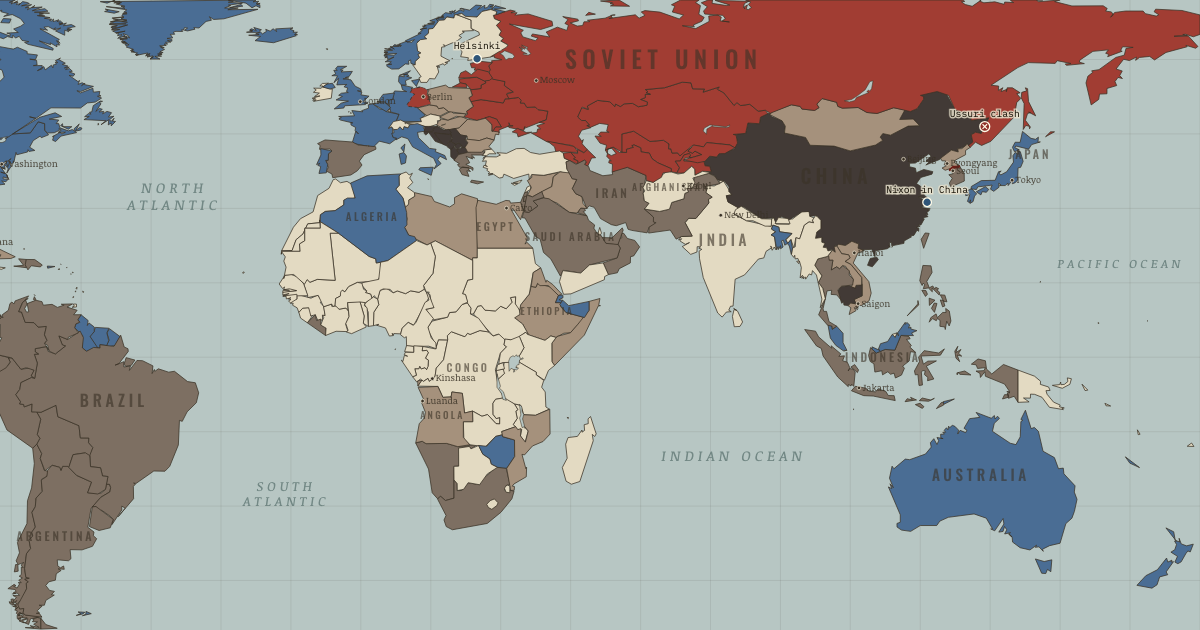
By 1969 all three of the major powers had reasons to ease the confrontation. Washington was bleeding in Vietnam and straining its economy, Moscow faced a hostile China as well as NATO, and Beijing feared a Soviet attack more than an American one. Nixon and Kissinger exploited this triangle by improving relations with China, which pushed an anxious Moscow toward summit diplomacy of its own. The whole movement rested on a cold calculation of interest rather than on any reconciliation of ideologies.
The short answer
- The split that made the triangle possible. The Sino-Soviet alliance died of accumulated insults: Khrushchev’s de-Stalinization (undermining Mao’s cult by proxy), his retreat at Cuba (“capitulationism”), the withdrawn nuclear tutors of 1959, and underneath it all the question of who leads world revolution. By 1969 two communist armies were shooting at each other across the Ussuri. The “monolith” Washington had spent twenty years containing had already broken itself. Kissinger’s insight was not creating the split but pricing it: be closer to each communist power than they are to each other, and both will pay for the privilege.
- Parity made arms control rational. SALT I froze launcher numbers and the ABM Treaty banned nationwide missile defenses. Deliberately preserving mutual vulnerability, the cold logic of MAD: if neither side can hope to survive a first strike, neither strikes. Critics called it institutionalized madness. Its defenders answered that it was the only stable equilibrium two scorpions in a bottle could reach. Note what it did not cover. Warheads (MIRVs multiplied through the loophole), theater weapons (the Euromissile crisis of Ch. 10 grows there). Arms control manages races, it does not end them.
- Economics pressed both ways. The USSR needed Western grain (harvest failures from 1972) and technology. America needed relief from a defense burden wrecking Bretton Woods (Nixon closed the gold window in 1971, ending the dollar’s convertibility. A Cold War cost signal). West Germany needed Eastern markets and family reunification. Détente was, among other things, a set of overdue invoices being netted against each other.
THE TURNING POINT
Beijing and Shanghai, 21–28 February 1972. “The week that changed the world” is barely an exaggeration: the map’s two largest anti-Western powers are now each other’s primary enemy, and both compete for Washington’s favor. Every Soviet decision thereafter is made with a second front in mind. A quarter of the Red Army ends up watching China, divisions that cannot watch NATO. Triangular diplomacy is the Cold War’s clearest demonstration that geometry can substitute for guns: nothing was fired, and the correlation of forces moved more than in any battle on this map.
What it changed
Helsinki’s slow fuse. Within two years of the signature: Moscow Helsinki Group (1976), Charter 77 in Prague, KOR in Poland. Dissidence reorganized as compliance monitoring, unpunishable in theory, persecuted in practice, and internationally visible either way. When Gorbachev later needed a language for reform and Eastern Europe needed one for exit, Helsinki had already written it. Basket III is the best case in this atlas for reading the fine print of “symbolic” agreements.
Détente’s decay: the periphery eats the center. Angola (1975), the Horn (1977–78), and Soviet-Cuban logistics behind both convince American critics that Moscow treats détente as cover for advance. Moscow answers that the Third World was never in the agreement. And that Egypt’s defection to Washington (Ch. 8) proves the West plays the same game. Both are right, which is the problem: a rules-based rivalry with no agreed rules for its most active front cannot hold. Afghanistan, December 1979, finishes it.
The dissenters institutionalize. A generation of American hawks. Team B, the Committee on the Present Danger. Builds the case that détente ratified Soviet gains and hid a buildup. Reagan will campaign on it. In Moscow, the military-industrial complex pockets parity and keeps building (the SS-20s that detonate the Euromissile crisis deploy from 1977, mid-détente). On both sides, the personnel and arguments of the Second Cold War are assembled inside the First Peace.
The full answer, argued
Judge it against its stated goal. Permanently stabilized coexistence. And it failed: by 1980 the powers were rearming and boycotting each other’s Olympics. Judge it against the counterfactual and it looks different: the ABM Treaty and SALT capped a race at its most dangerous inflection. The triangle deterred a Soviet strike on China that was seriously studied in 1969. Berlin was finally regularized (the 1971 Quadripartite Agreement. No Berlin crisis ever recurred). And Helsinki seeded the legitimacy collapse of 1989. The deepest reading: détente was less a policy that failed than a phase in which both empires, briefly honest about their limits, wrote documents their successors could not unwrite. Institutions built in moments of realism keep working after the realism ends. Which is an argument for building them.
An interesting fact
The triangle’s first public signal was a missed bus. At the world table-tennis championships in Nagoya in April 1971, the American player Glenn Cowan boarded the Chinese team’s shuttle by mistake, and three-time world champion Zhuang Zedong — breaking standing orders against contact with Americans — walked up the aisle and presented him with a silk-screen print of the Huangshan mountains. Mao, reading of the exchange, overruled his own foreign ministry and invited the US team to Beijing within days; three months later Kissinger feigned a stomachache in Islamabad and flew secretly to China to prepare what the ping-pong had begun.
This is the study layer of Détente and Nixon in China, chapter 9 of The Cold War, 1945–1991; the full index of the atlas is here.
Related questions
THE FREE PRINTABLE STUDY GUIDE
Join the Dispatch — a short welcome series, then a letter when a new atlas opens — and the printable study guide for The Cold War is yours now, free.
NO TRACKING · YOUR ADDRESS IS USED FOR THE DISPATCH AND NOTHING ELSE · UNSUBSCRIBE ANYTIME