Cold War · NOV 1983
Did Reagan end the Cold War or nearly start a nuclear war?
The seminar question: “Did Reagan’s pressure end the Cold War, or nearly end the world?”
In December 1979 the Soviet Union invaded Afghanistan to rescue a failing communist government, starting a nine-year war and ending détente. Soviet SS-20s and NATO’s Pershing II and cruise missiles raised tension in Europe, and in November 1983 Soviet intelligence read the Able Archer exercise as possible cover for an attack.
Chapter 10 is part of membership. WW2 is free — every chapter. Try chapters 1–2 of any 2 other atlases (3 with a free account). Opening a new atlas uses one of them. Membership opens all 21 — Join.
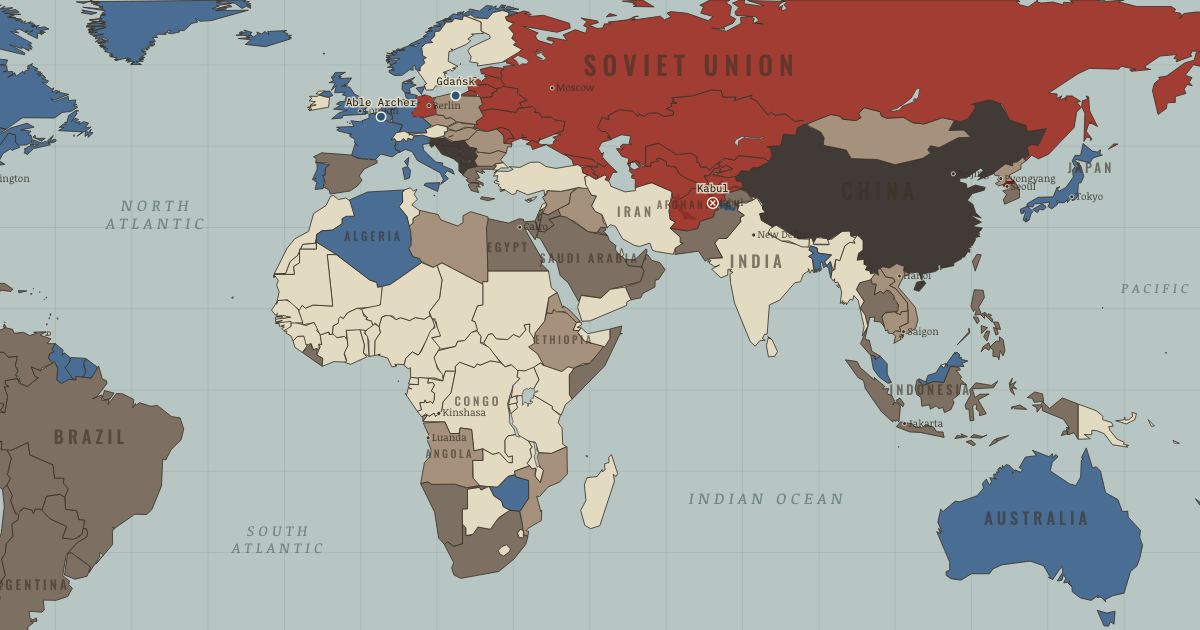
Soviet leaders had refused to intervene in Afghanistan many times before finally doing so in December 1979, because a friendly communist government there was collapsing under a revolt its own harsh reforms had provoked. What they intended as a brief stabilisation became a nine-year war, with Afghan deaths estimated between roughly half a million and two million, most studies clustering near a million, and about five million people driven into exile. American and allied support armed the resistance through Pakistan, and détente collapsed almost at once into a grain embargo, an Olympic boycott and a shelved arms-control treaty.
The short answer
- Afghanistan: the trap of the client state. Kabul’s communists seized power on their own in 1978 and set about radicalizing a devout rural society at gunpoint. Land decrees, literacy campaigns enforced by executions. Igniting the revolt that Moscow was then begged to suppress. The Politburo refused intervention a dozen times (“we would be fighting the people,” said Kosygin) before fear of losing the client. And, after Iran, of Islamist contagion into Soviet Central Asia. Overrode the analysis. Every file of the era says the same thing: they knew better, and went anyway, because empires price retreat higher than quagmire. Washington, reading global design where there was local panic, answered globally.
- The Euromissile spiral, a security dilemma in miniature. Moscow deployed SS-20s (1977) as a modernization. Mobile, accurate, aimed at Europe alone. Europe read a decoupling threat (would America trade Chicago for Hamburg?) and requested US missiles it then spent four years protesting. Each side’s theater fix was the other’s new terror. The 1983 deployments went ahead through the largest demonstrations in postwar European history. Moscow walked out of every arms talk. The episode is Chapter 1’s security dilemma with better rockets. And its resolution (Ch. 11’s INF Treaty, eliminating the entire class) shows the dilemma is escapable when one side changes the game’s premise.
- Reagan’s buildup: bankrupting strategy or dangerous bluff?. The case that it worked: SDI and the buildup confronted a Soviet economy already spending perhaps 15–20% of GDP on defense with a competition it could not join, strengthening Gorbachev’s reformist hand against his generals. The case that it nearly misfired: 1983 shows deterrence degrading into hair-trigger paranoia. Andropov’s USSR genuinely believed a first strike possible, and Able Archer plus the KAL 007 shootdown (a civilian airliner destroyed over Sakhalin that September) put the machinery on edge. Reagan himself, shaken by the war scare and by The Day After, pivoted toward negotiation in January 1984 (“a nuclear war cannot be won and must never be fought”). Hold both cases. The archives support both.
- Solidarity: the crack that martial law painted over. Gdańsk proved what Budapest and Prague had implied: the bloc’s workers, its official heroes, would organize against it the moment fear lapsed. Jaruzelski’s coup (13 Dec 1981) imprisoned the union but not the fact. Solidarity survived underground, funded by the AFL-CIO and the Vatican’s quiet networks, its very existence falsifying the system’s claim to represent labor. When the Round Table came in 1989, the negotiating partner was already formed. 1981’s defeat was 1989’s rehearsal.
THE TURNING POINT
Able Archer 83, 2–11 November 1983. A routine-for-NATO exercise. New codes, radio silence, leaders role-playing escalation. Meets a Soviet intelligence system ordered to find first-strike warning signs, and finds them. Warsaw Pact aircraft go to alert with nuclear loads. Nothing happens only because the exercise ends on schedule. The near-miss converts Reagan more than any briefing: “I feel the Soviets are so defense-minded, so paranoid…” he writes. The last act of the Cold War. Engagement, summits, INF. Begins as a direct response to how badly the second-to-last act almost ended.
What it changed
Afghanistan bleeds the metropole. The war costs the USSR 15,000 dead by the official count. Post-Soviet researchers argue the true figure may approach 26,000. Plus tens of billions of rubles, and its story about itself: draft-age coffins arriving in a country told nothing. It arms and trains transnational jihadism (a bill presented later to every party including America), and it hands Gorbachev his proof that the empire’s commitments exceed its means. He calls it “the bleeding wound” in 1986 and is out by February 1989.
The peace movements change the audience. Millions in Bonn, London, Amsterdam and New York (the June 1982 rally is the largest in US history to date) do not stop the deployments. But they make nuclear risk a mass political fact, push NATO into its “dual-track” negotiating posture, and build the Western constituency that will later embrace Gorbachev faster than Western governments do. Publics, too, are Cold War actors. 1983 is their loudest year.
The economics arrive on schedule. Oil prices. The subsidy that had floated Brezhnev’s stagnation. Collapse in 1986 from $30 toward $10. Soviet growth is by then near zero, its computers a generation behind, its grain imported. The Second Cold War did not create the Soviet crisis, but it priced every escape route except reform. Enter, in March 1985, a 54-year-old who believes reform is possible.
The full answer, argued
Disaggregate “pressure.” The buildup and SDI plausibly shifted Soviet elite calculations. Politburo records show real alarm at competing with American technology. And strengthened the argument for a reformer. But 1983 shows the same pressure producing not concession but paranoia: RYaN, KAL 007, Able Archer. What converted pressure into peace was the sequence. Pressure, then genuine engagement the moment a counterpart appeared (Reagan was writing private letters to Soviet leaders as early as 1981, and pivoted publicly in January 1984, a year before Gorbachev). Pressure without an exit ramp courts catastrophe. Ramps without pressure invite stalling. The craft is building both at once. And even then, the record says, you are betting on the other side producing a Gorbachev rather than an Andropov. Strategy proposes. Personnel disposes.
An interesting fact
Able Archer was the autumn’s second near-miss. On 26 September 1983, in a bunker south of Moscow, Lieutenant Colonel Stanislav Petrov watched the new Oko early-warning satellites report five American ICBMs inbound — and reasoned his way to “false alarm”: a real first strike, he judged, would not open with five missiles, and the ground radars showed nothing. The cause turned out to be sunlight glancing off high-altitude clouds. His decision stayed secret until the 1990s; he died in 2017, almost unknown in his own country.
This is the study layer of Afghanistan and the Second Cold War, chapter 10 of The Cold War, 1945–1991; the full index of the atlas is here.
Related questions
THE FREE PRINTABLE STUDY GUIDE
Join the Dispatch — a short welcome series, then a letter when a new atlas opens — and the printable study guide for The Cold War is yours now, free.
NO TRACKING · YOUR ADDRESS IS USED FOR THE DISPATCH AND NOTHING ELSE · UNSUBSCRIBE ANYTIME