WW2 · MAY 1942
Why was Pearl Harbor a strategic mistake for Japan?
The seminar question: “Pearl Harbor was one of the most successful surprise attacks in history. Make the case that it was also one of the worst strategic decisions ever made.”
Japan invaded China in 1937 but could not force a surrender, and its occupation brought mass atrocities such as the Nanjing Massacre. When it occupied southern Indochina in 1941, the US cut off its oil. Japan struck Pearl Harbor on 7 December 1941 and swept through Malaya, Singapore, the Philippines and the Dutch East Indies.
WW2 is free — every chapter. No sign-up.
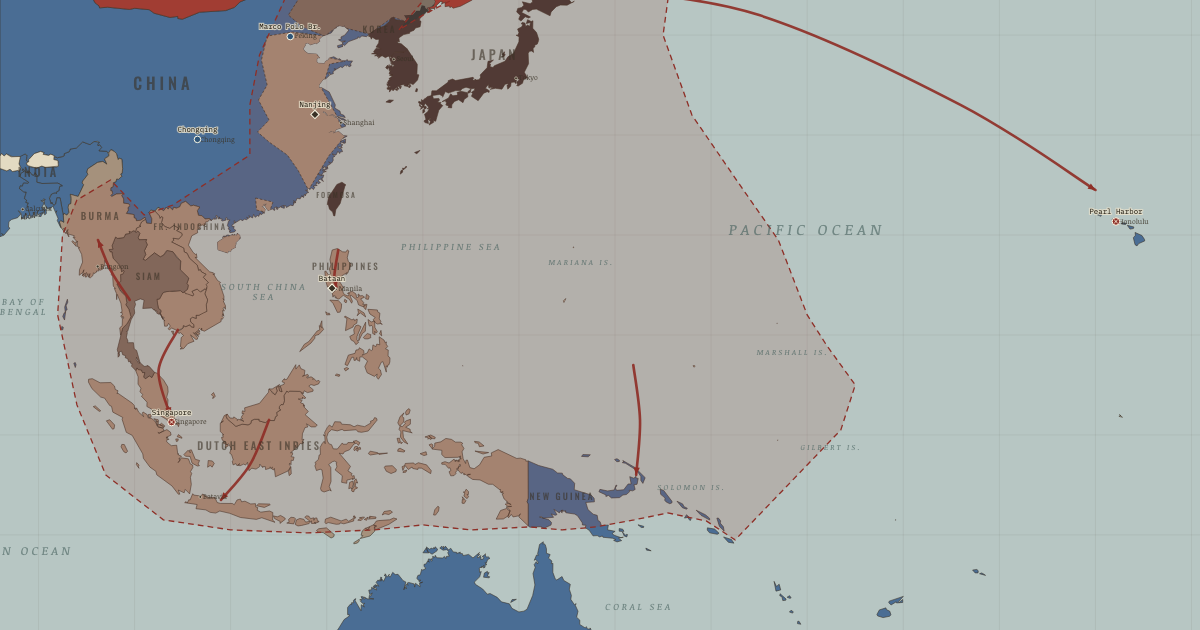
The conflict in Asia began well before the war in Europe. Japan had seized Manchuria in 1931 and launched full-scale war against China in 1937, capturing the coastal cities and the railways, but the Chinese state withdrew inland to Chongqing and fought on. Occupation brought systematic violence against the population, and the Nanjing Massacre included mass murder and sexual violence against civilians and prisoners, which this atlas treats as memorial history rather than as strategy. China’s continued resistance mattered strategically as well as morally, because it tied down a large share of the Japanese army that might otherwise have been used elsewhere.
The short answer
- An empire built on imported oil. Japan imported 80% of its oil, mostly from the USA. The July 1941 embargo (answering the Indochina occupation) started a countdown clock: fight soon with full tanks, or never fight at all. Economics set the timetable of Pearl Harbor almost to the month.
- The China quagmire. Four years of victories had produced no victory — Chiang Kai-shek traded space for time (sound familiar from Russia?), and Japan’s army demanded ever-wider war to justify sunk costs. Escalation as a substitute for strategy.
- Khalkhin Gol turns Japan south. In summer 1939 (see the marker on the Mongolian border) Zhukov crushed a Japanese army testing Siberia. Tokyo signed a neutrality pact with Moscow and pointed its ambitions at the resource-rich, European-owned south instead — a border battle you’ve never heard of that shaped the entire Pacific war, and freed the Siberian divisions that saved Moscow.
- The knockout-blow theory. Admiral Yamamoto — who had studied at Harvard and opposed the war — argued that if Japan must fight, its only chance was to destroy the US fleet on day one and win a big enough buffer that America would negotiate rather than pay the price of taking it back. He never believed it would work: “I shall run wild for six months … after that I have no expectation of success.”
THE TURNING POINT
Pearl Harbor, 7 December 1941. Tactically brilliant: eight battleships hit for the loss of 29 aircraft. Strategically self-defeating: the American carriers were at sea, the oil tanks and shipyards were barely touched — and a divided, isolationist America became a united, vengeful one overnight.
What it changed
The sleeping giant. US industry, one-tenth mobilized, out-produces the entire Axis within a year — by 1944 America launches more ship tonnage every month than Japan builds all year. Yamamoto’s six months prove almost exactly right.
Hitler’s strangest decision. Four days after Pearl Harbor, Germany declares war on the United States — obliging nobody, uniting everybody. Roosevelt’s “Germany first” strategy now faces no political obstacle.
Empires lose their aura. Singapore’s surrender — 80,000 troops to a smaller Japanese force — shatters the myth of European invincibility in Asia forever. Whatever happens next, the colonial world of 1939 is not coming back; the roads to Indian, Indonesian and Vietnamese independence all pass through 1942.
The full answer, argued
The attack met its immediate military aim but undermined its political aim. It missed carriers and key base infrastructure, while unifying a previously divided United States. Japan needed America to negotiate before superior US industry took effect. Pearl Harbor instead made negotiation politically impossible and full mobilization likely.
An interesting fact
Tokyo meant the Pearl Harbor strike to follow — by about half an hour — a formal note breaking off negotiations. But the message came in fourteen parts, the embassy was ordered to let no secretary see it, and the diplomats, typing it themselves and badly, delivered it nearly an hour after the bombs fell. American codebreakers reading the “Magic” intercepts had finished decoding it before the Japanese embassy did — and even delivered on time, the note declared no war; it merely ended the talks.
This is the study layer of Japanese expansion and Pearl Harbor, chapter 7 of The War Room — WW2, 1936–1945; the full index of the atlas is here.
Related questions
THE FREE PRINTABLE STUDY GUIDE
Join the Dispatch — a short welcome series, then a letter when a new atlas opens — and the printable study guide for WW2 is yours now, free.
NO TRACKING · YOUR ADDRESS IS USED FOR THE DISPATCH AND NOTHING ELSE · UNSUBSCRIBE ANYTIME