Cold War · DEC 1991
Did the Cold War really end without a war?
The seminar question: ““The Cold War ended without a war.” Defend and attack that sentence using three markers and two snapshots from this atlas.”
Germany reunified in October 1990 with Soviet consent. In August 1991 hardliners detained Gorbachev, but their coup collapsed within about sixty hours. After some 90 per cent of Ukrainian voters chose independence on 1 December, the leaders of Russia, Ukraine and Belarus dissolved the USSR, and Gorbachev resigned on 25 December.
Chapter 12 is part of membership. WW2 is free — every chapter. Try chapters 1–2 of any 2 other atlases (3 with a free account). Opening a new atlas uses one of them. Membership opens all 21 — Join.
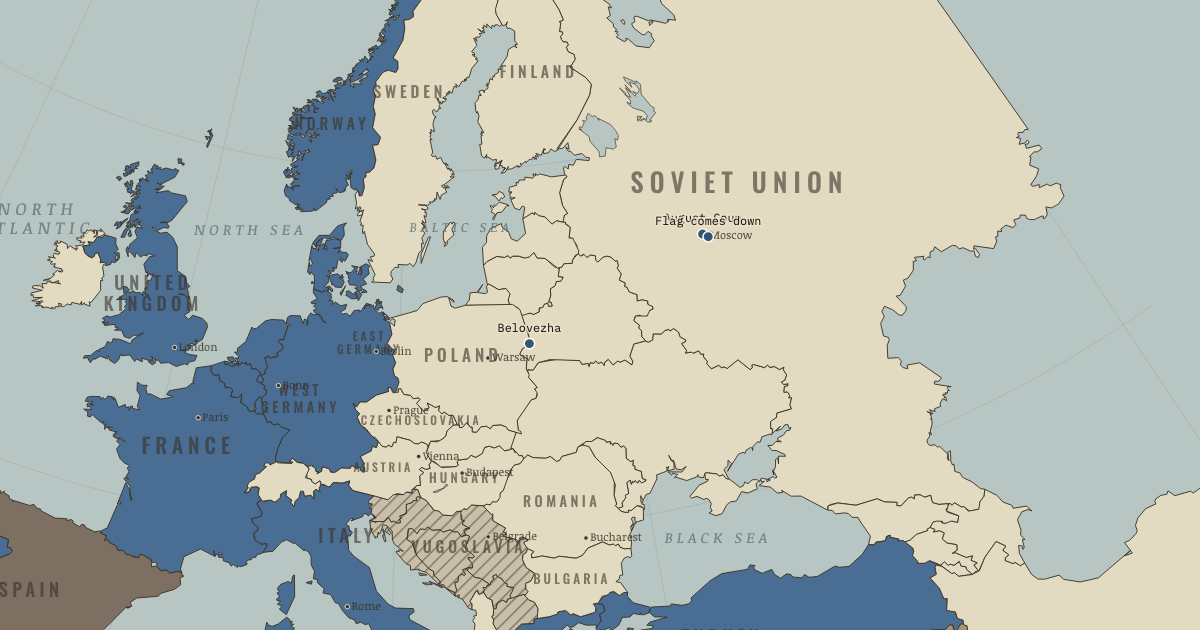
Germany reunified in October 1990 with Soviet consent, as Gorbachev, by now dependent on Western credits and drawn to the idea of a “common European home,” accepted the very outcome every predecessor had armed to prevent. Inside the USSR his balancing act was failing in both directions at once, because reformers around Boris Yeltsin, newly elected as president of Russia, pressed for faster sovereignty while hardliners demanded restoration of the old order. In August 1991 the hardliners struck, detaining Gorbachev and sending armour into Moscow, and their attempt collapsed within about sixty hours once crowds resisted and the troops refused to fire.
The short answer
- The August coup: the ratchet that broke. The plotters. KGB chief, defense minister, prime minister: the state’s own core. Had every instrument of Soviet power except one: a society still willing to obey it. Six years of glasnost had produced independent miners’ unions, elected deputies, free newspapers and a Russian president with his own mandate. The Taman division’s crews defected to the crowds they were sent to disperse, and three young men died stopping armor. The coup proved the hardliners’ own thesis. The union could survive only by force. And then proved force unavailable. After August, the question was not whether the USSR would end but on whose signature.
- Ukraine votes, and the union is arithmetic. On 1 December 1991, 90.3% of Ukrainian voters. With majorities in every region, including Crimea. Chose independence. Without Ukraine (a quarter of Soviet population and industry, the second republic), no union worth the name existed, and Yeltsin’s Russia preferred sovereignty over subsidizing the periphery anyway. Belovezha a week later ratified a fact the ballot had created. Note the instrument: the empire assembled by armies (Ch. 1) was dissolved by referendums and signatures. The era’s method had genuinely changed.
- An economy that could no longer buy time. 1991 Soviet GDP was collapsing at double digits. Gold reserves were nearly gone, the harvest was rotting unshipped, and Moscow was requesting Western food credits while its republics withheld taxes. The planned economy had failed slowly for twenty years and then all at once. And unlike 1956 or 1968, there was no cushion (oil price, terror, faith) left to absorb the failure. Whatever weight you give Reagan’s pressure or Gorbachev’s choices, the material floor gave way beneath both.
THE TURNING POINT
Belovezha, 8 December 1991. Three men in a forest lodge dissolve a nuclear superpower with a preamble: the USSR “as a subject of international law and a geopolitical reality is ceasing its existence.” They phone the US president before the Soviet one. It is the quietest hinge in this atlas. No battle, no crowd, a fax machine. And the most complete: 74 years of the Soviet project, 46 of bipolar world order, end as a change of letterhead. The armies that drew this map in 1945 (Ch. 1) are not consulted. That, more than anything, is what had changed.
What it changed
Who ended it? The four-way argument. Pressure (Reagan school): the buildup and SDI made the arms race unaffordable and emboldened reformers. Choice (Gorbachev school): nothing required a Soviet leader to renounce force. A Li Peng in Moscow shoots, and this atlas ends differently. Structure (economics school): a 1970s-technology command economy at 15–20% defense burden was doomed regardless. Leaders only chose the exit’s date and decency. People (1989 school): Solidarity, Leipzig, the Baltic chain. Legitimacy was withdrawn from below, and no Kremlin decision could have restored it. The honest synthesis: structure set the stage, pressure raised the rent, Gorbachev declined to burn the theater, and the audience walked out. Weight them yourself. The exam will not, but history teachers forever will.
What the new map inherits. Nuclear arsenals in four sudden states (Ukraine, Belarus, Kazakhstan disarm by treaty within years. A nonproliferation triumph with a long shadow). Yugoslavia already dissolving into Europe’s first wars since 1945. The hatching on this final map. NATO victorious and open-ended. Russia, shorn of empire and depression-struck, nursing the narrative that it was not defeated but dismantled. The post-Cold-War order’s crises. Expansion debates, frozen conflicts, the 2014 and 2022 wars over exactly the Belovezha borders. Are footnotes to this snapshot. The era ended. Its map kept legislating.
The ledger of the “long peace”. No direct great-power war in 46 years. Deterrence, bipolar discipline, or luck (Ch. 6 says: all three). But the chart below counts what “cold” cost where the war was hot: Korea, Vietnam, Afghanistan, Angola, Cambodia, Ethiopia, Central America. Something like 20 million people died in Cold War-connected conflicts, almost none of them in Europe, most of them in the countries this atlas’s Chapter 8 insists were players and not squares. Both facts. The peace and the price. Are true. Keeping them in one sentence is the era’s epitaph.
The full answer, argued
Defense: between the superpowers it holds absolutely. Pick m-b59 and m-ablearcher as the near-misses that stayed near, and the e89→e91 snapshots showing an empire dissolving with Soviet garrisons standing down in place. No Kursk, no Berlin 1945, ends this map. Attack: pick any three of m-pyongyang-bomb, m-tet, m-kabul, m-luanda, m-khmer and the w62→w75 snapshots, and the sentence collapses into a European parochialism. The war was continuously hot from Korea to Angola, killing millions who never saw the “long peace.” The synthesis is the atlas’s core lesson: where the map was drawn in 1945 by two armies facing each other, deterrence froze it. Where the map was still being drawn. The decolonizing world. The Cold War was fought with live ammunition, by proxy, in other people’s houses. Whether you call the era a peace depends on where you stand on the map. That is true of most history. This atlas just makes it visible.
An interesting fact
The decree dissolving a superpower was signed with a borrowed pen. On 25 December 1991, live on CNN, Gorbachev found that his Soviet felt-tip would not write and turned to the network’s president, Tom Johnson, asking whether the offered pen was American — “No, sir,” Johnson said, “it’s either French or German” — before signing with the Mont Blanc. Minutes later the cheget, the nuclear command briefcase, was handed across to Yeltsin’s officers, and the red flag over the Kremlin came down in front of a handful of bystanders.
This is the study layer of End of the Cold War, chapter 12 of The Cold War, 1945–1991; the full index of the atlas is here.
Related questions
THE FREE PRINTABLE STUDY GUIDE
Join the Dispatch — a short welcome series, then a letter when a new atlas opens — and the printable study guide for The Cold War is yours now, free.
NO TRACKING · YOUR ADDRESS IS USED FOR THE DISPATCH AND NOTHING ELSE · UNSUBSCRIBE ANYTIME