Crusades · 1291
Were the crusades worth it, or is that the wrong question?
The seminar question: “Two centuries, perhaps a million lives, Jerusalem held for less than a lifetime — were the crusades “worth it,” and is that even the right question?”
By 1291 mainland Outremer was gone, Cyprus alone remained Latin and Muslim Iberia had shrunk to Granada; a Christian-held Jerusalem had lasted less than a lifetime. Their legacies include the Rhineland massacres of 1096, the weakening of Byzantium in 1204, a lasting Catholic–Orthodox grievance and a portable model of holy war.
Chapter 12 is part of membership. WW2 is free — every chapter. Try chapters 1–2 of any 2 other atlases (3 with a free account). Opening a new atlas uses one of them. Membership opens all 21 — Join.
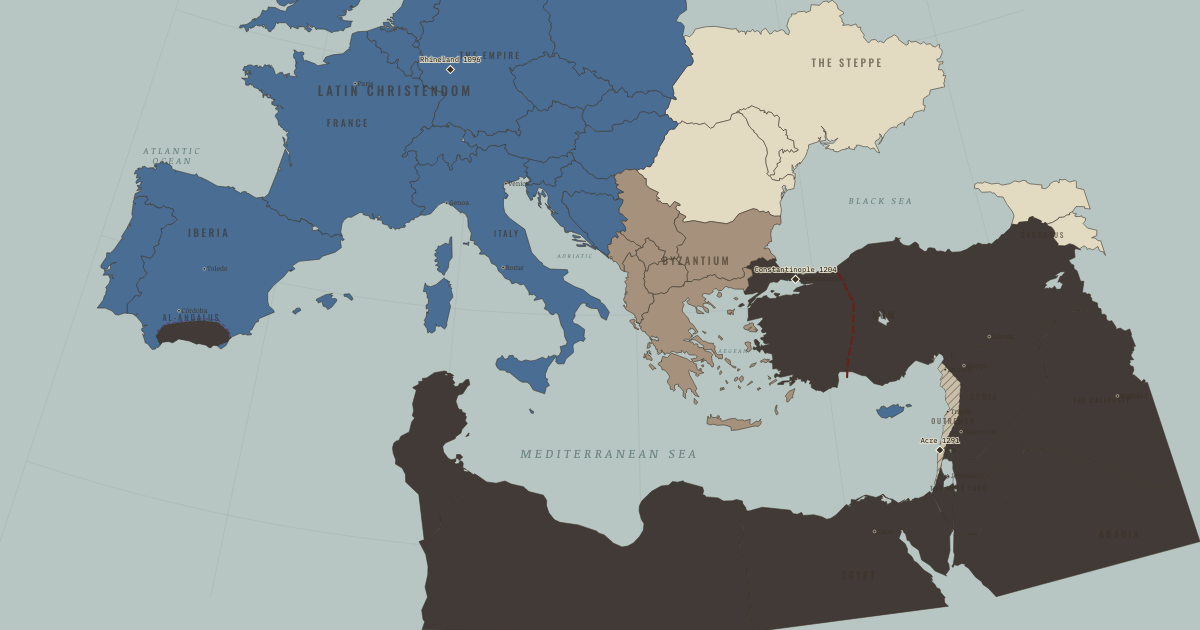
The final map shows the mainland states gone, Cyprus still Latin and al-Andalus reduced to Granada, the outcome of two centuries of holy war and perhaps a million lives, though the cost chart carries every caveat because medieval death tolls are the least reliable numbers in this atlas. Weighing what the crusades actually made requires the discipline of the counterfactual, of asking what would have happened without them. On the side of gain, the Levant trade enriched the Italian republics and Arabic and Greek learning flowed into the Latin West, yet Venice and Genoa were already trading east and the translators of Toledo and Sicily were already at work, so the crusades accelerated contacts that broader forces were making in any case. The benefits were real but largely conditional, and incidental gain should not be allowed to become a retrospective justification.
The short answer
- The states were always demographically hollow. Chapter 3’s tyranny of numbers is the deepest cause of the ending: a thin settler elite, ringed by a larger power and dependent on that power staying divided, could not survive the unification of its enemies. Once Zengi, Nur al-Din, Saladin and the Mamluks combined the Muslim Near East, the fall of Outremer was a question of when, not whether.
- Islam unified; Christendom did not. The century-long Muslim trend was cumulative — each leader built on the last toward a single power. The Christian crusades were episodic, rivalrous and divided, forever refighting the First Crusade’s lucky moment against an enemy that had learned. The asymmetry of unity, more than any single battle, decided the outcome.
- The idea outgrew the place. By 1300 crusading energy had spread to Iberia, the Baltic, the war on heretics and the papacy’s political enemies (Ch. 9). The Holy Land lost its monopoly on the idea even before it was lost in fact — which is why the movement could survive the death of the thing it was named for.
THE TURNING POINT
Acre, 18 May 1291 — the end, and the beginning of memory. The fall of the last city ends the crusader states but opens their contested afterlife. Almost at once, Acre becomes a symbol — of loss, of martyrdom, of a project to be revived or repudiated — and it has been argued over ever since. The most important thing the crusades made may be the long, unfinished quarrel about what they meant.
What it changed
A catastrophe for Europe’s Jews. The pogroms of 1096 and their successors mark a lasting worsening of Jewish life in Christendom — expulsions, ghettoization, blood libel — that far outlived the crusades themselves. It is the venture’s clearest and most terrible domestic legacy.
A maimed Byzantium, an advancing Islam. The wound of 1204 and the fall of Outremer left the eastern Mediterranean open; a weakened Byzantium fell to the Ottomans in 1453, and the frontier of Islam and Christendom moved into Europe. A crusade against Islam helped, in the end, to open Europe to it.
A word that would not die. “Crusade” survives as metaphor, honoured and abused, down to the present day. Read it always with the history and not the slogan: the medieval reality was stranger, sadder and more human than any modern use of the word admits.
The full answer, argued
“Worth it” is largely the wrong question because it imposes a modern cost-benefit calculation on a penitential and religious act. Those who went were not investing for a return. They believed they were answering God and saving their souls. Judged as strategy, the crusades failed over two centuries to secure their stated aim. Judged as a human phenomenon, they produced some exchange in trade and knowledge, although other forces were already driving that exchange. They also produced unmistakable harm: assaults on Europe’s Jews, the maiming of Byzantium, and poisoned relations between Christians and Muslims and between Catholics and Orthodox Christians. The historian’s task is not to award a score. It is to explain why people believed strongly enough to die for a distant city, how a fragile settler society lasted so long, and why it eventually fell. Understanding is more useful than either triumphalism or inherited guilt.
An interesting fact
Saladin’s modern fame has a strange itinerary. His Damascus tomb had fallen into neglect when Kaiser Wilhelm II visited in 1898, laid a gilded bronze wreath and paid for a new marble sarcophagus — a European romantic’s tribute, for the sultan’s towering modern reputation was partly re-imported from Western chivalric legend, which had kept his memory brighter than Muslim tradition itself did. Twenty years later T. E. Lawrence lifted the Kaiser’s wreath from the tomb as Ottoman Damascus fell; it sits today in the Imperial War Museum in London. The memory of the crusades, like the crusades themselves, keeps being taken up by later hands for present purposes.
This is the study layer of Legacy of the Crusades, chapter 12 of The Crusades, 1095–1291; the full index of the atlas is here.
Related questions
THE FREE PRINTABLE STUDY GUIDE
Join the Dispatch — a short welcome series, then a letter when a new atlas opens — and the printable study guide for The Crusades is yours now, free.
NO TRACKING · YOUR ADDRESS IS USED FOR THE DISPATCH AND NOTHING ELSE · UNSUBSCRIBE ANYTIME