Crusades · 1191
Was Richard I right not to try to hold Jerusalem?
The seminar question: “Richard beat Saladin at Arsuf and Jaffa but never tried to hold Jerusalem. Was that failure or realism?”
The Third Crusade brought three kings east, but Frederick Barbarossa drowned in the Saleph and Philip II left early. Richard I seized Cyprus, helped take Acre, where he had some 2,700 prisoners executed, and beat Saladin at Arsuf in 1191, yet never tried to hold Jerusalem; his 1192 treaty kept a reduced coastal state.
Chapter 7 is part of membership. WW2 is free — every chapter. Try chapters 1–2 of any 2 other atlases (3 with a free account). Opening a new atlas uses one of them. Membership opens all 21 — Join.
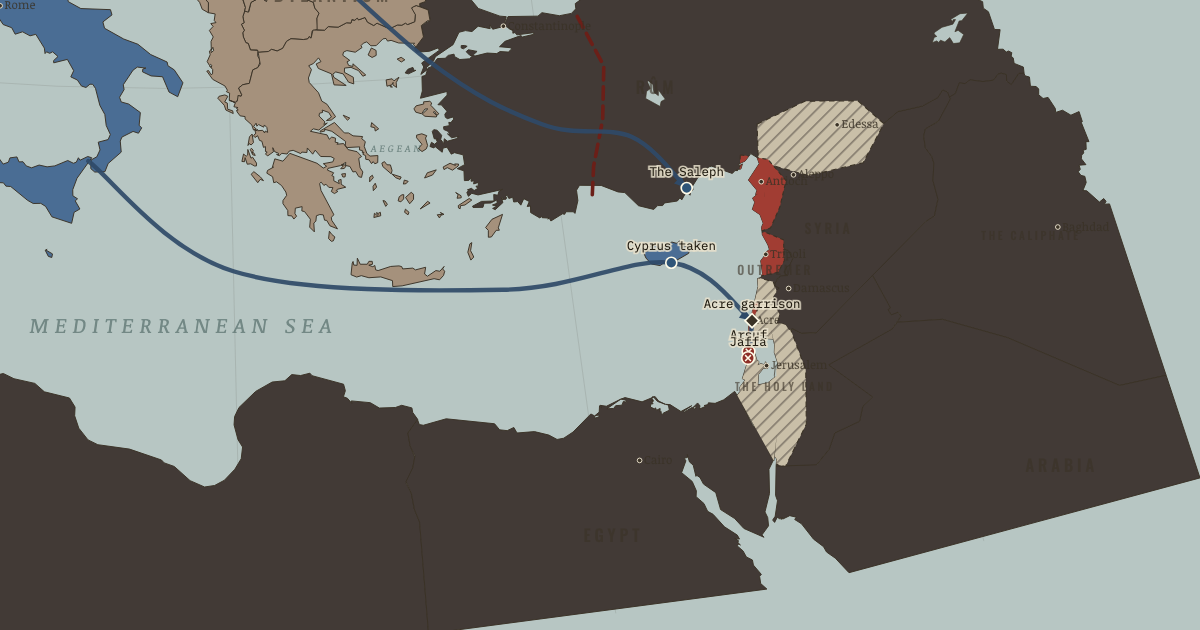
The Third Crusade lost much of its strength before it could be used. Frederick Barbarossa marched a huge German army overland only to drown in the Saleph in Cilicia in 1190, after which his force dissolved in grief and disease, so that the strongest of the three crusaders never arrived. Richard the Lionheart sailed instead, and on the way seized Cyprus from its Byzantine ruler in an unplanned conquest that turned out to be the crusade’s most durable prize, a Latin kingdom that would outlast every state on the mainland by three centuries. The long siege of Acre finally ended in 1191, and it was there that the campaign’s worst act took place.
The short answer
- The shock of 1187. The loss of Jerusalem and the True Cross galvanized Europe as nothing had since 1095. Kings who were bitter rivals at home all took the cross — which is also why the crusade was riven by their feuds the moment they arrived.
- The logistics of holding Jerusalem. This is the strategic heart of the chapter. Taking the inland city was conceivable; holding it, ringed by Muslim Syria and supplied from an Egypt in enemy hands, was not. Richard grasped that the Holy Land could ultimately be secured only by conquering Egypt — the insight that would drive every crusade after him.
- Exhaustion, personal and political. Richard had to go home: his rival Philip of France had already left to intrigue against his lands, and his brother John was scheming. Saladin’s emirs, too, were spent after years of war. The treaty of 1192 was the peace of two exhausted men who each needed it.
THE TURNING POINT
Arsuf, 7 September 1191. Arsuf proved that a disciplined crusader army could still beat Saladin in a straight fight — and, in the same stroke, proved that winning battles no longer won the war. Richard could defeat the sultan in the field and still not hold Jerusalem, because the problem was no longer tactical but strategic and logistical. The chapter’s deepest point is in that gap between victory and result.
What it changed
A rescued but truncated kingdom. Outremer survives — as a coastal strip governed from Acre, with Jerusalem a pilgrimage destination rather than a possession. The states will last another century in this diminished, seaward form.
Cyprus, the lasting prize. Almost incidentally, Richard’s capture of Cyprus gives the Latin world a rich, defensible island base that endures until 1571 — long after the mainland is lost. The crusade’s most durable conquest was the one no one had planned.
The Egypt doctrine. After Richard, every strategist sees that the road to Jerusalem runs through Cairo. The next four major crusades will all aim at Egypt — and mostly die there.
The full answer, argued
It was realism, and the mark of a general who understood the difference between a battle and a war. Richard could win field engagements, but a Jerusalem garrison would have been a besieged island in Muslim territory, cut off from the sea and impossible to supply while Egypt fed Saladin’s war. Storming the city for the symbolism and then losing it (as would happen to others) would have been the true failure. The 1192 treaty — pilgrim access without possession — extracted the most that force could deliver from an insoluble position, and Richard’s recognition that Egypt, not Jerusalem, was the strategic key was the crusade’s most clear-eyed conclusion. Judging him by the medieval yardstick (did he retake the Holy City?) misses that he read the map correctly and his contemporaries did not.
An interesting fact
For all the legend of their duel, Richard and Saladin never met — not once; every exchange ran through envoys, most often Saladin’s brother al-Adil. Their diplomacy produced the strangest proposal of the age: in October 1191 Richard offered his sister Joan, the widowed Queen of Sicily, in marriage to al-Adil, the couple to rule Jerusalem jointly. Saladin’s judge and biographer Baha al-Din, who recorded the negotiations, says the sultan accepted at once — reckoning Richard could never deliver — and Joan, when she heard of it, was furious at the idea of marrying a Muslim; the scheme dissolved. Every later painting of the two kings face to face depicts a meeting that never happened.
This is the study layer of Third Crusade, chapter 7 of The Crusades, 1095–1291; the full index of the atlas is here.
Related questions
THE FREE PRINTABLE STUDY GUIDE
Join the Dispatch — a short welcome series, then a letter when a new atlas opens — and the printable study guide for The Crusades is yours now, free.
NO TRACKING · YOUR ADDRESS IS USED FOR THE DISPATCH AND NOTHING ELSE · UNSUBSCRIBE ANYTIME