Crusades · 1204
Was the sack of Constantinople a plot or an accident?
The seminar question: “Was the sack of Constantinople a Venetian conspiracy or a chain of accidents?”
The Fourth Crusade ordered a Venetian fleet for twice the army that gathered and, unable to pay, stormed the Catholic city of Zara for Venice in 1202. A deposed Byzantine prince then promised money for his restoration; when he could not deliver, the crusaders sacked Constantinople in April 1204.
Chapter 8 is part of membership. WW2 is free — every chapter. Try chapters 1–2 of any 2 other atlases (3 with a free account). Opening a new atlas uses one of them. Membership opens all 21 — Join.
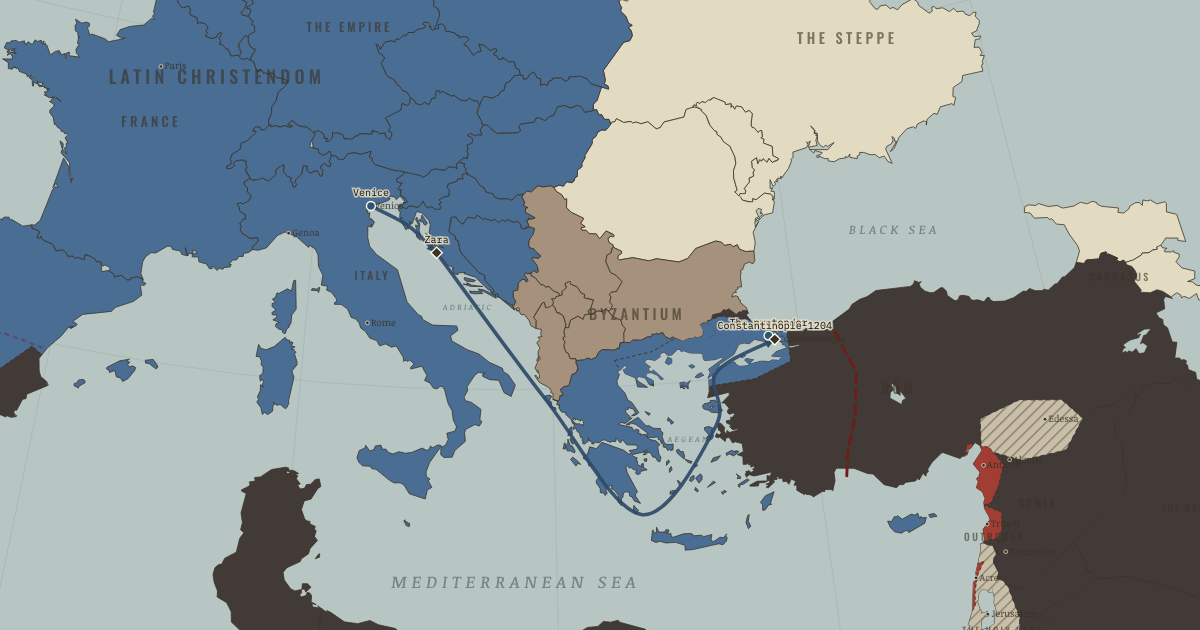
The crusade’s target was Egypt, the objective Richard had identified as the true key to Jerusalem, but the plan collapsed at its financial foundation. Bargaining at Venice in 1201, the leaders ordered shipping for far more men than ever assembled, and when they could not meet the agreed price the entire expedition fell into the hands of its creditor. Venice had invested heavily in building the fleet and pausing its normal commerce, so it held both a genuine claim and decisive leverage over a force that could not sail without it. To reduce the debt the crusaders agreed to capture Zara for Venice in 1202, a Catholic Christian city, and were excommunicated for it. That first compromise made each of the next ones easier.
The short answer
- The Venetian debt. The single decisive error was financial: contracting for a fleet the crusade could not afford, and thereby forfeiting its independence to the creditor. Everything downstream — Zara, the detour, the sack — grew from the leaders’ need to work off that debt. Money, not malice, bent the crusade.
- A Byzantine succession crisis. The empire’s own instability supplied the temptation. A plausible claimant with a dazzling offer turned a stranded army into a kingmaker; without the Angelos dynasty’s feud there is no pretext to sail to Constantinople at all.
- A century of Latin contempt for the Greeks. The distrust seeded on the First Crusade and hardened by Antioch and the Second Crusade had, by 1204, lowered the moral threshold for attacking “schismatic” Christians. It did not cause the sack, but it made it thinkable — and made it easy to rationalize afterward.
THE TURNING POINT
The pretender’s bargain, 1203. This is the hinge — the decision, not the atrocity. Accepting Alexios’s offer pointed the fleet at Constantinople in the first place; every step after it (the installation, the falling-out, the assault) followed with a grim logic. It is a case study in how a single compromised choice, made under financial pressure, can commit people to an outcome none of them set out to achieve.
What it changed
Byzantium fatally weakened. The Greeks retook Constantinople in 1261 (watch the map turn back), but the empire never recovered its strength or its lands. The sack of 1204 begins the long decline that ends with the Ottoman conquest of 1453 — the crusades’ most far-reaching, least-intended consequence.
A fragile Latin Empire. The Frankish empire over Greece and the straits was weak from birth and gone within two generations, leaving a shattered political landscape of Latin, Greek and Bulgarian successor states. The map’s brief blue over Byzantium marks a conquest that solved nothing.
The schism made permanent. More than any theological dispute, 1204 poisoned relations between the Orthodox and Catholic churches — a breach both still name eight centuries later. A crusade meant to reunite Christendom against Islam split it more deeply than ever.
The full answer, argued
The evidence favours contingency over conspiracy. The “Venetian plot” thesis — that the doge steered the crusade against a commercial rival from the start — founders on the fact that no one, Venetian or otherwise, could have planned the improbable sequence of the oversized fleet, the unpayable debt, the Zara detour, and the arrival of exactly the right pretender at exactly the right moment. Each step was a self-interested response to the last. But “no one intended it” is an explanation, not an absolution: the leaders repeatedly chose short-term advantage over their vows, and a century of contempt for the Greeks made the unthinkable easy. The lesson is how incrementally catastrophe can assemble itself from individually defensible decisions — and how “we never meant for this to happen” is both true and insufficient.
An interesting fact
The man steering the fleet, Doge Enrico Dandolo, was blind and in his nineties. Geoffrey of Villehardouin — a leader of the crusade, and openly partisan — describes the old man standing armed in the prow of his galley beneath the banner of St Mark, demanding to be put ashore first under the sea walls. Dandolo died in 1205 and was buried in Hagia Sophia itself, the great church his crusade had plundered; a marker in the gallery floor still bears his name. The Latin Empire lasted two generations — the grave of its engineer, rather longer.
This is the study layer of Fourth Crusade, chapter 8 of The Crusades, 1095–1291; the full index of the atlas is here.
Related questions
THE FREE PRINTABLE STUDY GUIDE
Join the Dispatch — a short welcome series, then a letter when a new atlas opens — and the printable study guide for The Crusades is yours now, free.
NO TRACKING · YOUR ADDRESS IS USED FOR THE DISPATCH AND NOTHING ELSE · UNSUBSCRIBE ANYTIME