WW2 · AUG 1945
Did the bomb, the Soviet invasion or blockade end WW2?
The seminar question: “What actually ended the Pacific war — the atomic bombs, the Soviet invasion, or the blockade? Why does the answer matter?”
By 1945 blockade and bombing had devastated Japan, and Iwo Jima and Okinawa showed how costly an invasion would be. The United States destroyed Hiroshima and Nagasaki with atomic bombs on 6 and 9 August, the Soviet Union invaded Manchuria, and Emperor Hirohito intervened to accept surrender, announced on 15 August.
WW2 is free — every chapter. No sign-up.
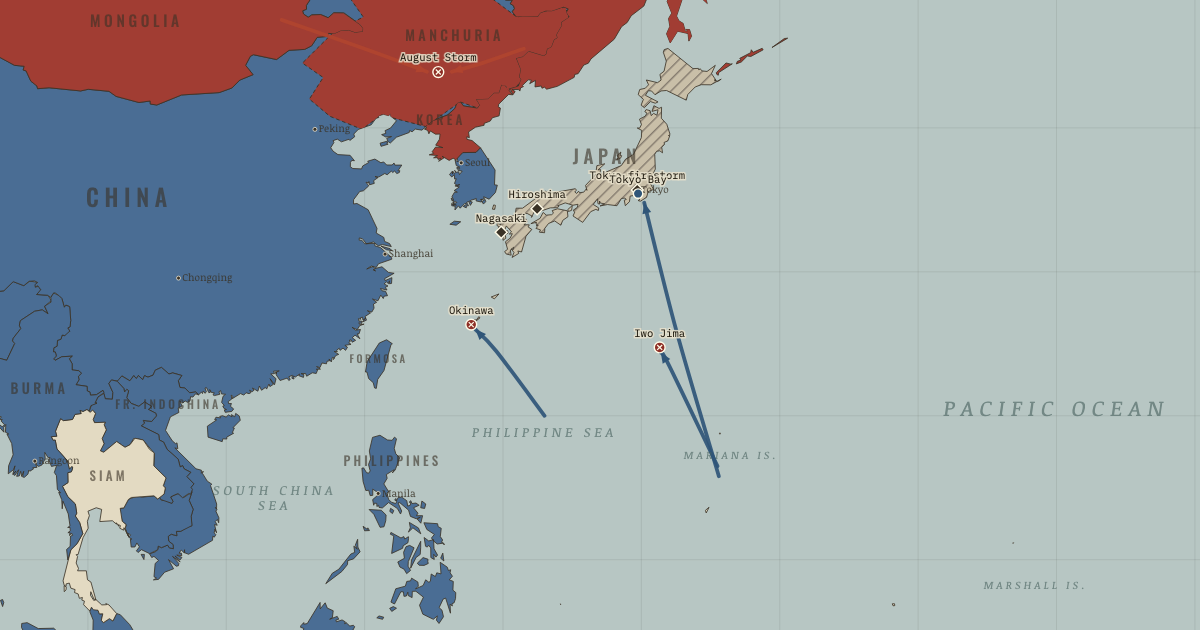
Long before the atomic bombs, blockade and submarine warfare had cut Japan off from food, fuel, and raw materials, and B-29 incendiary raids had begun to burn out its cities, with the Tokyo raid of 9 and 10 March killing around 100,000 people. The battles for Iwo Jima and Okinawa then showed, at fearful cost, what fighting near the home islands would mean. American casualty projections for a full invasion of Japan varied widely, and those uncertain estimates would later become central to the argument over whether the atomic bombs were necessary.
The short answer
- A government of two minds. By spring 1945 Japan’s civilians sought a mediated peace (hoping Moscow would broker it — not knowing Stalin had promised at Yalta to attack); the military faction demanded one apocalyptic homeland battle first to win better terms. The deadlock meant no one could choose surrender until something external broke it.
- Unconditional surrender and the Emperor. The Allies’ Potsdam Declaration demanded unconditional surrender but stayed silent on the throne. To Tokyo that silence read as a threat to the national essence itself — the single condition that, once implicitly conceded after the surrender, made acceptance possible. Words unsaid prolonged the war.
- The bomb’s momentum. The Manhattan Project — begun in fear of a German bomb — delivered its weapon after Germany died. With invasion casualty projections on his desk and a weapon of $2 billion already built, Truman later said the decision “was never a decision” — a lesson in how programs acquire inertia. The targets’ selection, and the absence of a demonstration option, remain morally debated.
THE TURNING POINT
Hiroshima, 08:15, 6 August. A single aircraft, a single bomb, a city gone — roughly 70,000 dead instantly, twice that by year’s end from burns and radiation. Whatever ended the war (see the question below), Hiroshima announced the new world: for the first time, the species could plausibly end itself. Every calculation of war and peace after 1945 happens in its shadow.
What it changed
Surrender — and a preserved throne. Japan is occupied (solely by the US), demilitarized, and given a democratic constitution that renounces war — while keeping the Emperor as symbol. The enemy of 1945 becomes the ally of 1951: consider what that says about war aims achieved versus vengeance forgone.
The Soviet week. August Storm overruns Manchuria in eleven days and takes Korea north of the 38th parallel — a hurried American line on a map that becomes, and remains, the world’s most fortified border. The Korean and Vietnamese wars are already loaded in the 1945 map.
The nuclear age. Four years later the USSR tests its own bomb; deterrence, arms races and the strange peace of mutually assured destruction structure the next half-century. The war’s final weapon becomes the postwar world’s central fact.
The full answer, argued
The best answer is a combination. Blockade and bombing created collapse; Soviet entry removed hope of mediation and threatened a second invasion; atomic bombs added unprecedented shock and a public reason for surrender. Weighting these causes differently changes judgments about nuclear necessity, deterrence, and why governments stop fighting.
An interesting fact
Around 160 trees within two kilometers of the Hiroshima hypocenter survived and lived — ginkgos, camphors, a weeping willow — putting out green shoots the following spring, in a city where rumor said nothing would grow for seventy-five years. They are registered today as hibakujumoku, “survivor trees,” each with its own nameplate, and their seeds and saplings are sent to cities around the world as living memorials. Many still lean toward the hypocenter — the blast written permanently into their growth.
This is the study layer of End of WW2 in the Pacific, chapter 14 of The War Room — WW2, 1936–1945; the full index of the atlas is here.
Related questions
THE FREE PRINTABLE STUDY GUIDE
Join the Dispatch — a short welcome series, then a letter when a new atlas opens — and the printable study guide for WW2 is yours now, free.
NO TRACKING · YOUR ADDRESS IS USED FOR THE DISPATCH AND NOTHING ELSE · UNSUBSCRIBE ANYTIME