WW2 · NOV 1943
Why did the Allies bypass Rabaul instead of capturing it?
The seminar question: “Why bypass a 100,000-man fortress like Rabaul instead of capturing it?”
The Allied Pacific counteroffensive began at Guadalcanal in August 1942. MacArthur advanced through New Guinea and Nimitz across the Central Pacific, leapfrogging strongholds such as Rabaul, while US submarines sank much of Japan’s merchant fleet. At Leyte Gulf in October 1944 much of Japan’s remaining fleet was destroyed.
WW2 is free — every chapter. No sign-up.
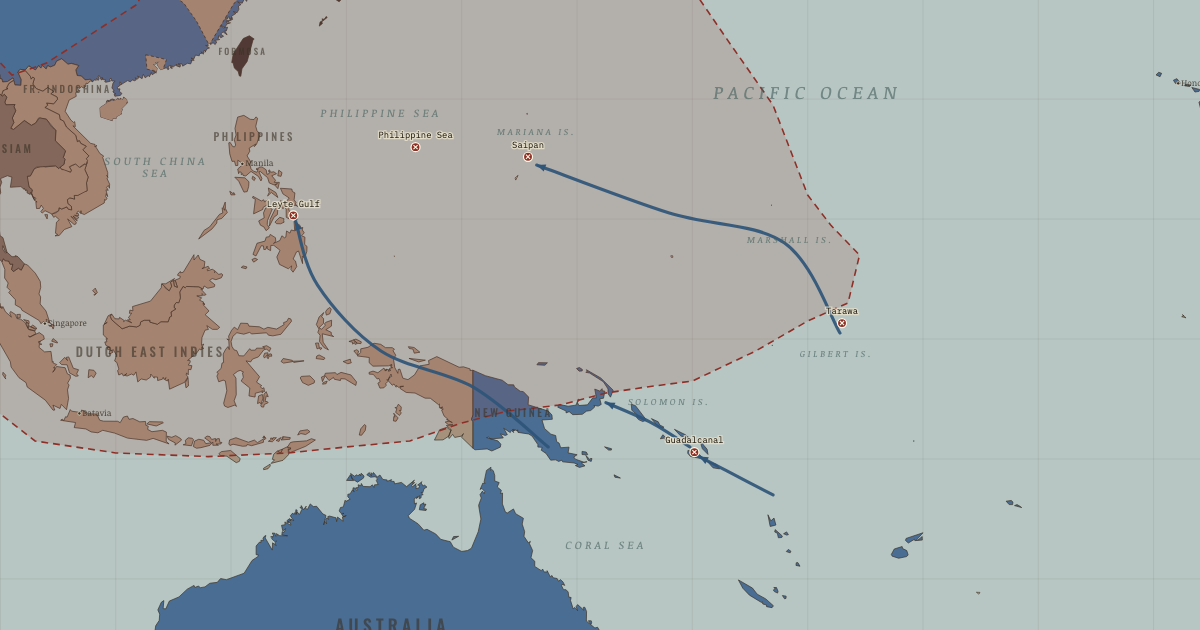
Guadalcanal was the first sustained Allied ground offensive of the Pacific war, and its lessons shaped everything that followed. Six months of grinding fighting on land, at sea, and in the air exhausted both sides, while tropical disease inflicted enormous losses of its own. Japan finally evacuated the island in February 1943. The result proved two things at once, that the Japanese perimeter could be pushed back, and that assaulting every defended island in turn would be far too costly to sustain across the whole ocean.
The short answer
- The tyranny of distance. The Pacific is a logistics war wearing a combat costume. Every arrow on this map is really a chain of tankers, floating dry docks and Seabee airfield battalions; the US built a mobile fleet base system that made the ocean itself passable. Japan never solved the same problem — its garrisons starved at the end of unguarded sea lanes.
- Two commanders, two roads. Inter-service rivalry produced parallel offensives (Army/MacArthur in the southwest, Navy/Nimitz in the center). Wasteful in theory, in practice it whipsawed Japanese defenses, which could never guess the next target — an accidental strategy of dilemma.
- Unrestricted submarine warfare. The quiet campaign: US subs sank over half of Japan’s merchant marine. An island empire that imported everything now imported almost nothing. By 1945 the blockade alone was defeating Japan — remember that when weighing how the war ended.
THE TURNING POINT
Guadalcanal, August 1942–February 1943. The first Allied ground offensive of the Pacific war becomes a meat-grinder both navies feed for six months. Japan finally evacuates — its first territorial loss. The lesson both sides learn: Japan’s soldiers will fight to the death, and America’s production will replace any loss. Both lessons will govern everything to 1945.
What it changed
The perimeter becomes a prison. Watch the red line on the map shrink from snapshot to snapshot. Each lost anchor (Gilberts → Marshalls → Marianas) exposes the next; bypassed garrisons — hundreds of thousands of men — spend the war growing vegetables and waiting for ships that never come.
Saipan brings the fire home. The Marianas (June 1944) put B-29 bombers in range of Tokyo, and their loss topples General Tojo’s government. The endgame chapter opens from these islands.
India holds, Burma turns. At Imphal and Kohima (spring 1944) Japan’s invasion of India is annihilated — its largest land defeat ever, largely at the hands of Indian divisions. The myth that Asia would welcome Japan as liberator dies in the Naga hills.
The full answer, argued
Isolation removed Rabaul’s ability to affect the campaign without paying the likely cost of assault. Air and sea control cut supply, movement, and communication. The objective was not possession of every island but destruction of Japan’s operational network. The comparison with Stalingrad is structural: attack the supporting system around a strongpoint.
An interesting fact
Among the Solomons’ thousand small actions: on 2 August 1943 a Japanese destroyer ran down the torpedo boat PT-109, and its 26-year-old skipper towed a burned crewman toward an islet by a life-jacket strap clenched in his teeth. Two Solomon Islander scouts working with the Allied coastwatchers, Biuku Gasa and Eroni Kumana, found the survivors and paddled a rescue message — carved into a coconut husk — through Japanese-held waters. The skipper was John F. Kennedy; the coconut sat on his desk in the Oval Office, and is displayed at his presidential library today.
This is the study layer of Pacific island-hopping campaign, chapter 11 of The War Room — WW2, 1936–1945; the full index of the atlas is here.
Related questions
THE FREE PRINTABLE STUDY GUIDE
Join the Dispatch — a short welcome series, then a letter when a new atlas opens — and the printable study guide for WW2 is yours now, free.
NO TRACKING · YOUR ADDRESS IS USED FOR THE DISPATCH AND NOTHING ELSE · UNSUBSCRIBE ANYTIME