Crusades · 1271
Why did Europe not send a fleet to save Acre in 1291?
After Jerusalem was lost for good in 1244, the Mamluks, who seized Egypt in 1250 and halted the Mongols at Ain Jalut in 1260, took the crusader strongholds one by one under Baibars and his successors. Antioch fell in 1268, Krak des Chevaliers in 1271, Tripoli in 1289 and Acre on 18 May 1291, ending mainland Outremer.
Chapter 11 is part of membership. WW2 is free — every chapter. Try chapters 1–2 of any 2 other atlases (3 with a free account). Opening a new atlas uses one of them. Membership opens all 21 — Join.
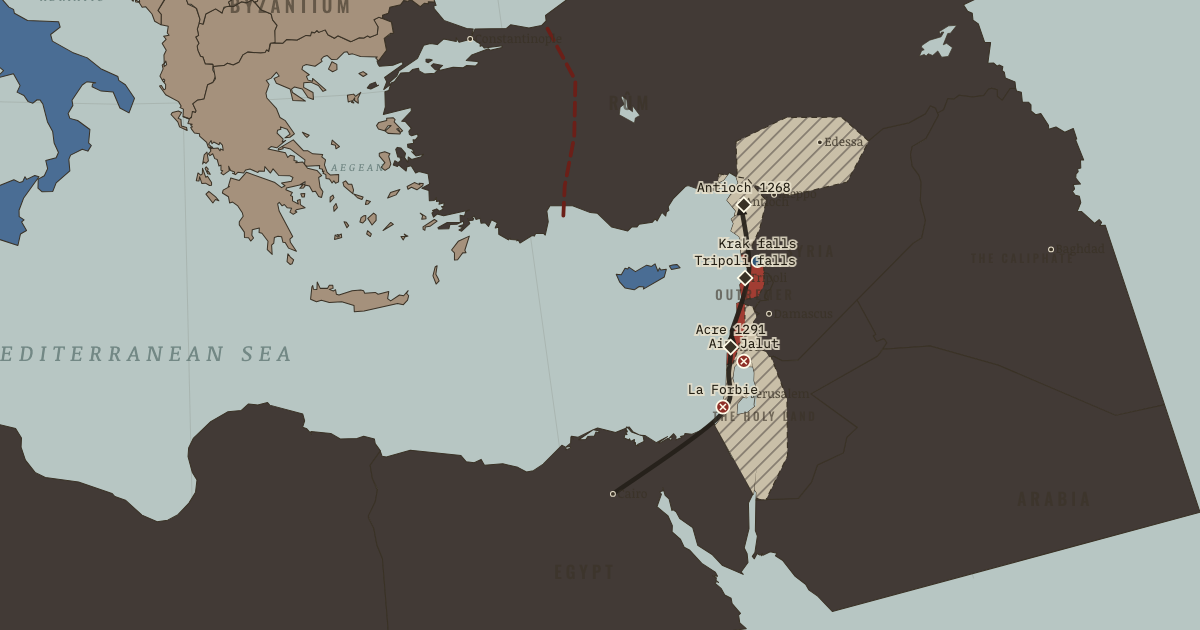
The instrument of Outremer’s end was, once again, a slave-soldier state, and its rise ran through two great shocks. At La Forbie near Gaza in 1244 an allied Frankish and Damascene army was destroyed by Egyptian forces and the Khwarezmian mercenaries who had just sacked Jerusalem, and this was the last time the crusader states fielded an army of any real size. Then the Mongols swept in, extinguishing Baghdad and the Abbasid caliphate, until at Ain Jalut in 1260 the Mamluks of Egypt halted them in Galilee. That victory did more than save the region, because it forged a disciplined, self-renewing military state, built on a slave-soldier system the Muslim world had used for centuries, that could now turn methodically against the crusader coast.
The short answer
- The Mamluk military state. The Mamluks were a professional army of slave-soldiers, trained from boyhood, promoted by merit, and renewed by purchase rather than birth — an institution with no dynastic weakness for the crusaders to exploit, wholly committed to jihad as state policy. Against a unified, professional, motivated Egypt, the thin crusader coast had no answer.
- The Mongol shock, survived. The Mongol invasions destroyed the Abbasid caliphate and terrified everyone — including the crusaders, some of whom hoped the Mongols might be allies against Islam. Ain Jalut ended that hope and, by making the Mamluks the saviours of Islam, gave them the prestige and the free hand to finish Outremer.
- European disengagement. No serious relief ever came. Crusade fatigue, the ruinous cost, the feud between popes and emperors, and the diversion of crusading energy to Iberia, the Baltic and Italian politics meant the states were left to die. The gap between Europe’s crusading rhetoric and its crusading will had never been wider.
THE TURNING POINT
Ain Jalut, 3 September 1260. The battle that made the machine. By halting the Mongols in Galilee, the Mamluks both removed the crusaders’ last conceivable ally and won the legitimacy to rule Egypt and Syria as Islam’s defenders. The disciplined slave-soldier state confirmed at Ain Jalut is exactly the instrument that then dismantles the crusader states with methodical, unstoppable efficiency. Outremer’s fate is sealed not on its own coast but in a Galilean valley, fighting the Mongols.
What it changed
Outremer erased. Watch the map: the last red drains to lost-hatch along the whole coast, and only Cyprus remains Latin. The mainland crusader states, born in 1099, are gone.
The orders relocate. The military orders outlive the Holy Land they were created to defend. The Hospitallers move to Rhodes and later Malta, while the Teutonic Knights build a Baltic state. The Templars move to Cyprus before the French king destroys their order in 1307–14.
Crusading survives its object. Astonishingly, the idea does not die with the states. Plans to recover the Holy Land, and crusade taxes and rhetoric, continue for centuries after 1291 — the clearest proof that the crusade was always as much an idea as a place.
The full answer, argued
Partly because it was tired and broke: two centuries of crusading had exhausted the enthusiasm, drained the treasuries, and bred a deep cynicism about crusade taxes that were often diverted to other wars. Partly because Europe was busy — kings were consolidating their own states, and the papacy was locked in conflict with the emperors. But mostly because the strategic case was hopeless and everyone half-knew it: the coast could not be held without controlling Egypt, and controlling Egypt had defeated Richard, the Fifth Crusade, and Saint Louis alike. Sending a relief fleet would have bought, at ruinous cost, a few more years for a position that could not be defended. The prayers were sincere; the calculation, unspoken, was that Acre could not be saved — and, more damningly, was no longer worth the price.
An interesting fact
The fall of Acre had an eyewitness with a pen: the anonymous chronicler known as the Templar of Tyre, secretary to the Grand Master William of Beaujeu, wrote from inside the walls. He records the master’s death in the breach — struck by a javelin as he raised his arm, and answering the men who cried that he was abandoning them: “I am not fleeing; I am dead,” showing them the wound. And 1291 was not quite the end: the Templars held Ruad, a waterless islet two miles off Tortosa, until 1302–03 — the true last toehold of Outremer, its garrison surrendered at last into captivity in Cairo.
This is the study layer of Fall of the crusader states, chapter 11 of The Crusades, 1095–1291; the full index of the atlas is here.
Related questions
THE FREE PRINTABLE STUDY GUIDE
Join the Dispatch — a short welcome series, then a letter when a new atlas opens — and the printable study guide for The Crusades is yours now, free.
NO TRACKING · YOUR ADDRESS IS USED FOR THE DISPATCH AND NOTHING ELSE · UNSUBSCRIBE ANYTIME