WW2 · NOV 1942
Why did Hitler forbid the Sixth Army to break out?
The seminar question: “Why did Hitler forbid the Sixth Army to break out of the pocket while escape was still possible?”
Axis-held territory peaked in November 1942, and within months the tide turned. Operation Uranus struck the Romanian armies on the flanks and trapped the German Sixth Army at Stalingrad, while British forces broke the Axis line at El Alamein and Anglo-American troops landed in Morocco and Algeria in Operation Torch.
WW2 is free — every chapter. No sign-up.
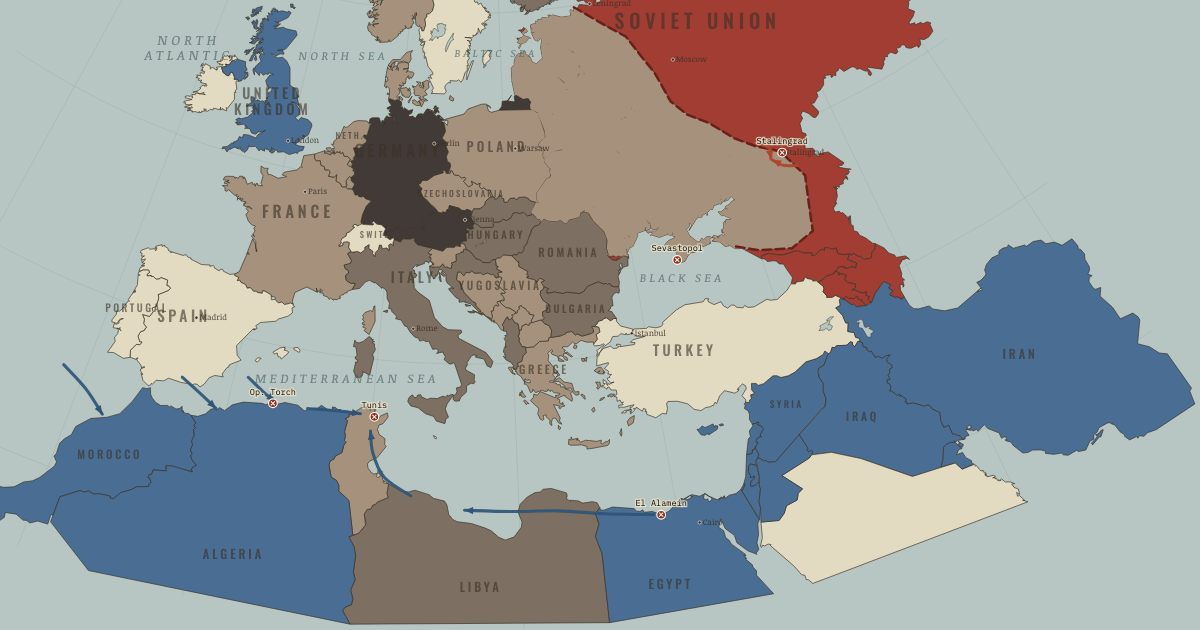
The map of November 1942 marks the Axis high-water mark, and the way it was reached already contained the seeds of collapse. German forces had driven toward the oil of the Caucasus while simultaneously fighting for Stalingrad on the Volga, so the offensive split its effort between an economic prize and a symbolic one and secured neither. Inside the city, close-quarters combat among the ruins cancelled out German advantages in movement and air power. Rather than attack the strongest German positions directly, Soviet commanders prepared a wider blow against the weak points on either side of them.
The short answer
- Oil, again. Case Blue’s real target was Caucasus oil — Germany’s war ran on a fraction of Allied fuel. Splitting the offensive between oil and Stalingrad’s symbolism meant achieving neither: a textbook case of objective creep.
- A name worth an army?. “Stalin’s city” became a prestige duel between dictators. Hitler publicly swore never to leave; Stalin ordered “Not a step back” (Order 227). Once both invested their names, military logic stopped governing either side — until Zhukov aimed at the flanks instead of the city.
- The Atlantic pipeline. El Alamein and Torch were possible because convoys — winning the U-boat war by inches — delivered American Shermans to Egypt and an invasion fleet to Africa. The unglamorous Battle of the Atlantic underwrites every Allied arrow on this map.
THE TURNING POINT
Operation Uranus, 19–23 November. The pincers meet at Kalach — aimed not at the Sixth Army but at the overstretched Romanian armies guarding its flanks. Attack the strong point’s weak frame, not the strong point. Göring promises supply by air and delivers a tenth of it; Hitler forbids breakout. On 2 February 1943 Field Marshal Paulus surrenders 91,000 frozen survivors.
What it changed
The myth of invincibility dies. A complete German field army has been erased. Germany declares three days of mourning; occupied Europe takes note; Turkey, Spain and Sweden re-hedge their neutrality. From here to Berlin the Wehrmacht is, with one exception (Kursk), permanently on the defensive.
Africa closes like a book. Squeezed between Montgomery (east) and Torch (west), the Axis rushes reinforcements into Tunisia only to lose them all — 250,000 prisoners in May 1943, a “second Stalingrad.” The Mediterranean reopens, and Italy is next.
“The end of the beginning”. Churchill’s famous line dates precisely here. Strategists on both sides now privately agree Germany cannot win; the questions become how long, how bloody, and who reaches Central Europe first.
The full answer, argued
He trusted Göring’s unrealistic airlift promise, generalized from earlier successful stand-fast orders, and treated retreat as a prestige defeat. Sunk costs and a command system that discouraged bad news reinforced one another. The airlift delivered only a fraction of the roughly 600 tons requested each day.
An interesting fact
In the pocket at Christmas 1942, Kurt Reuber — a German army doctor who was also a Protestant pastor — drew a mother and child in charcoal on the back of a captured Soviet map and hung it in his bunker, inscribed “Light, Life, Love.” The drawing flew out on one of the last aircraft; Reuber did not, and died in a Soviet prison camp in 1944. The Stalingrad Madonna hangs today in Berlin’s Kaiser Wilhelm Memorial Church, with copies given to the cathedrals of Coventry and Volgograd — three cities the war burned.
This is the study layer of Stalingrad and El Alamein, chapter 9 of The War Room — WW2, 1936–1945; the full index of the atlas is here.
Related questions
THE FREE PRINTABLE STUDY GUIDE
Join the Dispatch — a short welcome series, then a letter when a new atlas opens — and the printable study guide for WW2 is yours now, free.
NO TRACKING · YOUR ADDRESS IS USED FOR THE DISPATCH AND NOTHING ELSE · UNSUBSCRIBE ANYTIME