ON THIS DAY ·
Siege of Tunis
25 Aug 1270 — on his second crusade, Louis IX dies of dysentery in the camp outside Tunis, for reasons of strategy no one has ever fully explained. The last great royal crusade ends before it begins.
WW2 is free — every chapter. Try chapters 1–2 of any 2 other atlases (3 with a free account). Opening a new atlas uses one of them. Membership opens all 21 — Join.

The moment in context
The strategy of the thirteenth-century crusades was correct, and it kept delivering their armies into the one environment where their strengths counted for least. Richard’s insight had hardened into orthodoxy, so the great expeditions aimed at Egypt, whose taxes, grain and fleets underwrote Muslim control of Jerusalem. The Fifth Crusade took Damietta, the fortress guarding the eastern branch of the Nile, in 1219, then rejected the sultan al-Kamil’s astonishing offer to trade Egypt for Jerusalem, marched on Cairo and was trapped by the annual flood, forced to hand back everything it had won. The target made strategic sense, but the delta itself, divided among channels, mud and defended crossings that local forces understood far better, was the graveyard of the plan.
From Fifth to Eighth Crusades, chapter 10 of The Crusades, 1095–1291 (1229).
The place: Siege of Tunis — map and full story →
Teach this in 5 minutes
- Why it happened — The Egypt-first doctrine. Richard’s insight (Ch. 7) hardened into orthodoxy: the road to a secure Jerusalem ran through Cairo. It was correct in principle — and it repeatedly…
- The turn — Jerusalem regained by treaty, 18 February 1229. The most revealing moment of the later crusades: an excommunicate emperor recovers the Holy City without a battle, by negotiation — and is condemned…
- What it changed — A treaty-held Jerusalem, then gone. Frederick’s Jerusalem was undefended and short-lived; in 1244 Khwarezmian mercenaries sacked it and an allied army was destroyed at La Forbie (watch…
Then ask the room: Frederick II took Jerusalem by treaty and was condemned; Louis IX fought, failed, and was made a saint. What does that reveal about what the crusade was for? The argued answer is on the chapter page →
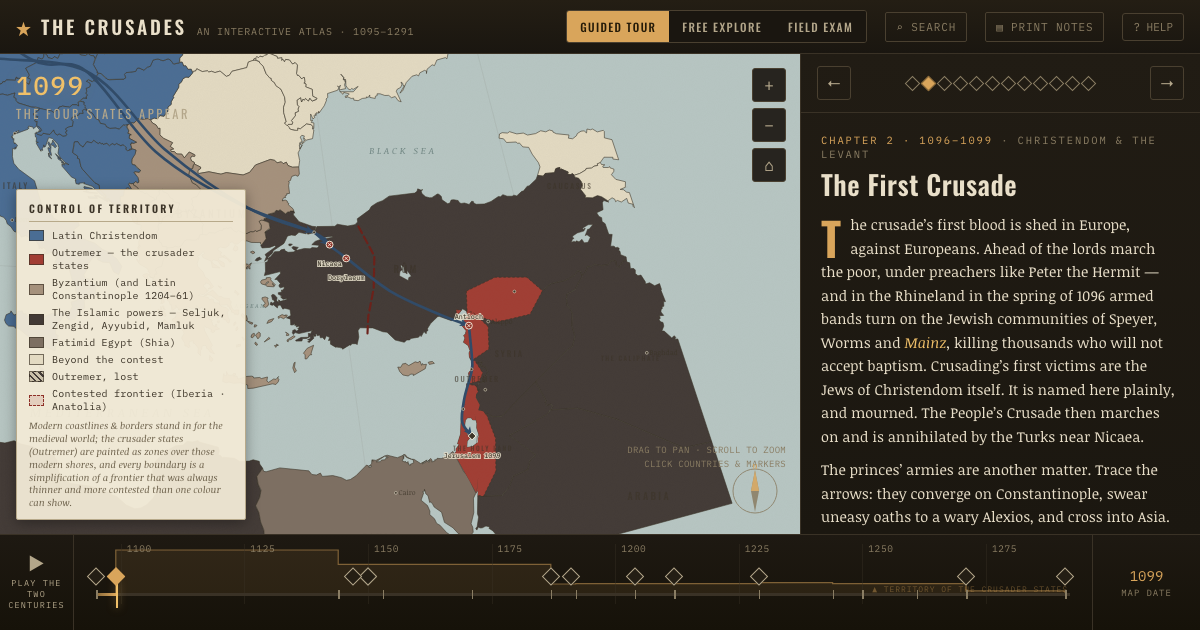
The atlas that shows it
THE FREE PRINTABLE STUDY GUIDE
Join the Dispatch — a short welcome series, then a letter when a new atlas opens — and the printable study guide for The Crusades is yours now, free.
NO TRACKING · YOUR ADDRESS IS USED FOR THE DISPATCH AND NOTHING ELSE · UNSUBSCRIBE ANYTIME