MAPS OF HISTORY · WWI · ALL CHAPTERS · CHAPTER 7
CHAPTER 7 · 1914–1918 · THE GLOBAL WAR · MAY 1917
The World’s War
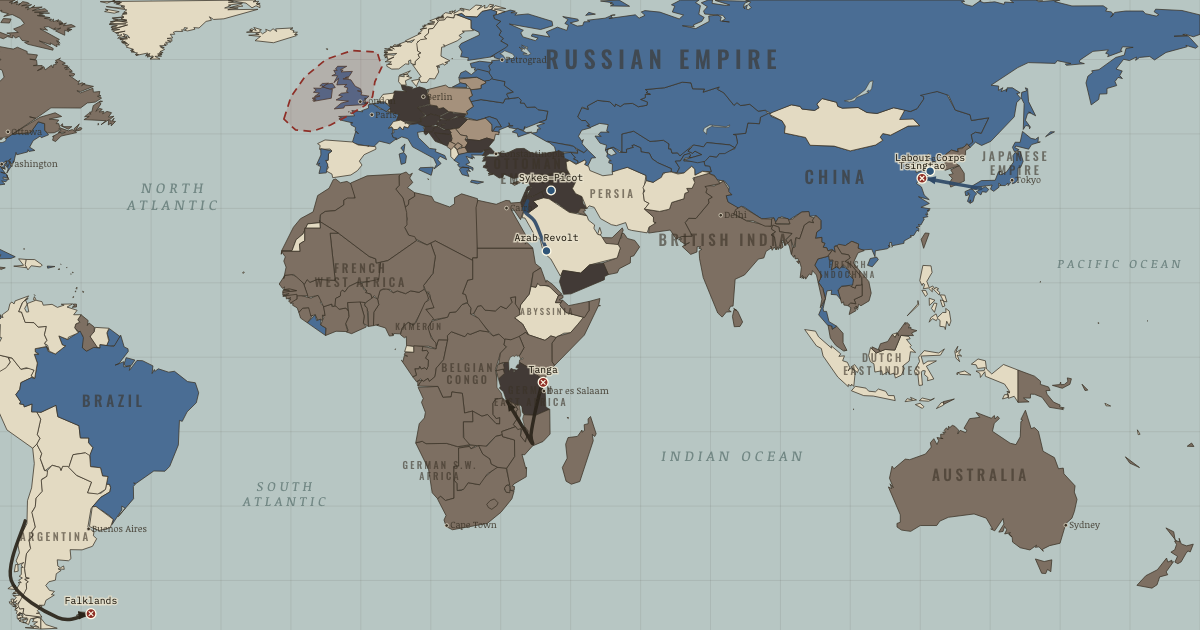
The map above is the world of APR 1917 — America comes in.
BRIEF EXPLANATION — THE ESSENTIAL ARGUMENT
The war became a world war because the European powers that fought it ruled empires spanning the globe, so that a quarrel begun in the Balkans drew in soldiers and resources from Africa, Asia, the Pacific and the Americas. Millions of colonized men served as soldiers, labourers and porters on distant fronts, most of them with no say in the matter, because a colony was legally at war the moment its ruling power was. Japan seized Germany’s possessions in China and the Pacific, imperial armies fought across Africa, and the Ottoman lands of the Middle East became a major theatre. The map of the war is therefore also a map of empire.
Wartime bargains struck in these regions reshaped the world that followed. To win an Arab uprising against the Ottomans, Britain encouraged the Arabs to expect independence, while at the same time it secretly agreed with France to divide the same Ottoman territory between them, and it later promised support for a Jewish national home in Palestine. Each promise served an immediate military need, but the promises could not all be honoured together. In demanding so much from its subject peoples, the war also weakened the claim that imperial rule was permanent, competent or deserved.
GUIDED EXPLANATION
The war became global because the European powers ruled empires, and those empires supplied the men and materials that kept the fighting going. Millions of soldiers, labourers and porters from Africa, Asia, the Pacific and the Americas sustained campaigns they had never chosen to join. India furnished the largest volunteer army yet raised, while the deaths of African porters were enormous but poorly recorded. Japan seized German possessions in China and the Pacific at little cost to itself, and imperial forces fought long campaigns across Africa.
In the Ottoman lands, Britain encouraged the Arab Revolt while secretly negotiating the Sykes–Picot division of the same territory with France, and it later promised support for a Jewish national home in Palestine. These wartime commitments served different immediate goals and could not all be reconciled with one another. The map therefore shows far more than distant battles. It shows imperial resources making a European war possible, and wartime bargains sowing future conflicts over who would rule the Middle East.
Control of shipping lanes, undersea cables and colonial bases made the conflict global from the first days of August 1914. Japan honoured its alliance with Britain because doing so let it seize German Tsingtao and the Pacific islands cheaply. In East Africa, the German commander Lettow-Vorbeck kept a small force in the field for years, but his campaign depended on coerced porters and devastated local food supplies, so its famous economy of force was in truth paid for mainly by Africans. Imperial service also changed political expectations, because Indian, African, Chinese and Dominion participants saw the European states lean heavily on them while still refusing them equal status. After 1918 the language of self-determination used by Wilson and the anti-imperial claims made by Lenin gave those experiences a political vocabulary. The war did not end empire at once, yet it fatally weakened the claim that imperial rule was permanent, competent or reciprocal.
DEEP EXPLANATION — EVIDENCE & INTERPRETATION
Imperial manpower and its unequal cost
Calling this a world war means more than noting that battles were fought outside Europe, because the empires moved people, food, animals, credit and raw materials across whole continents to sustain the fighting. Indian troops served in France, Africa and the Middle East, African soldiers and porters carried the supplies of campaigns that could not have moved without them, and Chinese labourers dug and repaired the ground behind the Western Front. Service could bring pay, status or the hope of political rights, yet recruitment ranged from genuine volunteering to harsh compulsion. The records of the dead are themselves unequal, since the armies of the home countries counted their casualties far more carefully than colonial administrations counted the porters who died of disease and hunger, and that imbalance in the evidence is itself evidence of imperial priorities. The war globalized European strategy while distributing its burdens along lines of race and legal status, and those burdens later strengthened demands for citizenship, reform and independence.
A set of incompatible promises
The Hussein–McMahon correspondence, the Sykes–Picot agreement and the Balfour Declaration were each addressed to a different wartime audience, which is why they could not be reconciled. Britain wanted an Arab revolt against Ottoman rule, close coordination with its French ally, and support for a Jewish national home in Palestine, and it pursued all three at once. The exact wording and territorial exclusions of the correspondence are still disputed, but the underlying constraint is clear, because policymakers made overlapping commitments before they knew how victory or local politics would unfold. This was less careless map-drawing than coalition management under deep uncertainty, in which future sovereignty was spent as present currency to buy immediate help. The bargain solved short-term diplomatic problems by creating long-term conflicts over legitimacy. After 1918 the mandate system preserved much of the old imperial control while presenting it as trusteeship, and the gap between promised self-government and imposed administration fed revolts and rival national movements across the region.
New here? Chapters 1–2 of every atlas are free to sample, and the WW2 atlas is free in full. One membership opens all thirteen — the Cartographer’s Circle.
THE SITES
ON THIS DAY
WHY IT HAPPENED
Empires wage war with empires. Why was a European war global on day one? Because its belligerents were not countries but systems: shipping lanes, coaling stations, colonial armies, cable networks. Britain’s first offensive acts of the war included cutting Germany’s undersea cables and hunting its commerce raiders in the Pacific. The colonies were not asked; legally most were simply at war the moment London or Paris was. On this map, sovereignty is the exception.
Japan’s calculated loyalty. Tokyo honored the 1902 alliance with unusual speed because the price was self-set: Germany’s Chinese port, the Marianas, Carolines and Marshalls — a Pacific empire for six weeks’ siege work. Then, with Europe distracted, the Twenty-One Demands (1915) tried to make China a protectorate. The Great War is chapter one of the Pacific war of 1941: the islands Japan took in 1914 are the ones America stormed in 1944.
The double promise. The McMahon–Hussein letters (1915–16) promised Arab independence in language whose exclusions are still argued; Sykes–Picot (May 1916) drew French and British zones straight through it; the Balfour Declaration (Nov 1917) promised a Jewish national home in Palestine as well. Each pledge made wartime sense — raise a revolt, bind an ally, court opinion. Together they were unkeepable, and everyone signing knew enough to know it. The modern Middle East’s founding documents are a war expedient in triplicate.
Lettow’s method — and its price. Lettow-Vorbeck understood he could not win, only cost: every month his few thousand kept a hundred thousand imperial troops, ships and porters occupied was a month they were not in France. Brilliant economy of force — paid almost entirely by Africans: requisitioned crops, burned villages, and porter deaths in six figures. The campaign colonial romance remembers as a gentleman’s safari was, for East Africa, a famine with front lines.
THE TURN
The double promise, 1916. Between January and May 1916, Britain committed itself to Arab independence and to partition with France over the same territory. It is this atlas’s cleanest example of a turning point that moves no army: when the Ottoman Empire falls (Ch. 10), these incompatible papers — plus Balfour’s — become the operating system of the modern Middle East. Mandates, revolts, borders drawn in straight lines: the war after the war starts here.
WHAT IT CHANGED
The empires lose their aura. A generation of colonial soldiers saw Europeans die badly, take orders, and depend on colonial labor and loyalty. Wilson’s “self-determination” and Lenin’s anti-imperialism gave the experience a vocabulary. 1919 answers: Egypt rises, India’s Amritsar massacre kills the liberal empire’s credibility, the May Fourth movement remakes Chinese politics when Versailles hands Shandong to Japan. Decolonization’s timetable was set in this war, even if the departures took another forty years.
Mandates: empire, renamed. The victors did not free the German and Ottoman territories; they distributed them as League of Nations “mandates” — trusteeships with report cards. Watch the world map at the end: the grey-tan actually grows. The gap between the war’s liberation rhetoric and its property settlement radicalized a century of nationalists, from Cairo to Hanoi (a young kitchen worker named Ho Chi Minh petitioned at Versailles, and was not received).
Soldiers of empire, remembered late. The Indian Army’s 74,000 dead, the tirailleurs at Verdun, the Chinese laborers clearing battlefields into 1920, the African porters without graves — imperial memory kept them footnotes for most of a century. Their service and its non-reward is not a sidebar to this war; for most of the world’s population, it was the war.
FIELD QUESTION — “A European civil war with global casualties” — is that a fair description of 1914–18?
It captures something real: the war’s causes were European, its decisive fronts were European, and the rest of the world was largely conscripted into it through imperial ownership. But push back with this map. For Japan and its neighbors this was a Pacific power transition, not Europe’s quarrel. For the Ottoman lands it was an imperial collapse with local wars — Arab revolt, Armenian genocide, Anatolia’s partition — whose stakes were entirely their own. For India, Africa and Indochina it was the event that turned abstract subjecthood into blood tax, and so began the end of the empires themselves. Perhaps the fairest formula: a European war that could only happen at world scale because Europe owned the world — and that, in fighting it, broke the ownership. Which is why the “world” in its name grew truer every year after 1918.
AN INTERESTING FACT
Lettow-Vorbeck’s askari were finally paid — in 1964. The West German Bundestag voted funds to honor the Kaiser’s unpaid wages, and a pay table was set up at Mwanza on Lake Victoria; most of the elderly veterans had no papers, so each claimant without one was handed a broom and put through the German manual of arms — none, the account runs, failed the test. It was one small settled debt in an imperial ledger otherwise left open: the African porters, dead in the hundreds of thousands, had no line in it at all.
THE DISPATCH
One short letter when a new atlas opens — and the printable study guide for WWI is yours now, free.
NO TRACKING · YOUR ADDRESS IS USED FOR THE DISPATCH AND NOTHING ELSE · UNSUBSCRIBE ANYTIME