Mongol Empire · 1260
Did Ain Jalut save Islam, or is it overrated?
The seminar question: “Ain Jalut is often called the battle that saved Islam — and often called overrated, since Hülegü had already left with the main army. Weigh both claims.”
Möngke sent his brother Hülegü west against the Nizari Ismaili fortresses, the Abbasid caliph and Syria: Alamut surrendered in 1256 and Baghdad fell in February 1258, ending the Abbasid caliphate there. After Möngke’s death drew Hülegü east, the Mamluks of Egypt defeated Kitbuqa’s smaller force at Ain Jalut on 3 September 1260.
Chapter 8 is part of membership. WW2 is free — every chapter. Try chapters 1–2 of any 2 other atlases (3 with a free account). Opening a new atlas uses one of them. Membership opens all 21 — Join.
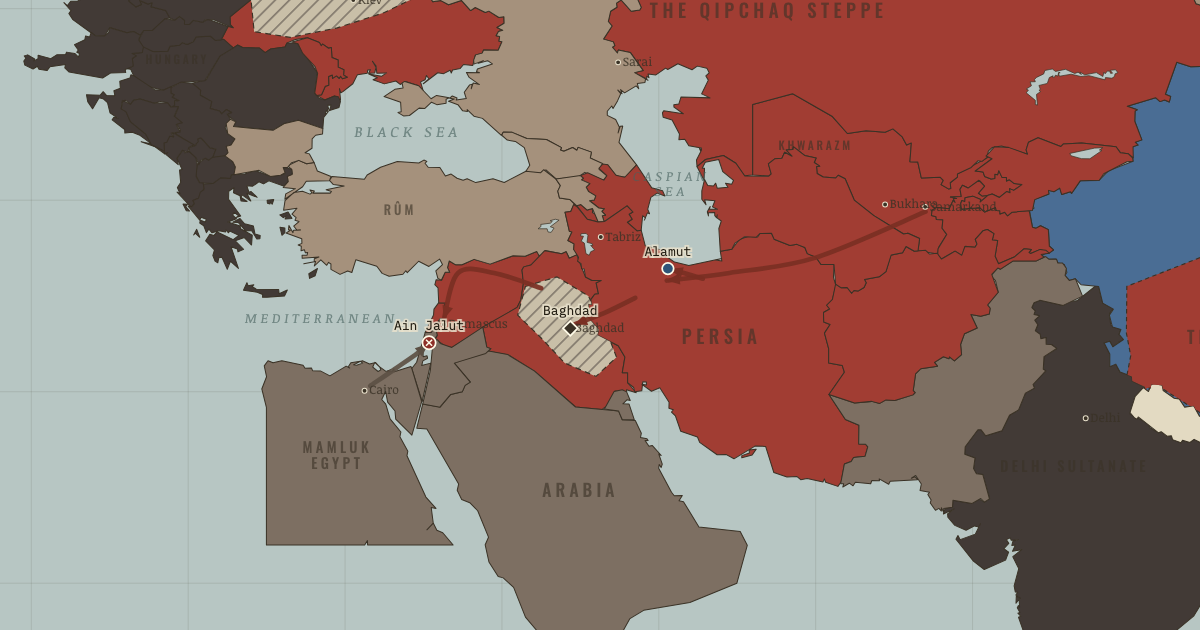
The western campaign opened against the Nizari Ismaili strongholds, called the Assassins in hostile sources, whose castles Mongol engineers reduced until Alamut surrendered in 1256. Hülegü then demanded Baghdad’s submission, and Caliph al-Musta‘sim refused while failing to prepare any effective defence, so the city fell in February 1258. The massacre and destruction ended the Abbasid caliphate in Baghdad and gravely damaged the city and its canal country. The story that the Tigris ran black with the ink of ruined books is literary memory rather than measurable evidence, and the human and institutional catastrophe needs no such legend to be understood.
The short answer
- Why Baghdad, why now. Not plunder-lust but agenda: Möngke’s kurultai of 1251 resolved to finish the two “universal” claims that rivaled the khan’s — the caliphate and the Song (his other brother’s assignment; Ch. 10). The caliph’s spiritual authority made him precisely the kind of power the Tengri mandate could not tolerate as an equal, only as a subject. Read the conquest as constitutional theory enforced by trebuchet.
- A hollow caliphate. Baghdad in 1258 was a memory wearing a crown: the caliphs had been warlords’ puppets for centuries, the treasury feuded with the army, Sunni–Shia riots split the city, and al-Musta‘sim — “a falconer,” his own officials despaired — neither paid for defense nor submitted in time. Hülegü’s Shia astrologer-advisor Nasir al-Din Tusi (saved from Alamut, note the empire recycling talent again) reportedly assured him no cosmic punishment would follow the caliph’s death. None did; the lesson every remaining power absorbed was that sanctity without soldiers is a target.
- The Mamluk anomaly. Egypt’s slave-soldier system accidentally built the one army with the Mongol toolkit and none of the Mongol dependencies: steppe-born horse-archers, centrally barracked, professionally drilled, fighting on interior lines with Egypt’s granary behind them — and with nowhere to retreat to, since Cairo was both their capital and their only home. Where feudal hosts and city militias had shattered, the Mongols finally met a mirror.
- A fatally divided theater. Hülegü’s departure was decisive but so was arithmetic: Syria’s scorched summer pastures could barely water the horses Kitbuqa kept (the ecology thesis again — compare Hungary, Ch. 6), the Crusaders of Acre chose neutrality tilted toward Egypt (safe passage and markets for the Mamluk army — Christendom quietly provisioning Islam’s defense against the power some popes had courted as an ally), and Berke’s Golden Horde, newly Muslim and enraged by the caliph’s death, was already threatening Hülegü’s rear. Ain Jalut was won in Egypt, but it was set up by the empire’s own geometry.
THE TURNING POINT
Ain Jalut, 3 September 1260. Small as battles go — tens of thousands a side — and epochal as thresholds go: the first Mongol defeat never afterward reversed. It saves Islamic civilization’s western heart weeks after its eastern one burned, makes the Mamluks Islam’s champions and Cairo the refuge-caliphate’s home, and fixes the empire’s southwest border at the Euphrates for sixty years of Ilkhan–Mamluk war. The myth of the unstoppable — worth armies by itself, as myths are — dies at a spring in Galilee.
What it changed
Sunni Islam reorganizes around Cairo. The Mamluks install a refugee Abbasid as shadow-caliph in Cairo and rule as Islam’s sword for 250 years, until the Ottomans. Baghdad, half-ruined and demoted to a provincial town of the Ilkhanate, does not anchor the region again for centuries. When a civilization’s center of gravity moves on this map, it moves because of one week in 1258.
The Ilkhanate is born facing enemies on three sides. Hülegü keeps Persia, Iraq and Anatolia’s overlordship — the Ilkhanate — but Ain Jalut plus Berke’s hostility (next chapter’s war) lock its borders almost immediately. A generation later its khans convert to Islam; the dynasty that killed the caliph ends as patron of Persian miniatures, mosque-builders and the historian Rashid al-Din’s world chronicle. History’s ironies are rarely this legible.
The first check becomes the pattern. Ain Jalut announces the era of limits: from 1260 the tide stops more often than it runs — Syria annually contested, Japan (Ch. 11) and Vietnam ahead. Conquest had been the empire’s solvent for every internal strain; watch what happens, starting next chapter, when the solvent runs out.
The full answer, argued
The cautious case says Kitbuqa led only the force left after Hülegü withdrew, while Egypt lay beyond difficult Syrian and Sinai supply conditions. The stronger claim concerns political effect: the Mamluks refused an ultimatum, won and repeated their resistance later. That protected Syria, raised Cairo’s status and changed what other rulers believed possible. Ain Jalut was limited as a measure of total Mongol strength but major as a signal and a durable border-making event.
An interesting fact
Within a year of Baghdad’s fall, Hülegü was financing the opposite of a destruction. At Maragheh in Azerbaijan, Nasir al-Din Tusi — the scholar the Mongols had plucked from Alamut — broke ground in 1259 on the best-equipped observatory the world had yet seen: salaried astronomers, at least one of them from China; a great library; instruments that produced the Zij-i Ilkhani star tables used across Eurasia for centuries. Tusi’s geometrical device for modeling planetary motion, the “Tusi couple,” later turns up — by a route historians still argue about — in the work of Copernicus. Hold both facts at once, as this chapter keeps asking: the dynasty that sacked the House of Wisdom underwrote one of medieval science’s greatest institutions.
This is the study layer of Fall of Baghdad and Ain Jalut, chapter 8 of The Mongol Empire, 1206–1294; the full index of the atlas is here.
Related questions
THE FREE PRINTABLE STUDY GUIDE
Join the Dispatch — a short welcome series, then a letter when a new atlas opens — and the printable study guide for The Mongol Empire is yours now, free.
NO TRACKING · YOUR ADDRESS IS USED FOR THE DISPATCH AND NOTHING ELSE · UNSUBSCRIBE ANYTIME